Question
Waves recorded in ECGHeart activity
(1) P wave(a) Ventricular repolarization
(2) QRS complex(b) Atrial depolarization
(3) T wave(c) Isoelectric segment
(4) ST segment(d) Ventricular depolarization

Answer

Waves recorded in ECGHeart activity
(1) P wave(b) Atrial depolarization
(2) QRS complex(d) Ventricular depolarization
(3) T wave(a) Ventricular repolarization
(4) ST segment(c) Isoelectric segment

Need a full question paper?

Generate a complete, print-ready paper with questions like this in minutes — across 16+ boards, with answer keys.

Start Generating Free

Similar questions

Column A (Part of Anatropous ovule)Column B (Terminology)
(1) Opening at the apex(a) Hilum
(2) Stalk of the ovule(b) Integument
(3) Protective covering(c) Micropyle
(4) Place of attachment of body and stalk(d) Funiculus
Active absorption and Passive absorption.
Distinguish between: Blastula and Gastrula ### Give two differences between blastula and gastrula.
Read the following and answer any four questions from (i) to (v) given below:
Embryo develops at the micropylar end of the embryo sac, where the zygote is situated. Most zygotes divided only after certain amount of endosperm is formed. The early stages of embryo development are similar in both monocotyledons and dicotyledons. The zygote gives rise to the proembryo and subsequently to the globular heart-shaped and mature embryo. A typical dicotyledonous embryo consists of an embryonal axis and two cotyledons. Embryo of monocotyledons possess only one cotyledon.
  1. True embryo develops as a result of fusion of:
  1. Two polar nuclei of embryo sac.
  2. An egg cell and a male gamete.
  3. Synergid and male gamete.
  4. A male gamete and antipodals.
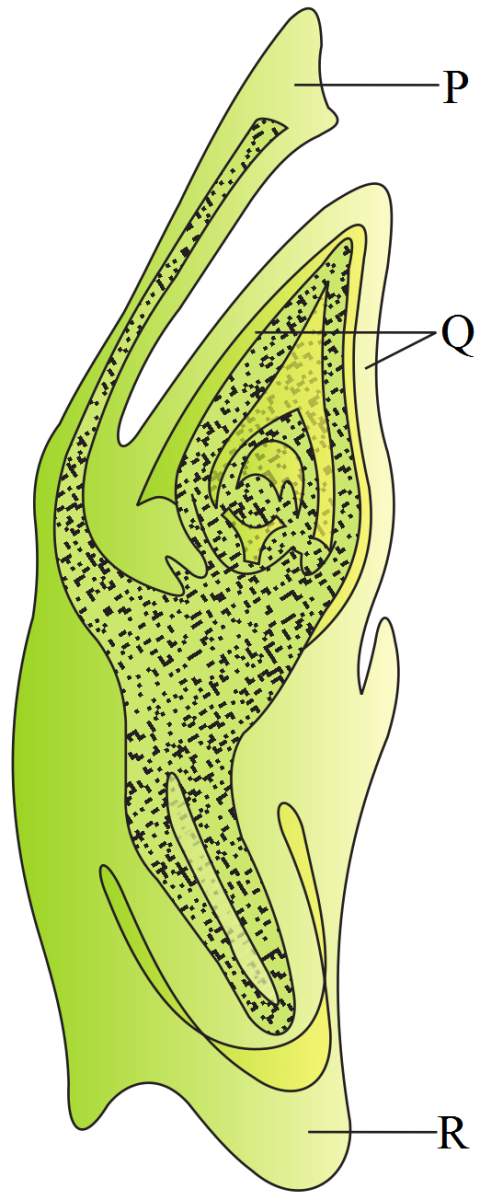
  1. Refer to the given diagram of the embryo of an angiospermous plant with parts labelled P, Q and R. Select the correct statement(s) regarding this.
  1. Part 'P' supplies nutrition to the developing embryo.
  2. Part 'Q' is the protective sheath of radicle and root cap.
  3. Part 'R' is the protective sheath of shoot apex and leaf primordia.
  4. The embryo shown in the diagram is present in members of Family Poaceae.
  1. (IV) only.
  2. (II) and (III) only.
  3. (I) and (IV) only.
  4. (I), (II), (III) and (IV).
  1. Which of the given statements are true?
  1. During the development of a dicot embryo, heart-shaped embryo is followed by globular embryo.
  2. The part of embryonal axis above the level of cotyledons is epicotyl, while the part below the level of cotyledons is hypocotyl.
  3. Monocot seeds possess a single cotyledon, represented by scutellum.
  1. (I) and (II).
  2. (II) and (III).
  3. (I) and (III).
  4. (I), (II) and (III).
  1. Consider the following parts of an embryonal axis of a dicot seed.
  1. Hypocotyl.
  2. Epicotyl.
  3. Radicle.
  4. Plumule.
In which of the following the above parts are correctly arranged from top to base?
  1. (III) → (I) → (II) → (IV).
  2. (II) → (I) → (III) → (IV).
  3. (IV) → (II) → (I) → (III).
  4. (III) → (IV) → (II) → (I).
  1. In grass family, the cotyledon, is called:
  1. Epiblast.
  2. Plumule.
  3. Scutellum.
  4. Perisperm.
Column AColumn B
(1) Tansley(a) 10% law
(2) C. Elton(b) Ecosystem services
(3) R. Lindemann(c) Ecological pyramids
(4) Millennium Ecosystem Assessment report(d) Ecosystem
Column AColumn B
(1) Sir Edward Sharpey Schafer(a) Chemically synthesized DNA sequence of insulin
(2) Hakura(b) Discovery of insulin
(3) Gilbert and Villokomaroff(c) PCR
(4) K. Mullis (d) Insulin production using r-DNA technology
Why are vectors needed for replication of DNA during rDNA technology?
Distinguish between : Genetic diversity and Species diversity.
Distinguish between : Communicable and non-communicable diseases.
Read the following and answer any four questions from (i) to (v) given below:
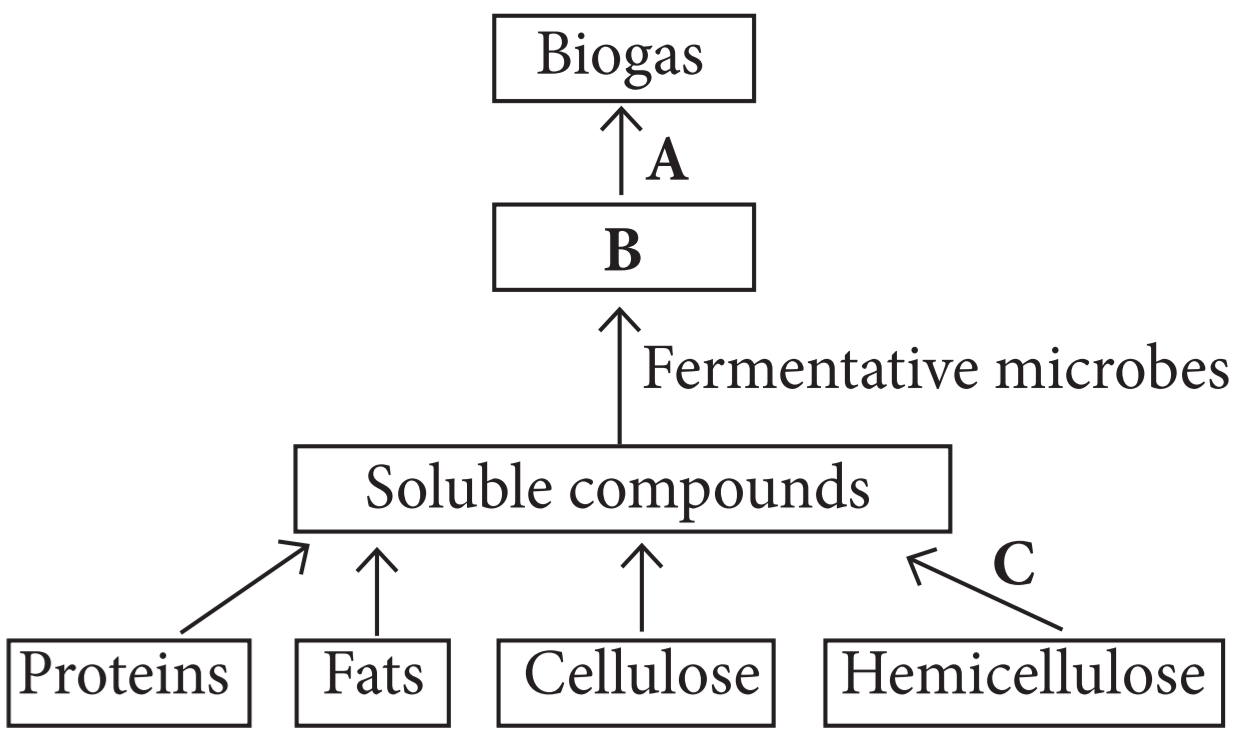
Villagers in a place near Chambur started planning to make power supply for agricultural purposes from cow dung. 'Tiley have started a biogas plant for the purpose. Study the flow chart for biogas production given below and answer the following questions.
  1. Biagas is composed of majorly:
  1. Methane, $CO_2$ and $O_2$​​​​​​​
  2. $CO_2, H_2S$ and H
  3. Methane, $CO_2​​​​​​​$
  4. $H_2S, H$ and $O_2​​​​​​​$
  1. In the given flow chart, 'A' denotes:
  1. Aerobic bacteria.
  2. Methanogenic bacteria.
  3. Cellulose degrading bacteria.
  4. Yeast and protozoa.
  1. What is represented by 'B' in the flow chart?
  1. Carbohydrates.
  2. Protein polymers.
  3. Organic acids.
  4. Fat globules.
  1. 'C' in the given flow chart causes:
  1. Aerobic breakdown of complex organic compounds.
  2. Anaerobic digestion of complex organic compounds.
  3. Fermentation of organic compounds.
  4. Fermentation of monomers.
  1. If 'A' is not added in the procedure.
  1. Methane will not be formed.
  2. $CO_2​​​​​​​$​​​​​​​ will not be formed.
  3. Organic compounds will not be converted to $H_2S$
  4. $O_2​​​​​​​$ will not be formed.