Question
Do magnetic forces obey Newton's third law. Verify for two current elements $\text{dI}_1=\text{dI}\hat{\text{i}}$ located at the origin and $\text{dI}_2=\text{dI}\hat{\text{j}}$ located at (0, R, 0). Both carry current I.

Answer

Key concept: In this problem first we have to find the direction of magnetic field due to one wire at the point on other wire, then the magnetic force on that current carrying wire.
According to Biot-Savart's law, magnetic field B is parallel to idl × r and idl is the current carrying element having it's direction along the direction of flow of current.
Here, for the direction of magnetic field, at dl2, located at (0, R, 0) due to wire dlx is given by B || idl × r or i × j (because point (0, R, 0) lies ony-axis), but i × j = k.
So, the direction of magnetic field at dl2 is along z-direction.
The direction of magnetic force exerted at dl2 due to the magnetic field of first wire is along the x-axis.
F - i(l × B), i.e., F || (i × k) or along -j direction.
Therefore, force due to dl [on dl2 is non-zero.]
Now, for the direction of magnetic field, at dx, located at (0, 0, 0) due to wire d2 is given by B || idl × r or j × -j (because origin lies on y-direction w.r.t. point (0, R, 0), but j × -j = 0.
So, the magnetic field at dx does not exist.
Force due to dl2 on dl1, is zero.
So, magnetic forces do not obey Newton's third law. But they obey Newton's third law if current carrying element are placed parallel to each other.
Need a full question paper?

Generate a complete, print-ready paper with questions like this in minutes — across 16+ boards, with answer keys.

Start Generating Free

Similar questions

  1. With the help of a neat and labelled diagram, explain the principle and working of a moving coil galvanometer.
  2. What is the function of uniform radial field and how is it produced?
  3. Define current sensitivity of a galvanometer. How is current sensitivity increased?
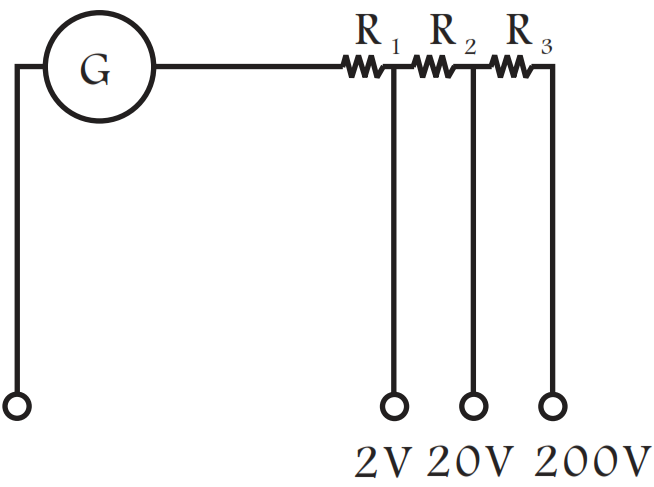
A multirange voltmeter can be constructed by using a galvanometer circuit as shown in Fig. We want to construct a voltmeter that can measure 2V, 20V and 200V using a galvanometer of resistance 10Ω and that produces maximum deflection for current of 1mA. Find R1, R2 and R3 that have to be used.

What is interference of light? Write two essential conditions for sustained interference pattern to be produced on the screen.
Draw a graph showing the variation of intensity versus the position on the screen in Young’s experiment when (a) both the slits are opened and (b) one of the slits is closed.
What is the effect on the interference pattern in Young’s double slit experiment when:
  1. Screen is moved closer to the plane of slits?
  2. Separation between two slits is increased?
Explain your answer in each case.
A particle executes simple harmonic motion with an amplitude of 10cm and time period 6s. At t = 0 it is at position x = 5cm going towards positive x-direction. Write the equation for the displacement x at time t. Find the magnitude of the acceleration of the particle at t = 4s.
The current in a conductor and the potential difference across its ends are measured by an ammeter and a voltmeter. The meters draw negligible currents. The ammeter is accurate but the voltmeter has a zero error (that is, it does not read zero when no potential difference is applied). Calculate the zero error if the readings for two different conditions are 1.75A, 14.4V and 2.75A, 22.4V.
In many experimental set-ups the source and screen are fixed at a distance say D and the lens is movable. Show that there are two positions for the lens for which an image is formed on the screen. Find the distance between these points and the ratio of the image sizes for these two points.
Two identical pith balls, each carrying a charge q, are suspended from a common point by two strings of equal length l. Find the mass of each ball if the angle between the strings is $2\theta$ in equilibrium.
When a dielectric is placed in an electric field, it gets polarized. The electric field in a polarized material is less than the applied field. When a paramagnetic substance is kept in a magnetic field, the field in the substance is more than the applied field. Explain the reason of this opposite behaviour.
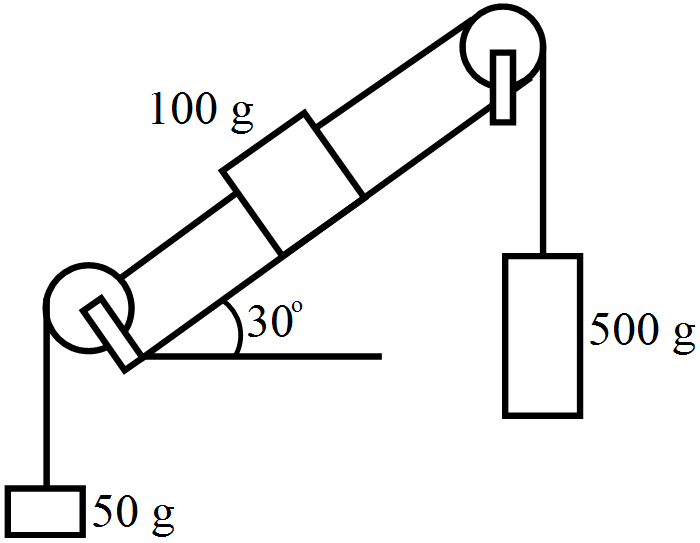
Find the acceleration of the 500g block in figure.

A scooter company gives the following specifications about its product.
  • Weight of the scooter - 95kg.
  • Maximum speed - 60km/h.
  • Maximum engine power - 3.5hp.
  • Pick up time to get the maximum speed - 5s.
  • Check the validity of these specifications.