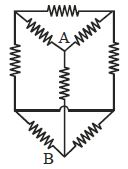
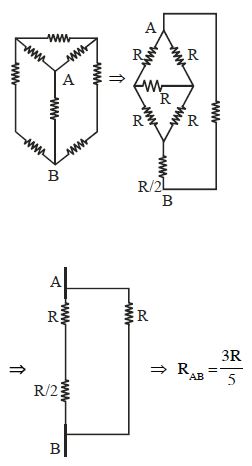
Effective resistance between points $A$ and $B$ for following network is (each branch of resistance is $R$)
Diffcult


Download our appand get started for free
Experience the future of education. Simply download our apps or reach out to us for more information. Let's shape the future of learning together!No signup needed.*
Similar Questions
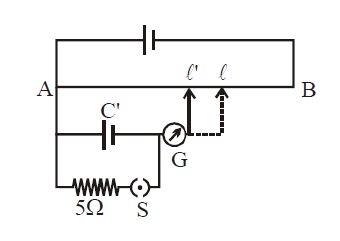
- 1In the potentiometer circuit as shown in the figure, the balance length $Al = 60\ cm$ when switch $S$ is open. When switch $S$ is closed and the value of $R$ is $5W$ the balance length $Al' = 50 cm.$ The internal resistance of the cell $C'$ is : .............. $\Omega$View Solution
- 2A potential difference of $10 \,V$ is applied across a conductor of $1000 \,\Omega$. The number of electrons flowing through the conductor in $300 \,s$ is ..........View Solution
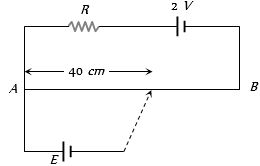
- 3$AB$ is a potentiometer wire of length $100\, cm$ and its resistance is $10 \,\Omega$. It is connected in series with a resistance $R = 40 \,\Omega$ and a battery of $e.m.f.$ $2 \,V$ and negligible internal resistance. If a source of unknown $e.m.f.$ $E$ is balanced by $40\, cm$ length of the potentiometer wire, the value of $E$ is ................. $V$View Solution
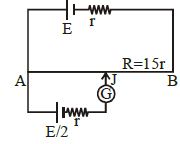
- 4The potentiometer wire $AB$ is $600\,\, cm$ long at what distance from $A$ should the Jockey $J$ touch the wire to get zero deflection in the galvanomenter ................ $\mathrm{cm}$View Solution
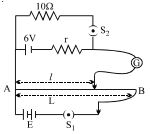
- 5In the arrangement shown in figure when the switch $S_2$ is open, the galvanometer shows no deflection for $l = L/2$. When the switch $S_2$ is closed, the galvanometer shows no deflection for $l = 5L /12$ . The internal resistance $(r)$ of $6\, V$ cell, and the $\mathrm{emf}$ $E$ of the other battery are respectivelyView Solution
- 6A $d.c.$ main supply of $e.m.f.\, 220\, V$ is connected across a storage battery of $e.m.f.\, 200\, V$ through a resistance of $1\,\Omega $. The battery terminals are connected to an external resistance $'R'$ . The minimum value of $'R'$, so that a current passes through the battery to charge it is ............... $\Omega$View Solution
- 7A resistor develops $300 \,J$ of thermal energy in $15 \,s$, when a current of $2\, A$ is passed through it. If the current increases to $3 \,A$, the energy developed in $10\,\,s$ is........$J.$View Solution
- 8View SolutionAcross a metallic conductor of non-uniform cross section a constant potential difference is applied. The quantity which remains constant along the conductor is
- 9Equivalent resistance between the adjacent corners of a regular $n$-sided polygon of uniform wire of resistance $R$ would be:View Solution
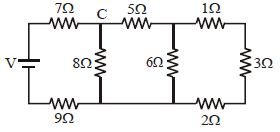
- 10In the ladder network shown, current through the resistor $3\, \Omega$ is $0.25\,A$. The input voltage $'V'$ is equal to:- ........... $V$View Solution