MCQ
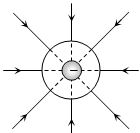
Electric lines of force about negative point charge are
  • A
    Circular, anticlockwise
  • B
    Circular, clockwise
  • Radial, inward
  • D
    Radial, outward

Answer

Correct option: C.
Radial, inward
c
(c) Electric lines force due to negative charge are radially inward.

Need a full question paper?

Generate a complete, print-ready paper with questions like this in minutes — across 16+ boards, with answer keys.
Start Generating Free

Similar questions

The propagation constant of a photon of wavelength $6284 A^{\circ}$.
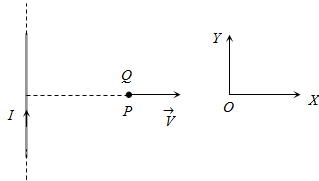
A very long straight wire carries a current I. At the instant when a charge +Q at point P has velocity $\overrightarrow V$, as shown, the force on the charge is
Consider the nuclear reaction

$X^{200} \rightarrow A^{110} + B^{90}$

If the binding energy per nucleon for $X, A$ and $B$ is $7.4 \,MeV, 8.2\, MeV$ and $8.2\, MeV$ respectively, what is the energy released ? ......... $MeV$ 

Photoelectric effect experiments are performed using three different metal plates $\mathrm{p}, \mathrm{q}$ and $\mathrm{r}$ having work functions $\phi_p=2.0 \mathrm{eV}, \phi_q=2.5 \mathrm{eV}$ and $\phi_r=3.0 \mathrm{eV}$, respectively. A light beam containing wavelengths of $550 \mathrm{~nm}, 450 \mathrm{~nm}$ and $350 \mathrm{~nm}$ with equal intensities illuminates each of the plates. The correct I-V graph for the experiment is [Take $h c=1240 \mathrm{eV} \mathrm{nm}$ ]
The sun makes $0.5^o$ angle on earth surface. Its image is made by convex lens of $50 cm$ focal length. The diameter of the image will be......$mm$
For which of the following dependence of drift velocity $v$ on electric field $E$ is ohm's law obeyed
What percentage of original radioactive atoms is left after five half lives
An infinite number of point charges, each carrying $1 \,\mu C$ charge, are placed along the y-axis at $y=1\, m , 2\, m , 4 \,m , 8\, m \ldots \ldots \ldots \ldots \ldots$

The total force on a $1 \,C$ point charge, placed at the origin, is $x \times 10^{3}\, N$. The value of $x$, to the nearest integer, is .........

[Take $\left.\frac{1}{4 \pi \in_{0}}=9 \times 10^{9} \,Nm ^{2} / C ^{2}\right]$
If a diamagnetic substance is brought near north or south pole of a bar magnet, it is