MCQ
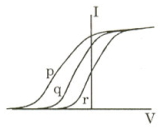
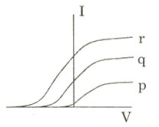
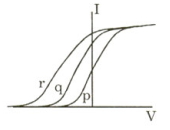
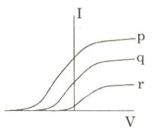
Photoelectric effect experiments are performed using three different metal plates $\mathrm{p}, \mathrm{q}$ and $\mathrm{r}$ having work functions $\phi_p=2.0 \mathrm{eV}, \phi_q=2.5 \mathrm{eV}$ and $\phi_r=3.0 \mathrm{eV}$, respectively. A light beam containing wavelengths of $550 \mathrm{~nm}, 450 \mathrm{~nm}$ and $350 \mathrm{~nm}$ with equal intensities illuminates each of the plates. The correct I-V graph for the experiment is [Take $h c=1240 \mathrm{eV} \mathrm{nm}$ ]

  • B

  • C

  • D

Answer

Correct option: A.

a
Given $\phi_p=2.0 \ eV , \phi_{ q }=2.5 \ eV$ and $\phi_{ r }=3.0 \ eV$

From the above we can find the cutoff wavelength for each plate $\lambda_p=621 \ nm$, $\lambda_q=496 \ nm$ and $\lambda_r=414 \ nm$

It's mentioned that each plate is illuminated by a light that consists of $3$ different wavelengths i.e. $550 \ nm , 450 \ nm , 350 \ nm$ of equal intensities.

Now since the cut off wavelength of plate $p$ is higher than all $3$ incident wavelengths so all $3$ types of photons will contribute to photoelectrons. Whereas in the case of plate q incident photons of wavelength $450 \ nm$ won't be able to contribute in photocurrent as it is higher than it's cut off wavelength of $496 \ nm$. So naturally its photo current will be lesser than the plate $p$ since its being excited by only $2$ wavelegths. In case of plate $r, 2$ incident wavelengths i.e. $550 \ nm$ and $450 \ nm$ won't be able to excite the photo electrons. Hnece its photocurrent will be only due to photon of wavelength $350 \ nm$ and hence will be least.

$I_p
Need a full question paper?

Generate a complete, print-ready paper with questions like this in minutes — across 16+ boards, with answer keys.

Start Generating Free

Similar questions

The ratio of intensities at two points $P$ and $Q$ on the screen in a Young's double slit experiment where phase difference between two wave of same amplitude are $\pi / 3$ and $\pi / 2$, respectively are
The angular resolution of a $10 \;cm$ diameter telescope at a wavelength of $5000 \;\mathring A$ is of the order
The collector plate in an experiment on photoelectric effect is kept vertically above the emitter plate. Light source is put on and a saturation photo current is recorded. An electric field is switched on which has a vertically downward direction
A moving coil galvanometer has $100$ turns and each turn has an area of $2.0 \mathrm{~cm}^2$. The magnetic field produced by the magnet is $0.01 \mathrm{~T}$ and the deflection in the coil is $0.05$ radian when a current of $10 \mathrm{~mA}$ is passed through it. The torsional constant of the suspension wire is $\mathrm{x} \times 10^{-5} \mathrm{~N}-\mathrm{m} / \mathrm{rad}$. The value of $\mathrm{x}$ is____.
An electric dipole will experience a net force when it is placed in.
The relaxation time in conductors
A plano-convex lens (focal length $f_2,$ refractive index $\mu _2,$ radius of curvature $R$ ) fits exactly into a plano-concave lens (focal length $f_1,$ refractive index $\mu _1,$ radius of curvature $R$ ). Their plane surfaces are parallel to each other. Then, the focal length of the combination will be
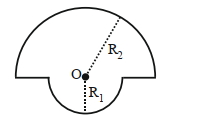
The magnetic field at the centre of a wire loop formed by two semicircular wires of radii $R_1=2 \pi\  \mathrm{m}$ and $R_2=4 \pi\  \mathrm{m}$ carrying current $I=4 \mathrm{~A}$ as per figure given below is $\alpha \times 10^{-7} \mathrm{~T}$. The value of $\alpha$ is___________ (Centre $\mathrm{O}$ is common for all segments)
If the distance between object and its two times magnified virtual image produced by a curved mirror is $15 \mathrm{~cm}$, the focal length of the mirror must be :
According to Maxwell’s Hypothesis, a changing electric field gives rise to?