MCQ
Electromagnets are made of soft iron because soft iron has:
- AHigh retentivity and high coercive force.
- BHigh retentivity and low coercive force.
- CLow retentivity and high coercive force.
- DLow retentivity and low coercive force.
Explanation:
Electro magnets arc made of soft iron because soft iron has Low retentivity and Low coercive force.
Generate a complete, print-ready paper with questions like this in minutes — across 16+ boards, with answer keys.
The refractive index of the material of the prism and liquid are 1.56 and 1.32 respectively. What will be the value of q for the following refraction
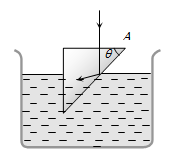
|
(a) sinθ ≥ |
(b) sinθ ≥ |
(c) sinθ ≥ |
(d) sinθ ≥ |
Which radiation in sunlight, causes heating effect
|
(a) Ultraviolet |
(b) Infrared |
(c) Visible light |
(d) All of these |
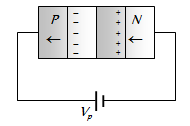
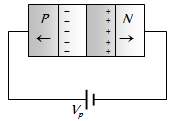
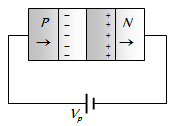
In the case of forward biasing of PN-junction, which one of the following figures correctly depicts the direction of flow of carriers
(a)
|
(b)
|
(c)
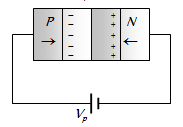
|
(d)
|
A lens (focal length 50 cm) forms the image of a distant object which subtends an angle of 1 milliradian at the lens. What is the size of the image
|
(a) 5 mm |
(b) 1 mm |
(c) 0.5 mm |
(d) 0.1 mm |
To deposit one gm equivalent of an element at an electrode, the quantity of electricity needed is
|
(a) One ampere |
(b) 96000 amperes |
(c) 96500 farads |
(d) 96500 coulombs |
The work function of a metal is 1.6  J. When the metal surface is illuminated by the light of wavelength 6400 Å, then the maximum kinetic energy of emitted photo-electrons will be (Planck's constant h = 6.4
  )
)
|
(a) 14 |
(b) 2.8 |
(c) 1.4 |
(d) 1.4 |
A condenser of capacitance 10 μF has been charged to 100 volts. It is now connected to another uncharged condenser in parallel. The common potential becomes 40 volts. The capacitance of another condenser is
|
(a) 15 μF |
(b) 5 μF |
(c) 10 μF |
(d) 16.6 μF |