MCQ
Emf is most closely related to
  • A
    Mechanical force
  • Potential difference
  • C
    Electric field
  • D
    Magnetic field

Answer

Correct option: B.
Potential difference
b
$EMF$ is most closely related to Potential difference.

Need a full question paper?

Generate a complete, print-ready paper with questions like this in minutes — across 16+ boards, with answer keys.
Start Generating Free

Similar questions

A ferromagnetic material is placed in an external magnetic field. The magnetic domains:
A current of $2\, amp$. flows in a long, straight wire of radius $2\, mm$. The intensity of magnetic field on the axis of the wire is
In the depletion region of a diode:
Size of nucleus:
In a compound microscope, the focal length of the objective and the eye lens are $2.5 \,cm$ and $5 \,cm$ respectively. An object is placed at $3.75\, cm$ before the objective and image is formed at the least distance of distinct vision, then the distance between two lenses will be......$cm$ ($i.e.$ length of the microscopic tube)
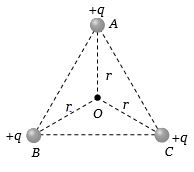
$ABC$ is an equilateral triangle. Charges $ + \,q$ are placed at each corner. The electric intensity at $O$ will be
Assertion : Microwaves are better carrier of signals than optical waves.

Reason : Microwaves move faster than optical waves.

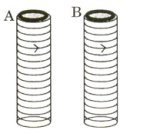
Two metallic rings $\mathrm{A}$ and $\mathrm{B}$, identical in shape and size but having different resistivities $\rho_A$ and $\rho_B$, are kept on top of two identical solenoids as shown in the figure. When current $I$ is switched on in both the solenoids in identical manner, the rings $\mathrm{A}$ and $\mathrm{B}$ jump to heights $h_A$ and $h_B$, respectively, with $h_A>h_B$. The possible relation$(s)$ between their resistivities and their masses $m_A$ and $m_B$ is(are)

$(A)$ $\rho_A>\rho_B$ and $m_A=m_B$

$(B)$ $\rho_A<\rho_B$ and $m_A=m_B$

$(C)$ $\rho_A>\rho_B$ and $m_A > m_B$

$(D)$ $\rho_A<\rho_B$ and $m_A < m_B$
Assertion : Annihilation of electron and positron is an example of decay of charges.
Reason : In the process of annihilation an electron and a positron combine to give a gamma particle.
In a cyclotron, the angular frequency of a charged particle is independent of