The potential energy of a particle with displacement $X$ is $U(X)$. The motion is simple harmonic, when ($K$ is a positive constant)
Easy
Download our app for free and get started
(a) $F = - \,kx$
==> $dW = Fdx = - \,kxdx$
So $\int_{\,0}^{\,W} {dW} = \int_{\,0}^{\,x} { - kx\,dx} $
==> $W = U = - \frac{1}{2}k{x^2}$

Download our appand get started for free
Experience the future of education. Simply download our apps or reach out to us for more information. Let's shape the future of learning together!No signup needed.*
Similar Questions
- 1View SolutionA simple pendulum is taken from the equator to the pole. Its period
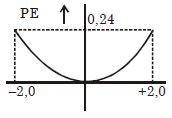
- 2A particle executing $S.H.M.$ its potential energy $V/S$ displacement graph is given by The value of restoring force constant is ..... $N/m$View Solution
- 3View SolutionIf the metal bob of a simple pendulum is replaced by a wooden bob, then its time period will
- 4View SolutionThe velocity of a particle performing simple harmonic motion, when it passes through its mean position is
- 5Two masses $m_1=1 \,kg$ and $m_2=0.5 \,kg$ are suspended together by a massless spring of spring constant $12.5 \,Nm ^{-1}$. When masses are in equilibrium $m_1$ is removed without disturbing the system. New amplitude of oscillation will be .......... $cm$View Solution
- 6The amplitude of a damped oscillator decreases to $0.9$ times its original magnitude in $5\ s$. In another $10\ s$ it will decrease to $\alpha $ times its original magnitude, where $\alpha $ equalsView Solution
- 7A particle moves with simple harmonic motion in a straight line. In first $\tau \,s,$ after starting from rest it travels a distance $a,$ and in next $\tau \,s$ it travels $2a,$ in same direction, thenView Solution
- 8A simple pendulum with a metallic bob has a time period $T$. The bob is now immersed in a non-viscous liquid and oscillated. If the density of the liquid is $1 / 4$ that of metal, the time period of the same pendulum will be ...........View Solution
- 9The maximum velocity of a body undergoing $S.H.M$. is $0.2\,m/s$ and its acceleration at $0.1\,m$ from the mean position is $0.4\,m/s^2$. The amplitude of the $S.H.M.$ is .... $m$View Solution
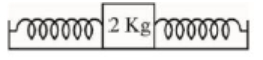
- 10A block of mass $2\,kg$ is attached with two identical springs of spring constant $20\,N / m$ each. The block is placed on a frictionless surface and the ends of the springs are attached to rigid supports (see figure). When the mass is displaced from its equilibrium position, it executes a simple harmonic motion. The time period of oscillation is $\frac{\pi}{\sqrt{x}}$ in SI unit. The value of $x$ is $..........$View Solution