Question
Explain briefly the process of charging a parallel plate capacitor when it is connected across a d.c. battery. A capacitor of capacitance ‘C’ is charged to ‘V’ volts by a battery. After some time the battery is disconnected, and the distance between the plates is doubled. Now a slab of dielectric constant, 1 < k < 2, is introduced to fill the space between the plates. How will the following be affected:
  1. The electric field between the plates of the capacitor.
  2. The energy stored in the capacitor.
Justify your answer by writing the necessary expressions.

Answer

Process of charging:
The electrons, from the plate of the capacitor, which is connected to the positive terminal of the battery, move towards the battery. The reverse happens at the other plate. Hence, the plates get positively and negatively charged respectively.
Effect of dielectric:
  1. Electric fields decreases Justification.
Because initially $\text{E}_{1} = \frac{\sigma}{\varepsilon}_{\circ}$ and finally $\text{E}_{2} =\frac{1}{\text{k}}.\frac{\sigma}{\varepsilon}_{\circ}$

$\text{E} = \frac{\text{E}_{1}}{\text{K}}$
  1. Energy stored increases:
New capacitance$\text{C} = \bigg(\frac{\varepsilon_\circ\text{A}}{2\text{d}}\bigg)\text{k}$

$ = \frac{\text{K}}{2}\text{C}_{\circ} , $

$\therefore\text{C} < \text{C}_{\circ}$

Initially Energy $ = \frac{\text{Q}^{2}}{2\text{c}}$ and Energy $ = \frac{\text{Q}^{2}}{\text{c}}.\frac{2}{\text{k}}\text{as }1 < \text{K} < 2.$

Need a full question paper?

Generate a complete, print-ready paper with questions like this in minutes — across 16+ boards, with answer keys.

Start Generating Free

Similar questions

The density of an ideal gas is $1.25 \times 10^{-3}gcm^3$ at STP. Calculate the molecular weight of the gas.
Light of wavelength 5000 Å falls on a plane reflecting surface. What are the wavelength and frequency of the reflected light? For what angle of incidence is the reflected ray normal to the incident ray?
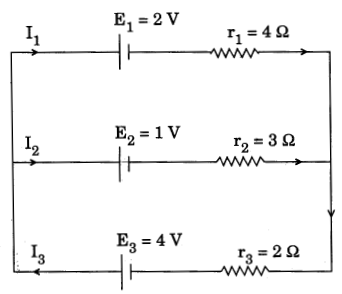
State Kirchhoff’s rules. Use these rules to write the expressions for the currents $I_1, I_2$ and $I_3$ in the circuit diagram shown.
Water is filled in a rectangular tank of size 3m × 2m × 1m.
  1. Find the total force exerted by the water on the bottom surface of the tank.
  2. Consider a vertical side of area 2m × 1m. Take a horizontal strip of width ox metre in this side, situated at a depth of x metre from the surface of water. Find the force by the water on this strip.
  3. Find the torque of the force calculated in part.(b) about the bottom edge of this side.
  4. Find the total force by the water on this side.
  5. Find the total torque by the water on the side about.
The bottom edge. Neglect the atmospheric pressure and take $g = 10m/s^2.$
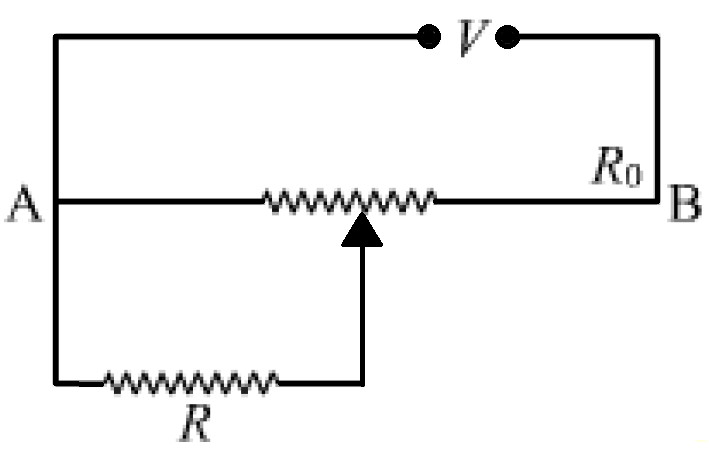
A resistance of R draws current from a potentiometer. The potentiometer wire, AB, has a total resistance of $R_o.$ A voltage V is supplied to the potentiometer. Derive an expression for the voltage across R when the sliding contact is in the middle of potentiometer wire.
The human eye has an approximate angular resolution of $\phi=5.8\times10^{-4}$ rad and a typical photoprinter prints a minimum of 300dpi (dots per inch, 1inch = 2.54cm). At what minimal distance z should a printed page be held so that one does not see the individual dots.
Half life of $^{238}\text{U}_{92}$against$\alpha$ decay is $4.5 \times 10^{9}$years. Calculate the activity of Ig sample of$^{238}\text{U}_{92}$? Given Avogadro's number $= 6 \times 10^{26}$atoms/kmol.
Calculate the magnetic dipole moment corresponding to the motion of the electron in the ground state of a hydrogen atom.
Two circular loops are placed coaxially but separated by a distance. A battery is suddenly connected to one of the loops establishing a current in it. Will there be a current induced in the other loop? If yes, when does the current start and when does it end? Do the loops attract each other or do they repel?
Why is it not possible to make permanent magnets from paramagnetic materials?