Question
Explain characteristics of electric charge.

Answer

►(1) There are two types of electric charge :
         (i) Positive charge.
         (ii) Negative charge.
   (2) Heterogeneous electric charges repel and homogeneous charge attracts each other.
   (3) Electric charge without mass does not exist.
   (4) Charge is an internal property of matter.

Need a full question paper?

Generate a complete, print-ready paper with questions like this in minutes — across 16+ boards, with answer keys.
Start Generating Free

Similar questions

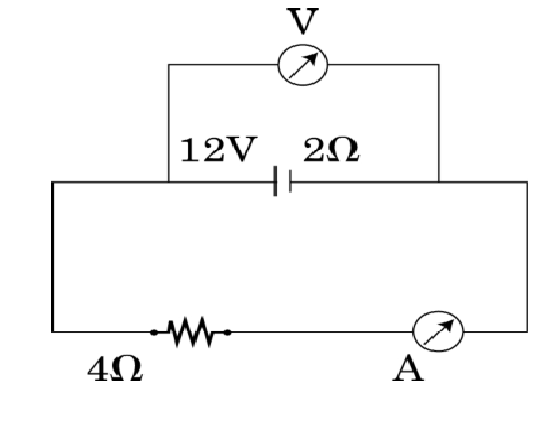
A battery of emf 12V and internal resistance 2 $\Omega$ is connected to a 4 $\Omega$ resistor as shown in the figure.
  1. Show that a voltmeter when placed across the cell and across the resistor, in turn, given the same reading.
  2. To record the voltage and the current in the circuit, why is voltmeter placed in parallel and ammeter in series in the circuit?
A metal sphere of radius $1\ mm$ and mass $50\ mg$ falls vertically in glycerine. Find:
  1. The viscous force exerted by the glycerine on the sphere when the speed of the sphere is $1\ cm/s.$
  2. The hydrostatic force exerted by the glycerine on the sphere and.
  3. The terminal velocity with which the sphere will move down without acceleration. Density of glycerine $= 1260\ kg/m^3$ and its coefficient of viscosity at room temperature $= 8.0$ poise.
Explain the representation of AC current and voltage by rotating vectors. (phasors).
Half-life time of a radioactive element is 10 years. In how much time it will be left (1/16)th of its original mass ?
Using the formula $\overrightarrow{\text{F}}=\text{q}\overrightarrow{\text{v}}\times\overrightarrow{\text{B}}$ and $\text{B}=\frac{\mu_0\text{i}}{2\pi\text{r}},$ show that the $SI$ units of the magnetic field $B$ and the permeability constant $\mu_0$ may be written as $N/A-m$ and $NA^2$ respectively.
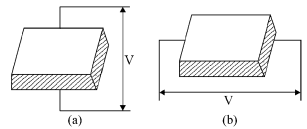
In a given figure, a rectangular object is shown. Its length is I, breadth is 0.5 I and thickness 0.25 I . To measure its resistance, potential difference $V$ is applied in two ways [figure (a) and (b)]. In which arrangement, the resistance of the substance will be more?
Image
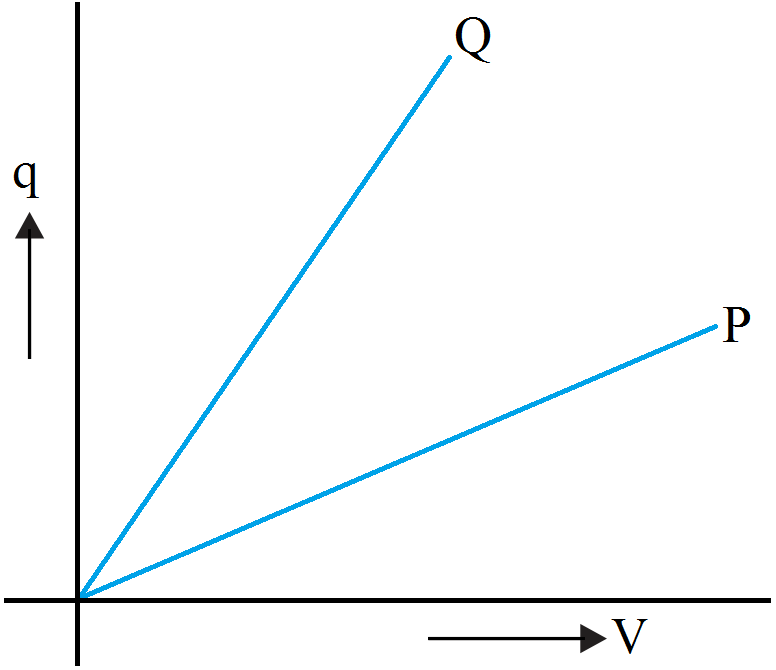
The given graph shows the variation of charge $q$ versus potential difference $V$ for two capacitors $C_1$ and $C_2.$ The two capacitors have same plate separation but the plate area of $C_2$ is double than that of $C_1.$ Which of the two graphs $P$ and $Q$ correspond to capacitors $C_1$ and $C_2$ and why?
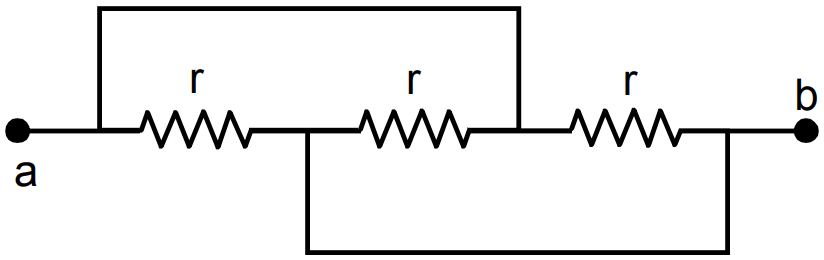
Find the equivalent resistance of the network shown in figure. between the points a and b.
Work function of aluminium is 4.2eV. If two photons, each of energy 2.5eV, are incident on its surface, will the emission of electrons take place? Justify your answer.
Define lens and write its formula.