Question
Explain Coulomb’s law in vector form.

Answer

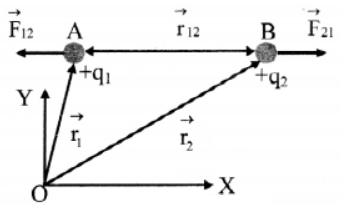
$i.$ Let $q_1$ and $q_2$ be the two similar point charges situated at points $A$ and $B$ and let $\vec{r}_{12}$ be the distance of separation between them.
$ii.$ The force $\vec{F}_{21}$ exerted on $q _2$ by $q _1$ is given by,
$\overrightarrow{ F }_{21}=\frac{1}{4 \pi \varepsilon_0} \frac{ q _1 q _2}{\left| r _{12}\right|^2} \times \hat{ r }_{12}$
where, $\hat{r}_{12}$ is the unit vector from $A$ to $B$.
$\vec{F}_{21}$ acts on $q _2$ at $B$ and is directed along $BA$ , away from $B$.
Image
$iii.$ Similarly, the force $\vec{F}_{12}$ exerted on $q _1$ by $q _2$ is given by, $\vec{F}_{12}=\frac{1}{4 \pi \varepsilon_0} \frac{ q _1 q _2}{\left| r _{12}\right|^2} \times \hat{ r _{21}}$
where, $\hat{r}_{21}$ is the unit vector from $B$ to $A . \vec{F}_{12}$ acts on $q _1$ at $A$ and is directed along $BA ,$ away from $A$.
$iv.$ The unit vectors $\hat{r}_{12}$ and $\hat{r}_{21}$ are oppositely directed i.e., $\hat{r}_{12}=-\hat{r}_{21}$ Hence, $\vec{F}_{21}=-\vec{F}_{12}$
Thus, the two charges experience force of equal magnitude and opposite in direction.
$v.$ These two forces form an action$-$reaction pair.
$vi.$ As $\vec{F}_{21}$ and $\vec{F}_{12}$ act along the line joining the two charges, the electrostatic force is a central force.

Need a full question paper?

Generate a complete, print-ready paper with questions like this in minutes — across 16+ boards, with answer keys.
Start Generating Free

Similar questions

State some important features of the depletion region.
There are three charges of magnitude $3 \ pC, 2 \ pC$ and $3 \ pC$ located at three corners $A, B$ and $C$ of a square $\text{ABCD}$ of each side measuring $2 m.$ Determine the net force on $2 \ pC$ charge.
Why do astronauts in an orbiting satellite have a feeling of weightlessness?
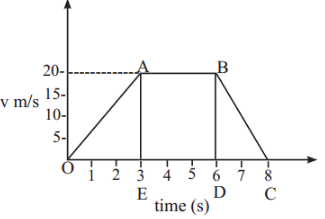
A velocity-time graph is shown in the adjoining figure.

Image
Determine:
  1. initial speed of the car
  2. maximum speed attained by the car
  3. part of the graph showing zero acceleration
  4. part of the graph showing constant retardation
  5. distance travelled by the car in first 6 sec.
Explain how to find the location of centre of mass or centre of gravity of a laminar object.
Derive equations of motion graphically for a particle having uniform acceleration, moving along a straight line.
Figure shows a fixed pulley. A massless inextensible string with masses $m_1$ and $m_2 > m_1$ attached to its two ends is passing over the pulley. Such an arrangement is called an Atwood machine. Calculate accelerations of the masses and force due to the tension along the string assuming axle of the pulley to be frictionless.
Image
A convex lens held some distance above a 6 cm long pencil produces its image of SOME size. On shifting the lens by a distance equal to its focal length, it again produces the image of the SAME size as earlier. Determine the image size.
Explain the graph showing variation of acceleration due to gravity with altitude and depth.
A liquid drop of $1.00 g$ falls from height of cliff $1.00 \ km.$ It hits the ground with a speed of $50 \ m s^{-1}.$ What is the work done by the unknown force? $($Take $g = 9.8 \ m/s^2)$