Question
Explain different ways of classifying data.

Answer

Generally, data are classified on the basis of the following four bases: Geographical Classification: In geographical classification, data are classified on the basis of geographical or locational differences – such as cities, districts, or villages – between various elements of the data set. The following is an example of a geographical distribution. (Figures are hypothetical)
States of India
Punjab
Haryana
J & k
Bihar
Orissa
M.P.
Poverty (%)
12
10
3.5
39
38
34
Chronological Classification: When data are classified on the basis of time, the classification is known as chronological classification. Such classifications are also called time series because data are usually listed in chronological order starting with the earliest period. The following is an example of a Chronological distribution. (Figures are hypothetical)
Year
1951
1961
1971
1981
1991
2001
Poverty (%)
52
50
47
38
36
26
Another example can be:
Month
Family expenditure per member
January
2000
February
3000
March
1000
April
1200
May
2300
June
1400
July
1100
August
4300
September
900
October
1900
November
2100
December
3100
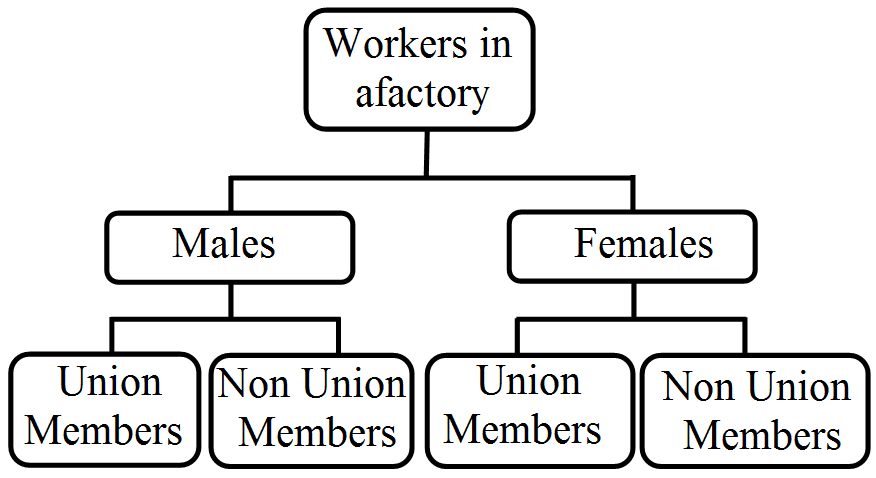
Qualitative Classification: In qualitative classification, data are classified on the basis of descriptive characteristics or on the basis of attributes like sex, literacy, region, caste, or education, which cannot be quantified. This is done in two ways: Simple classification: In this type of classification, each class is subdivided into two sub-classes and only one attribute is studied, for example male and female; blind and not blind, educated and uneducated; and so on. Manifold classification: In this type of classification, a class is subdivided into more than two subclasses which may be sub-divided further. An example is given below:
Quantitative Classification: In this classification, data are classified on the basis of characteristics which can be measured such as height, weight, income, expenditure, production, or sales. An example is given below:
Salary Per Month
No. of workers
0-10000
40
10,000-20,000
10
20000-30000
13
30000-40000
8
40,000-50,000
12
50,000 and above
7

Need a full question paper?

Generate a complete, print-ready paper with questions like this in minutes — across 16+ boards, with answer keys.

Start Generating Free