Question
Explain loss of biodiversity.

Answer

→ The biological wealth of our planet has been declining rapidly and the accusing finger is clearly pointing to human activities.
→ The colonisation of tropical Pacific Islands by humans is said to have led to the extinction of more than 2,000 species of native birds.
→ The IUCN Red List (2004) documents the extinction of 784 species (including 338 vertebrates, 359 invertebrates and 87 plants) in the last 500 years.
→Some examples of recent extinctions include the
→ Dodo (Mauritius), Quagga (Africa), Thylacine (Australia), Steller's Sea Cow (Russia) and three subspecies (Bali, Javan, Caspian) of tiger.
→ The last twenty years alone have witnessed the disappearance of 27 species.
→ Careful analysis of records shows that extinctions across taxa are not random; some groups like amphibians appear to be more vulnerable to extinction.
→ Adding to the grim scenario of extinctions is the fact that more than 15,500 species world- wide are facing the threat of extinction.
→ Presently, 12 per cent of all bird species, 23 per cent of all mammal species, 32 per cent of all amphibian species and 31per cent of all gymnosperm species in the world face the threat of extinction.
→ From a study of the history of life on earth through fossil records, shows that large-scale loss of species like the one we are currently witnessing have also happened earlier, even before humans appeared on the scene.
→ During long the period (> 3 billion years) since the origin and diversification of life on earth there were five episodes of mass extinction of species.
→ The difference is in the rates; the current species extinction rates are estimated to be 100 to 1,000 times faster than in the pre-human times and our activities are responsible for the faster rates.
→ Ecologists warn that if the present trends. continue, nearly half of all the species on earth might be wiped out within the next 100 years.

Need a full question paper?

Generate a complete, print-ready paper with questions like this in minutes — across 16+ boards, with answer keys.

Start Generating Free

Similar questions

Read the following and answer any four questions from 2(i) to 2(v) given below:

Restriction endonuclease was isolated for the first ti me by W. Arb er in 1962 in bacteria. Restriction endonucleases cut the DNA duplex at specific points therefore they are also called as molecular scissors or biological scissors. Three types of restriction endonucleases are Type I, Type II and Type III but only Type II restriction endonucleases are used in recombinant DNA technology. Restriction endonuclease EcoR I recognises the base sequence GAATTC in DNA duplex and cut strands between G and A.

  1. Only type II restriction enzymes are used in gene manipulation because
  1. ATP is not required for cleaving.
  2. It consists of three different subunits.
  3. It makes cleavage or cut in both the strands of DNA molecule.
  4. Both (a) and (c).
  1. Which of the following ions are used by restriction endonucleases for restriction?
  1. Mg2+ ions
  2. Mn2+ ions
  3. Na2+ ions
  4. K2+ ions
  1.  Restriction endonuclease was isolated for the first time in a:
  1. Plant cell.
  2. Animal cell.
  3. Prokaryotic cell.
  4. Genninal cell.
  1. Restriction endonucleases are also called as molecular or biological scissors because,
  1. They cleave base pairs of DNA only at their terminal ends.
  2. They cleave one or both the strands of DNA.
  3. They act only on single stranded DNA.
  4. None of these.
  1. Select the option that correctly states the working action of restriction endonuclease EcoR I on DNA sequence GAATTC
  1. $\ \ \ \ \ \ \ \ \ \ \ \ \downarrow\\5'-\text{GAATTC}-3'\\3'-\text{CTTAAG}-5'\\\ \ \ \ \ \ \ \ \ \ \ \ \ \ \ \ \ \ \uparrow$

  2. $ \ \ \ \ \ \ \ \ \ \ \downarrow\\5'-\text{GAATTC}-3'\\3'-\text{CTTAAG}-5'\\\ \ \ \ \ \ \ \ \ \ \ \ \ \ \ \ \ \ \ \ \uparrow$

  3. $\ \ \ \ \ \ \ \ \ \ \ \ \ \ \ \ \ \ \ \ \ \downarrow\\5'-\text{GAATTC}-3'\\3'-\text{CTTAAG}-5'\\\ \ \ \ \ \ \ \ \ \uparrow$

  4. $\ \ \ \ \ \ \ \ \ \ \ \ \ \ \ \downarrow\\5'-\text{GAATTC}-3'\\3'-\text{CTTAAG}-5'\\\ \ \ \ \ \ \ \ \ \ \ \ \ \ \uparrow$
Polymerase chain reaction:
  1. Is a method of synthesising human protein from human DNA
  2. Uses restriction enzymes
  3. Can produce billions of copies of a DNA fragment
  4. Takes place naturally in bacteria
Describe: Genetic engineered insulin
Read the following and answer any four questions from (i) to (v) given below:

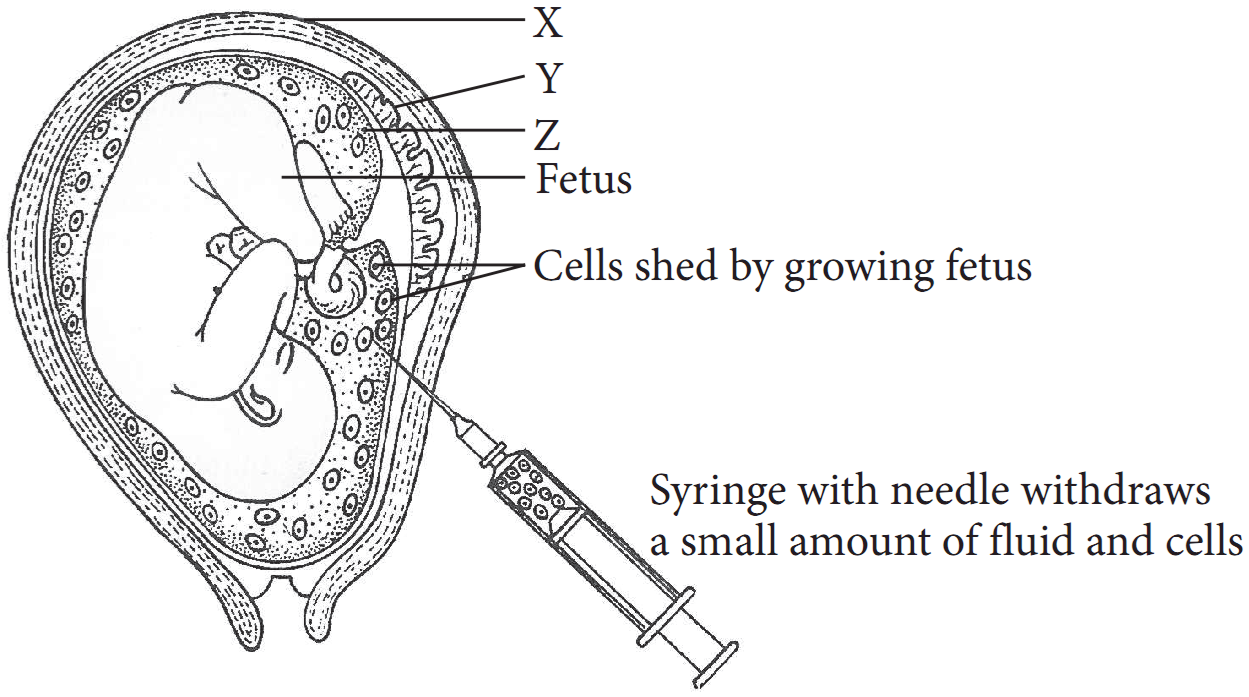
A technique known as amniocentesis is used to determine fetal abnormalities. This test chromosomal pattern in amniotic fluid. However, this technique is legally banned now.

  1. Identify X and Y in the above given figure.
S. No
X
Y
(a)
Amnion
Chorion
(b)
Uterine wall
Placenta
(c)
Placenta
Uterine wall
(d)
Uterine wall
Amnion
  1. What is the function of Z?
  1. Z is an amniotic fluid which prevents dessication of an embryo.
  2. Z is yolk sac which functions as site of early blood cell formation.
  3. Z is amnion, which takes part in placenta formation.
  4. None of these
  1. Which of the following diseases can not be diagnosed by amniocentesis?
  1. Down's syndrome.
  2. Sickle cell disease.
  3. Jaundice.
  4. Cystic fibrosis.
  1. Assertion: Amniocentesis is legally banned for sex determination.

Reason: Amniocentesis was being misused for aborting normal female fetus.

  1. Both assertion and reason are true, and reason is the correct explanation of assertion.
  2. Both assertion and reason are true, but reason is not the correct explanation of assertion.
  3. Assertion is true, but reason is false.
  4. Both assertion and reason are false.
  1. Which of these is a non-invasive technique of detecting fetal disorder?
  1. Fetoscopy.
  2. Chorionic villi sampling.
  3. Amniocentesis.
  4. Ultrasound imaging.
Read the following and answer any four questions from (i) to (v) given below:

When it comes to biopesticides, one of the most widely used fungi is Beauveria bassiana. It infects a range of insects like, pecan weevil, Colorado potato beetle, kudzu bug, etc. It causes a disease known as the white muscardine. Even after an insect is killed, the white mold continues to produce millions of new infective spores that are released into the environment. It is commercially formulated as products including Naturalis L, Mycotrol, BotaniGard, etc. Some other widely used molds are Trichoderma, Metarhizium, etc. Some of them release enzymes that dissolve potential pathogens, others form barriers around plant roots and make it impossible for harmful bacteria and pathogens to pass through.

  1. The key benefits of the biopesticides are that they are:
  1. Highly effective.
  2. Target specific.
  3. Reduced environmental risks.
  4. all of these.
  1. Naturalis-L is a conunercial formulation containing:
  1. Bacterial biopesticide.
  2. Fungal biopesticide.
  3. Fungal biofertiliser.
  4. Chemical pesticide.
  1. Which of the following is used as an effective bacterial biopesticide?
  1. Trichoderma.
  2. Beauveria.
  3. Bacillus thuringiensis.
  4. All of these.
  1. Baeuveria causes a disease called:
  1. White muscardine.
  2. Aspergillosis
  3. Green muscardine.
  4. Powdary mildews.
  1. Assertion: Trichoderma, found in root ecosystem, exerts biological control over several plant pathogens.

Reason: Trichoderma release enzyme which inhibits growth of several disease causing pathogens.
  1. Both assertion and reason are true and reason is the correct explanation of assertion.
  2. Both assertion and reason are true but reason is not the correct explanation of assertion.
  3. Assertion is true but reason is false.
  4. Both assertion and reason are false.
Read the following text carefully and answer the questions that follow:
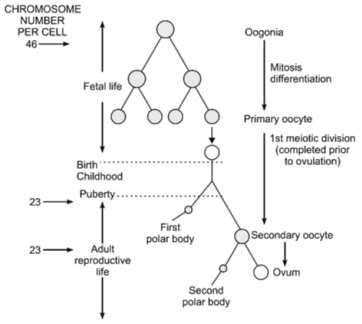
The process of formation of a mature female gamete is called oogenesis which is markedly different from spermatogenesis. A schematic representation of Oogenesis is shown below study the flow chart carefully.
Image
i. How is a primary oocyte different from a secondary oocyte? (1)
i. Mention the changes taking place during the transition of a secondary follicle to Graafian follicle in the oogonia. (1)
iii. How many primary follicles are left in each ovary in a human female at puberty? (2)
OR
What happen to graafuan follicle after ovulation? (2)
What is the mechanism by which the AIDS virus causes deficiency of immune system of the infected person?
Read the following and answer any four questions from (i) to (v) given below:

Alcohols are important industrial solvents. Ethanol, methanol, propanol and butanol are produced commercially by fermentation activity of some fungi, majorly yeasts. During fermentation, yeast cells convert cereal derived sugars into ethanol and CO2 At the same time hundreds of secondary metabolites that influence the aroma and taste of alcohol are produced. Sugar concentration affects the rate of fermentation reactions. Yeast cannot grow in very strong sugar solution. In case of complex carbohydrate containing nutrient media, 1% malt or Rhizopus is used along with yeasts. Hydrolysis of starch is carried out at high temperature for 30 ruins. 'Tile crushed food mixed with hot water for obtaining malt in called mash. 'Tile nutrient medium prior to fermentation in called wort. Wort is cooled down to appropriate temperature and inoculated with strain of yeast.

  1. Tile rate of alcohol production is measured on the basis of:
  1. Amount of sugar present in the medium.
  2. Amount of CO2 produced per unit time.
  3. Amount of yeast added in the medium.
  4. All of these.
  1. A number of chemicals are produced at the time of alcoholic fermentation with the change of nutrient media, pH and aeration. Select such by-product from the following.
  1. Phenylethanol.
  2. Amyl alcohol.
  3. Glycerol.
  4. All of these.
  1. During alcoholic fermentation of cereals and potato, the crushed food mixed with hot water for obtaining malt is called:
  1. Juice.
  2. Mash.
  3. Wort.
  4. None of these.
  1. Distilled alcohol with 95% ethanol content is called:
  1. Absolute alcohol.
  2. Rectified spirit.
  3. Gin.
  4. Brandy.
  1. Assertion: Rhizopus or 1% malt is used in the nutrient medium when it contains complex carbohydrates.

Reason: Yeast does not possess sufficient diastase or amylase. 

  1. Both assertion and reason are true and reason is the correct explanation of assertion.
  2. Both assertion and reason are true but reason is not the correct explanation of assertion.
  3. Assertion is true but reason is false.
  4. Both assertion and reason are false.
Explain the life cycle of Plasmodium (with diagram).
Write a short note on pollination by wind.