Question
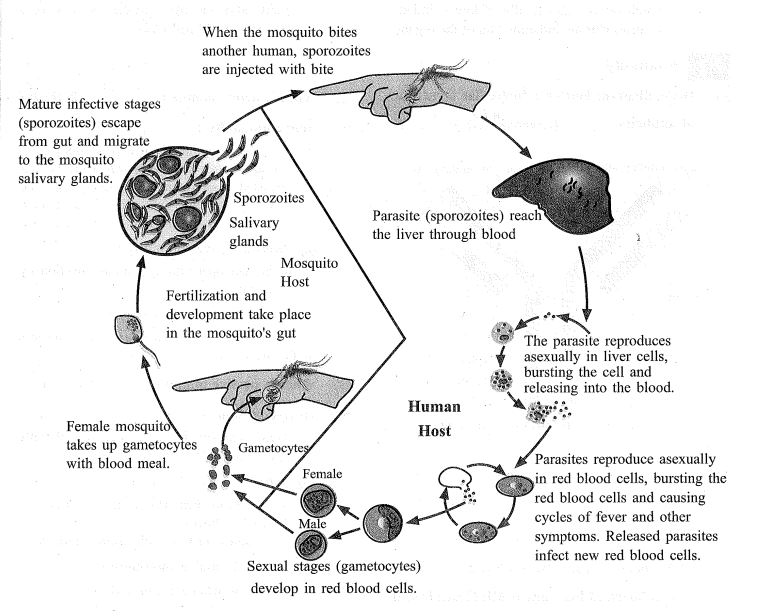
Explain the life cycle of Plasmodium (with diagram).
Answer

Plasmodium enters the human body in the form of sporozoites when an infected female Anopheles mosquito bites a human.
→Initially this parasite multiplies in the liver cells and then invades the blood cells causing RBC's to rupture.
→Rupture of RBC releases a toxic substance called hemozoin, which causes chills and high fever for 3 to 4 days.
→At this stage, when a female Anopheles mosquito bites an infected person, the parasite enters the mosquito's body, where it develops further.
→There they multiply and form sporozoites.
→This sporozoite is stored in the salivary gland of the mosquito.
When this infected female mosquito bites a person, the parasite enters her body and develops.
→Malaria parasite requires two hosts to complete its life cycle,
(1) Man,(2) Mosquitoes.
→Reproduction in Plasmodium
Asexual reproduction in humans:
→The parasite reproduces in the human RBC and destroys the RBC.
→In RBC the sexual stage (germ cells) develop male and female germs (male- microgamete, female-mega gamete).
→These genes enter mosquitoes from humans through mosquito bites.
Sexual reproduction in mosquito:
→The sexual genes (Gametes) entered into the mosquito from the human being are fertilized in the intestine of the mosquito and induce development.
→In order to develop, the sporozoite stage is stored in the salivary gland of the mosquito.
→Malaria is a disease caused by Plasmodium- like parasites in humans.
→Different species of Plasmodium like (Plasmodium falciparum, Plasmodium vivax, Plasmodium ovale) are responsible for different types of malaria.
Image

Need a full question paper?

Generate a complete, print-ready paper with questions like this in minutes — across 16+ boards, with answer keys.
Start Generating Free

Similar questions

Explain structure and working of biogas plant with diagram.
What is transgenic animals? How it is useful for man kind?
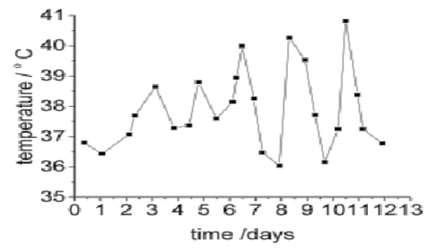
Given below is the pattern of temperature in a person suffering from a non-viral disease transmitted by mosquitoes. Study the graph and answer the questions that follow:
Image
A. Explain the factor(s) responsible for this pattern of temperature.
B. How does this pathogen multiply in the human body?
C. How is this infection transmitted to humans?
OR
D. Which stages of the life cycle of this pathogen are completed in the mosquito's gut?
Explain: Chromosomal Theory of Inheritance.###Briefly mention the contribution of T.H. Morgan in genetics.
Read the following text carefully and answer the questions that follow:
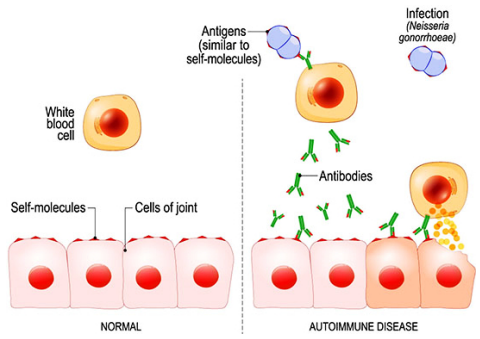
A healthy immune system defends the body against disease and infection. But if the immune system malfunctions, it mistakenly attacks healthy cells, tissues, and organs. Called autoimmune disease, these attacks can affect any part of the body, weakening bodily function and even turning life-threatening.
Image
i. Why are autoimmune diseases called degenerative diseases? (1)
ii. Name the autoimmune disease of body muscles. (1)
iii. Which types of immunity is provided by T-lymphocytes? (2)
OR
Which immune cells form humoral immune system? (2)
Read the following and answer any four questions from (i) to (v) given below:

DNA replication is a complex multistep process that requires enzymes, protein factors and metal ions. DNA replication in eukaryotes occurs in the nucleus during the S-phase of the cell cycle. It is semidiscontinuous in eukaryotes. in prokaryotes, replication takes place in the cytoplasm. DNA replication in bacteria occurs prior to fission. Nucleoid or viral chromosome is a single molecule of nucleic acid, it may be linear of circular. Nucleic acid in a virus is either DNA or RNA but never both.
  1. In viral DNA, how many origin of replication are present?
  1. Single
  2. Twice
  3. Multiple
  4. None
  1. Select the main enzyme involved in DNA replication.
  1. DNA ligase
  2. DNA dependent DNA polymerase
  3. Topoisomerase
  4. Helicase
  1. Read the given statement and select the option that correctly fill in the blanks. Enzyme (i) acts over the Ori site and unwinds the two strands of DNA by destroying (ii) bonds.
  1. (i)-Helicase (ii) Glycosidic
  2. (i)-Helicase (ii)-Hydrogen
  3. (i)-Unwindase (ii)-Phosphodiester
  4. (i)-Unwindase (ii)-Glycosidic
  1. DNA strand, built up of Okazaki fragments, is called.
  1. Lagging strand.
  2. Leading strand.
  3. Complementary strand.
  4. Parental strand.
  1. Select the incorrect statement about DNA polymerase in eukaryotes.
  1. Polymerase $\alpha$ is required for initiation of replication.
  2. When the RNA primer gets removed the gap is filled by DNA polymerase $\beta$ in eukaryotes.
  3. Polymerase $\in$ helps in elongation of lagging strand.
  4. Polymerase $\delta$ is largest and main enzyme for DNA replication in eukaryotes.
Microbes can be used to decrease the use of chemical fertilizers and pesticides. Explain how this can be accomplished.###How biofertilizers increase fertility of soil?
Read the following and answer any four questions from 6(i) to 6(v) given below:

Rama lives in a society where a robbery occurred last night. Robbers came into the flat and murdered the old lady residing there. Police came and restricted the entry into the flat. They took samples from the room, where the dead body was found. While examining, they found that there is some blood and tissue in the nails of old lady. According to their observation, police filtered out their inspection to three suspects viz. servant, cook and milkman. Finally after two days of robbery, police caught the criminal. It was the old lady's cook. Rama was amazed to see that how quickly police completed and shut the case. She asked the inspector that how they did it? The police man told her that it become possible due to the sample collected from the victim, that lead them to the criminal. TI1e sample taken from nail scraping was amplified using PCR and then tested.

  1. What technique was used by the police to identify the criminal?
  1. DNA fingerprinting.
  2. Gel electrophoresis.
  3. Molecular diagnosis.
  4. Clonning.
  1. In PCR, the temperature used to denature the DNA is about:
  1. 76º
  2. 25º
  3. 95º
  4. 40º
  1. Which of the following statements regarding PCR is correct?
  1. Taq polymerase, which is isolated from bacterium Thermus aquaticus is stable at low temperature only.
  2. With the help of DNA ligase, the complementary sticky ends of the DNA are joined to produce a rDNA.
  3. Since the sequence of primers are complementary to 5' end of the template DNA, they anneal to it.
  4. DNA purified from the cell is precipitated by adding hot ethanol.
  1. Taq polymerase synthesises DNA region between the primers using:
  1. Mg2+
  2. dNTPs
  3. DNA ligase
  4. Both (a) and (b).
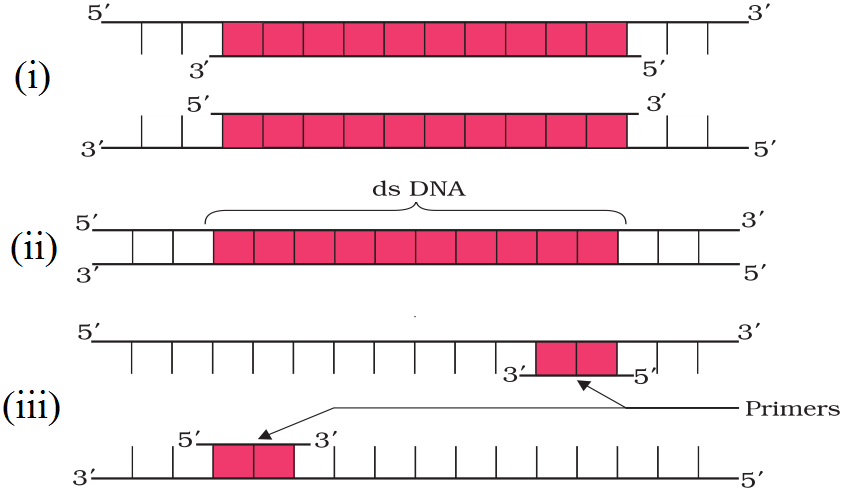
  1. Given below are steps of polymerase chain reaction.

Select the option that correctly mention the sequence in which they occur.

  1. (ii) → (iii) → (i)
  2. (i) → (ii) → (iii)
  3. (iii) → (i) → (ii)
  4. (ii) → (i) → (iii)
Read the following and answer any four questions from (i) to (v) given below:

Oogenesis is the process of formation of ovum in ovaries. It consists of three phases : multiplication, growth and maturation. Oogenesis is controlled by hormones GnRH, LH, FSH. GnRH secreted by the hypothalamus stimulates the anterior lobe of pituitary gland to secrete LH and FSH.

  1. What is the function of hormone FSH?
  1. It inhibits the formation of estrogen.
  2. It induces the release of secondary oocyte.
  3. It stimulates the growth of Graafian follicles.
  4. It causes ovulation.
  1. Which hormone induces the rupture of the mature Graafian follicle?
  1. Follicle stimulating hormone.
  2. Gonadotropin releasing hormone.
  3. Progesterone.
  4. Luteinising hormone.
  1. Which cell division is involved in the formation of secondary oocyte?
  1. Mitosis.
  2. Meiosis I.
  3. Amitosis.
  4. Meiosis II.
  1. Identify the function(s) of LH.
  1. Release of secondary oocyte from Graafian follicle.
  2. Stimulates corpus luteum to secrete progesterone.
  3. Stimulates estrogen formation.
  4. Promotes development of egg to form secondary oocyte.
  1. (A) and (B) only.
  2. (B) and (C) only.
  3. (A), (C) and (D) only.
  4. (B) only.
  1. Assertion: The increase in progesterone level exerts positive feedback on GnRH.

Reason: The rising level of progesterone stimulate production of FSH and LH.

  1. Both assertion and reason are true, and reason is the correct explanation of assertion.
  2. Both assertion and reason are true, but reason is not the correct explanation of assertion.
  3. Assertion is true, but reason is false.
  4. Both assertion and reason are false.
Explain parasitism as population interaction with examples.