Question
Describe: Genetic engineered insulin

Answer

→ Insulin is produced by beta cells of pancreas.
→ Insulin plays important role in a sugar or carbohydrate metabolism.
→ Due to lack of insulin diabetes mellitus occurs in humans.
→ Insulin used for diabetes was earlier extracted from pancreas of slaughtered cattle and pigs.
→ Insulin from an animal source, though caused some patients to develop allergy or other types of reactions to the foreign protein.
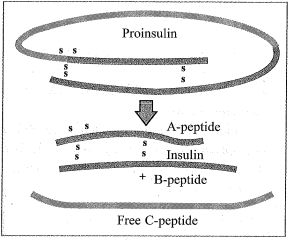
Image
→ Insulin consists of two short polypeptide chains: chain A and chain B.
→ Polypeptide Chain A contains 21 amino acids and chain B contains 30 amino acids that are linked together by disulphide bridges.
→ In mammals, including humans, insulin is synthesised as a pro-hormone (like a pro-enzyme, the pro-hormone also needs to be processed before it becomes a fully mature and functional hormone) which contains an extra stretch called the C peptide.
→ This C peptide is not present in the mature insulin and is removed during maturation into insulin.
→ The main challenge for production of insulin using rDNA techniques was getting insulin assembled into a mature form.
→ In 1983, Eli Lilly an American company prepared two DNA sequences corresponding to A and B, chains of human insulin and introduced them in plasmids of E. coli to produce insulin chains.
→ Chains A and B were produced separately, extracted and combined by creating disulfide bonds to form human insulin.
Need a full question paper?

Generate a complete, print-ready paper with questions like this in minutes — across 16+ boards, with answer keys.

Start Generating Free

Similar questions

Explain with diagram - Hershey and Chase experiment.###On the basis of experimental proof explain the diagram that DNA is genetic material.###How did Hershey and Chase differentiate between DNA and protein in their experiment while proving that DNA is the genetic material?
Explain: Acquired Immunity.
A regulatory body working under MoEF for the release of transgenic crop is ____________:
  1. NBPGR
  2. NSC
  3. NIPGR
  4. GEAC
Differentiate between following.
Read the following and answer any four questions from (i) to (v) given below:
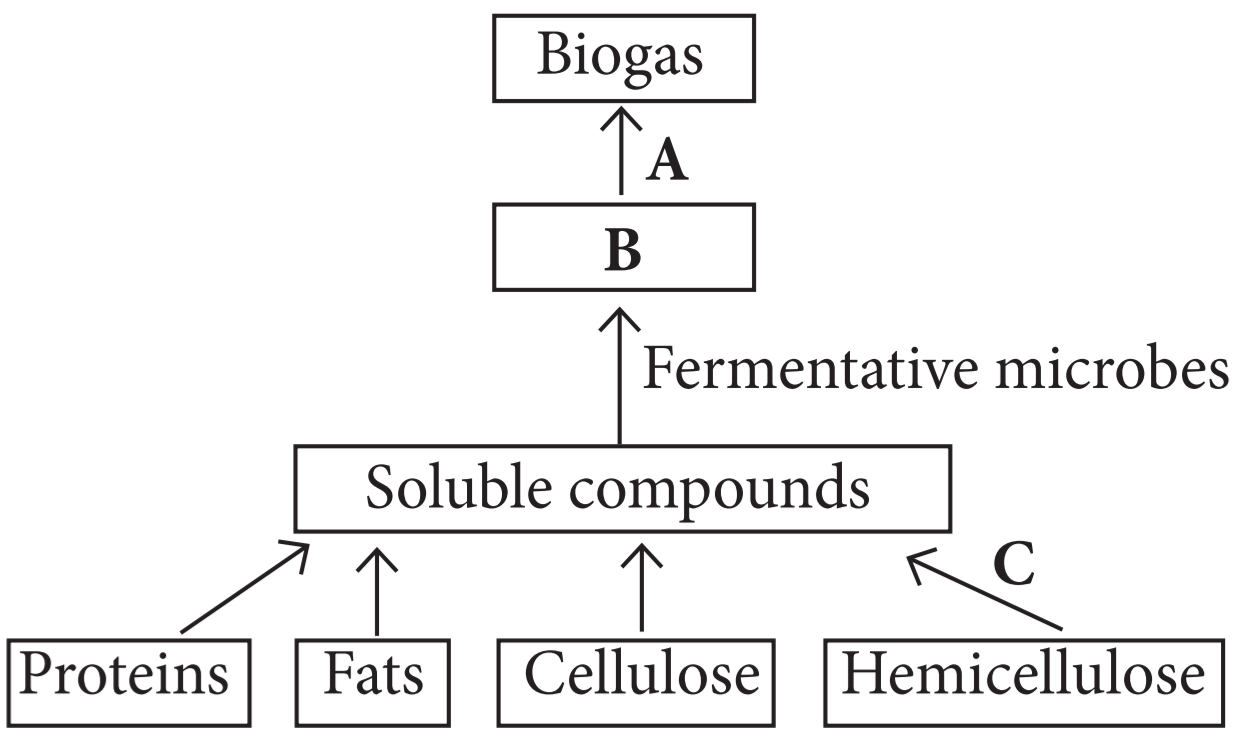
Villagers in a place near Chambur started planning to make power supply for agricultural purposes from cow dung. 'Tiley have started a biogas plant for the purpose. Study the flow chart for biogas production given below and answer the following questions.

  1. Biagas is composed of majorly:
  1. Methane, CO2 and O2
  2. CO2, H2S and H
  3. Methane, CO2
  4.  H2S, H and O2
  1. In the given flow chart, 'A' denotes:
  1. Aerobic bacteria.
  2. Methanogenic bacteria.
  3. Cellulose degrading bacteria.
  4. Yeast and protozoa.
  1. What is represented by 'B' in the flow chart?
  1. Carbohydrates.
  2. Protein polymers.
  3. Organic acids.
  4. Fat globules.
  1. 'C' in the given flow chart causes:
  1. Aerobic breakdown of complex organic compounds.
  2. Anaerobic digestion of complex organic compounds.
  3. Fermentation of organic compounds.
  4. Fermentation of monomers.
  1.  If 'A' is not added in the procedure.
  1. Methane will not be formed.
  2. CO2 will not be formed.
  3. Organic compounds will not be converted to H2S
  4. O2 will not be formed.
Read the following and answer any four questions from (i) to (v) given below:

ln many species of fig trees, there is a tight one-to-one relationship with the pollinator species of wasp. It means that a given fig species can be pollinated only by its 'partner' wasp species and no other species. The wasp pollinates the fig inflorescence while looking for suitable egg-laying sites. ln return for the favour of pollination, the fig offers the wasp some of its developing seeds as food for the developing wasp larvae.

  1. The interaction between fig trees and wasp is an example of:
  1. Mutualism
  2. Commensalism
  3. Amensalism
  4. Parasitism
  1. AD the given interactions are similar to interaction between fig trees and wasp, except.
  1. Plant and animal relation for pollination.
  2. Association of algae and fungi in lichens.
  3. Association of cattle egret and grazing cattle.
  4. Association of fungi and roots of higher plants in mycorrhiza.
  1. In which of the following interactions both partners are adversely affected?
  1. Parasitism
  2. Mutualism
  3. Competition
  4. Predation
  1. ln relationship between fig and wasp:
  1. One benefitted other harmed.
  2. Both are benefitted.
  3. One benefitted other unaffected.
  4. One inhibited, other unaffected.
  1. Assertion: Fig and wasp cannot complete their life cycle without each other.

Reason: They show mutualistic relationship.

  1. Both assertion and reason are true and reason is the correct explanation of assertion.
  2. Both assertion and reason are true but reason is not the correct explanation of assertion.
  3. Assertion is true but reason is false.
  4. Both assertion and reason are false.
Read the following and answer any four questions from (i) to (v) given below:
Disposal of untreated sewage into the river or freshwater pond causes huge water pollution. Four water samples from different sources (A, B, C, D) are collected and tested for BOD value in a lab to assess their quality. The BOD values are presented in the given table. Water samples are collected from primary effluent, secondary effluent, untreated sewage and river water. Study the given table and answer the following.
Sample BOD
A 20mg/ L
B 5mg/ L
C 300mg/ L
D 400mg/ L
  1. The source of sample 'C' is:
  1. River water.
  2. Primary effluent.
  3. Secondary effluent.
  4. Untreated sewage water.
  1. If sewage in untreated condition is disposed off in a freshwater body then.
  1. BOD and dissolved oxygen both will increase.
  2. BOD will increase and dissolved oxygen will decreas.
  3. BOD will decrease and dissolved oxygen will increase.
  4. BOD and dissolved oxygen both will decrease.
  1. A large number of pathogenic microbes can be present in water sample of:
  1. C
  2. A
  3. D
  4. Both (a) and (c).
  1. High value of BOD in sample O is due to:
  1. High amount of organic wastes and aerobic microbes.
  2. High amount of inorganic wastes and anaerobic microbes.
  3. High amount of organic wastes and anaerobic microbes.
  4. High amount of inorganic wastes and aerobic microbes.
  1. River water is represented by the sample.
  1. A
  2. B
  3. C
  4. D
Read the following and answer any four questions from (i) to (v) given below:
In recombinant DNA technology, the fragments of DNA generated after cutting the DNA by restriction enzymes are separated according to their size or length by gel electrophoresis. Gel electrophoresis is performed in a gel matrix so that molecules of similar electric charges can be separated on the basis of size. Most commonly used matrix in gel electrophoresis is agarose. The fragments are separated under the influence of electric field. The separated DNA fragments can be seen only after staining the DNA with compound known as ethidium bromide (EtBr) followed by exposure to UV radiation as bright orange band.
  1. Gel electrophoresis is used for the separation of
  1. DNA only.
  2. DNA and RNA only.
  3. DNA and proteins only.
  4. DNA, RNA and proteins.
  1. Most commonly used matrix is _____ which is a ______ extracted from _______.
  1. (i) agarose (ii) polysaccharide (iii) sea weed
  2. (i) agarose (ii) protein (iii) sea weed
  3. (i) EtBr (ii) polysaccharide (iii) sea weed
  4. (i) EtBr (ii) protein (iii) bacteria
  1. A DNA molecule was treated with a restriction endonuclease and three fragments of size (i) 426kb, (ii) 129kb and (iii) 46kb were obtained. Identify the order in which these bands will arrange themselves in the gel plate after gel electrophoresis is completed. (Assuming that negative part of electrode is towards the well)
  1. (iii) → (ii) → (i)
  2. (i) → (ii) → (iii)
  3. (i) → (iii) → (ii)
  4. (iii) → (i) → (ii)
  1. Which of the following statements regarding gel electrophoresis is incorrect?
  1. Separated DNA fragments can be seen only after staining DNA with EtBr.
  2. DNA fragments are separated according to their size.
  3. Under the influence of electric field, positively charged molecules move towards the anode and negatively charged molecules move towards the cathode.
  4. None of these.
  1. The factor that will not affect the rate of DNA migration in gel electrophoresis is:
  1. Size of DNA molecule.
  2. Concentration of DNA.
  3. Voltage supplied.
  4. Concentration of the gel.
Write a note Lac operon
What is transgenic animals? How it is useful for man kind?