Question
Explain nuclear energy.

Answer

Image

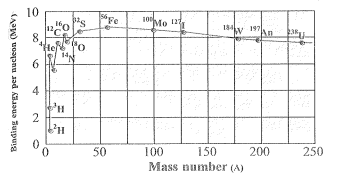
The curve of binding energy per nucleon versus mass number A is shown in figure.
The binding energy per nucleon is nearly constant ( 8 MeV ) in the region between $A =30$ to $A =170$.
For the lighter nuclei region $A <30$ and for the heavier nuclei region $A >170$ the binding energy per nucleon is less than 8.0 MeV .
If nuclei with less total binding energy transform to nuclei with greater binding energy there will be a net energy release.
"When a heavy nucleus decays into two or more intermediate mass fragments, then the total binding energy increases. Energy is released during this process. This process is called nuclear fission".
→"When two or more light nucleus fuse into heavier nucleus then also the total binding energy increases. Due to this energy is realeased during this process. This process is called nuclear fusion".
Exothermic chemical reactions underlie conventional energy sources such as coal or petroleum. Here the energies involved are in the range of electron volts. On the other hand, in a nuclear reaction, the energy release is of the order of MeV .
Thus for the same quantity of matter, nuclear sources produce a million $\left(10^6\right)$ times more energy than a chemical source.
For example :
Fission of 1 kg of uranium generates $10^{14} J$ of energy compare it with burning of 1 kg of coal that give $10^7 J$.

Need a full question paper?

Generate a complete, print-ready paper with questions like this in minutes — across 16+ boards, with answer keys.
Start Generating Free

Similar questions

If work function of caesium metal is 2.14 eV , then calculate its threshold frequency.
Let $\overrightarrow{\text{A}}=5\vec{\text{i}}-4\vec{\text{j}}$ and $\overrightarrow{\text{B}}=-7.5\vec{\text{i}}+6\vec{\text{j}}.$
  1. Do we have $\overrightarrow{\text{B}}\text{k}\vec{\text{A}}?$
  2. Can we say $\frac{\overrightarrow{\text{B}}}{\overrightarrow{\text{A}}}=\text{k}?$
Explain : Electrostatic shielding.
Find the intensity at a point on a screen in Young’s double slit experiment where the interfering waves have a path difference of (i) $\lambda/6$, and (ii) $\lambda/2.$
Two transparent slabs having equal thickness but different refractive indices $\mu_1$ and $\mu_2$ are pasted side by side to form a composite slab. This slab is placed just after the double slit in a Young's experiment so that the light from one slit goes through one material and the light from the other slit goes through the other material. What should be the minimum thickness of the slab so that there is a minimum at the point P0 which is equidistant from the slits?
Answer the following question:
The energy and momentum of an electron are related to the frequency and wavelength of the associated matter wave by the relations:
$\text{E}=\text{h v, p}=\frac{\text{h}}{\lambda}$
But while the value of λ is physically significant, the value of ν (and therefore, the value of the phase speed ν λ) has no physical significance. Why?
Two conducting spheres of radii R1 and R2 are kept widely separated from each other. What are their individual capacitances? If the spheres are connected by a metal wire, what will be the capacitance of the combination? Think in terms of series-parallel connections.
Write the history of magnet in brief.
i. Define the terms: impact parameter and distance of closest approach for an -particle in the GeigerMarsden scattering experiment.
ii. What will be the value of the impact parameter for scattering angle (I) $\theta=0^{\circ}$ and (II) $\theta=180^{\circ}$ ?
If the total mechanical energy of a particle is zero, is its linear momentum necessarily zero? Is it necessarily non-zero?