Question
Explain (or write a short note on) capacitors and capacitance.
Answer

Image
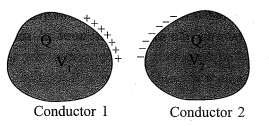
A system of two conductors separated by a dielectric medium, is called a capacitor.
As shown in fig., two isolated/ or separated) conductors have charges $+Q$ and $-Q$ and their potentials are $V_1$ and $V_2$ respectively, and p.d. between them is $V=V_1-V_2$.
These conductors can be charged by connecting them to a battery. Charge on any one of the two conductors is called the charge of capacitor.
Total (Net) charge of the capacitor is zero.
The electric field in the region between the conductors is proportional to charge Q . ( $E \propto Q$ )
The p.d. between two conductors means the work done per unit positive charge in taking a small test charge from the conductor 2 to conductor 1 against electric field. As the charge increases, potential also increases.
Consequently, $V \propto Q$
and therefore, the ratio $\frac{ Q }{ V }$ is constant.
$\therefore C =\frac{ Q }{ V }$
where constant C is called the capacitance of the capacitor.
C is independent of Q and V .
C depends on geometric configuration (shape, size, separation) of the system of two conductors, and on the dielectric constant of the material placed between two conductors.
SI unit of capacitance is F (farad) OR C/V $1 F=1 C$. $V ^1$
Its dimensional formula is $M ^{-1} L^{-2} T^4 A^2$
Smaller units used in day to day life :
$\begin{array}{l}
1 \mu F =10^{-6} F \quad 1 p F=10^{-12} F \\
1 n F=10^{-9} F
\end{array}$
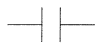
The circuit symbol of a capacitor with fixed capacitance is :

Image

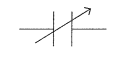
While the capacitor with variable capacitance is shown as

Image

Need a full question paper?

Generate a complete, print-ready paper with questions like this in minutes — across 16+ boards, with answer keys.
Start Generating Free

Similar questions

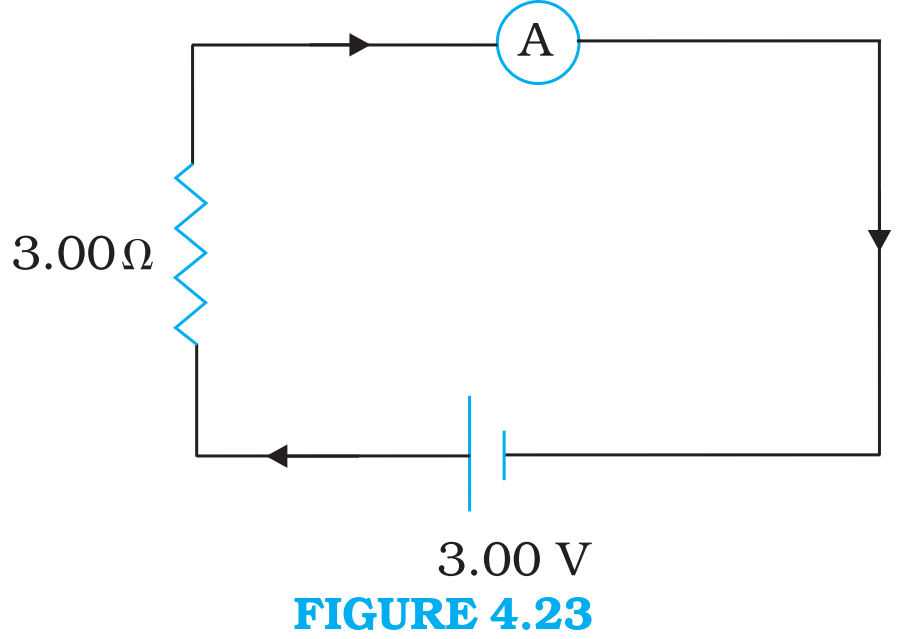
In the circuit (Fig. 4.23) the current is to be measured. What is the value of the current if the ammeter shown (a) is a galvanometer with a resistance $R_G=60.00 \Omega$; (b) is a galvanometer described in (a) but converted to an ammeter by a shunt resistance $r_s=0.02 \Omega$; (c) is an ideal ammeter with zero resistance?
Image
When an electron in hydrogen atom jumps from the third excited state to the ground state, how would the de Broglie wavelength associated with the electron change? Justify your answer.
Find the intensity at a point on a screen in Young’s double slit experiment where the interfering waves of equal intensity have a path difference of (i) $\lambda/4$, and (ii) $\lambda/3$.
Ultraviolet radiations of different frequencies ν1 and ν2, are incident on two photosensitive materials having work functions W1 and W2 (W1 > W2) respectively. The kinetic energy of the emitted photoelectrons is same in both the cases. Which one of the two relations will be of the higher frequency?
A charge Q is placed at the centre of a cube. Find the flux of the electric field through the six surfaces of the cube.
Find the dimensions of:

  1. The specific heat capacity c.
  2. The coefficient of linear expansion a.
  3. The gas constant R.
Some of the equations involving these quantities are

$\text{Q = mc(T}_2-\text{T}_1),\text{l}_{\text{t}}=\text{l}_0[1+\alpha(\text{T}_2-\text{T}_1)]$ and $\text{PV = nRT}.$
A spherical surface of radius 30cm separates two transparent media A and B with refractive indices 1.33 and 1.48 respectively. The medium A is on the convex side of the surface. Where should a point object be placed in medium A so that the paraxial rays become parallel after refraction at the surface?
Find the amount of silver liberated at cathode if 0.500A of current is passed through AgNO3 electrolyte for 1 hour. Atomic weight of silver a 107.9 g/mole.
Light of wavelength 560nm goes through a pinhole of diameter 0.20mm and falls on a wall at a distance of 2.00m. What will be the radius of the central bright spot formed on the wall?