Question
Explain population attributes.

Answer

→ A population has certain attributes whereas, an individual organism does not.
→ An individual may have births and deaths, but a population has birth rates and death rates.
→ In a population these rates refer to per capita births and deaths. The rates, hence, expressed are change in numbers (increase or decrease) with respect to members of the population
Birth rates : Refer to per capita births. E.g. In a pond, there are 20 lotus plants last year Through reproduction 8 new plants are added. Hence, the current population 28 The birth rate 8/20-0.4 offspring per lotus per year.
Death rates : Refer to per capita deaths.
E.g. 4 individuals in a laboratory population of 40 fruit flies died during a week. Hence, the death rate-4/40-0.1 individuals per fruit fly per week.
→ Sex ratio : A population has a sex ratio.
E.g. 60% of the population is females and 40% males
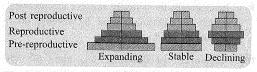
→ Age pyramid : It is the structure obtained when the age distribution (% individuals of a given age or age group) is plotted for the population.
→ For human population, age pyramids generally show age distribution of males and females in a combined diagram.
Image
Population size or population density (N) : It is the number of individuals of a species per unit area or volume.
→ E.g. population density of Siberian cranes at Bharatpur wetlands in any year is <10. It is millions for Chlamydomonas in a pond.
Growth status Expanding (growing) Representation of age pyramids for human population, population size is also measured in % cover or biomass.
→ E.g. In an area, 200 Parthenium plants and a huge banyan tree are seen. In such cases, measuring % cover or biomass is meaningful to show importance of banyan tree.
Total number is a difficult measure for a huge population. In such cases, relative population density (without knowing absolute population density) is used.
→ E.g. Number of fish caught per trap indicates its total population density in the lake.
→ In some cases, indirect estimation of population sizes is performed. E.g. Tiger census in national parks & tiger reserves based on pug marks & fecal pellets.
Need a full question paper?

Generate a complete, print-ready paper with questions like this in minutes — across 16+ boards, with answer keys.

Start Generating Free

Similar questions

Differentiate between Monohybrid & Dihybrid Cross.
Read the following and answer any four questions from (i) to (v) given below:

Oral administration of small doses of hormones is contraceptive method used by the females. They are used in the form of tablets and hence called the pills. The oral pills are two types; mini pills and combined pills.

  1. Mini pills contain:
  1. Estrogen only.
  2. Progestin only.
  3. Combination of progesterone-estrogen.
  4. Inhibin.
  1. How do hormonal pills prevent pregnancy?
  1. By phagocytosing the sperms.
  2. By inhibiting ovulation.
  3. By preventing sperms from entering the vagina.
  4. All of these.
  1. Pill containing non-steroidal preparation, centchroman is:
  1. Mala D.
  2. Mala N.
  3. I-Pill.
  4. Saheli.
  1. Which among the following is incorrect for oral contraceptives?
  1. Oral pills alter the uterine endometrium and make it unsuitable for implantation.
  2. Oral pills have to be taken daily for 7 days starting within first five days of menstrual cycle.
  3. Oral pills increase the risk of intravascular clotting.
  4. Oral pills contain either progestin alone or combination of progestogen and estrogen.
  1. Assertion: Mala D, a combined contraceptive pill, have to be taken daily without a break.

Reason: Mala D contains synthetic progesterone and estrogen.

  1. Both assertion and reason are true, and reason is the correct explanation of assertion.
  2. Both assertion and reason are true, but reason is not the correct explanation of assertion.
  3. Assertion is true, but reason is false.
  4. Both assertion and reason are false.
Write a short note on pollination by wind.
Read the following and answer any four questions from (i) to (v) given below:
DNA fingerprinting is a technique of determining nucleotide sequences of certain areas of DNA which are unique to each individual. Each person has a unique DNA fingerprint. Each fingerprint is the same for every cell, tissue and organ of a person. DNA fingerprinting is the basis of paternity testing in case of disputes.
  1. The technique developed to identify a person with the help of DNA restriction analysis is known as.
  1. DNA profiting
  2. DNA fingerprinting
  3. RFLP
  4. Both (a) and (b).
  1. For DNA fingerprinting, DNA is obtained from.
  1. Blood
  2. Hair root cells
  3. Semen
  4. All of these
  1. During DNA fingerprinting, the radioactive probes.
  1. Hybridise with DNA sample to form double stranded structure
  2. Egrade the DNA
  3. Create positive charge on DNA
  4. Cut the DNA sample at various sites.
  1. In India, DNA fingerprinting technique was developed by?
  1. Dr. Lalji Singh
  2. Alec Jeffreys
  3. Dr. Khorana
  4. None of these.
  1. Which of the following is true about DNA fingerprinting?
  1. VNTR is used as probe.
  2. DNA samples are loaded on agarose gel electrophoresis.
  3. It is based on identification of nucleotide sequence present on the DNA molecule.
  4. All of these
Read the following and answer any four questions from (i) to (v) given below:

Unlike animals, plants cannot runaway for their defence, therefore, they have evolved an astonishing variety of morphological and chemical defences against herbivores. Thorns are the most common morphological means of defence. Many plants produce and store chemicals that make the herbivore sick when they are eaten, inhibit feeding or digestion, disrupt its reproduction or even kill it. Some plants produce highly poisonous chemicals and that is why no cattle or goats browse on those plants. A wide variety of chemical substances that we extract from plants on a conunercial scale are produced by them actually as defence against grazers and browsers.

  1. Why you never see cattle or goats browsing on weed Calotropisl?
  1. It produces highly poisonous tannins.
  2. It produces quinine which is bitter in taste.
  3. It produces poisonous cardiac glycosides.
  4. It bears prickles.


  1. What could be the possible reason for invasive growth of the prickly pear cactus introduced in Australia?
  1. Absence of predators.
  2. New mycorrhizal association.
  3. Abundant water availability.
  4. All of these.
  1. Which of the following is most likely to sick by consuming chemicals produced by plants?
  1. Frog
  2. Goat
  3. Human
  4. Pigeon
  1. Plant evolve variety of morphological and chemical defences against.
  1. Prey
  2. Predator
  3. Commenal
  4. Mutualist
  1. Assertion: Some plant functions as predator in nature.

Reason: Phytoph ago us insects feed on plant sap.

  1. Both assertion and reason are true and reason is the correct explanation of assertion.
  2. Both assertion and reason are true but reason is not the correct explanation of assertion.
  3. Assertion is true but reason is false.
  4. Both assertion and reason are false.
Explain Methodology of HGP
Define ecological pyramids and describe with examples, pyramids of number and biomass.
Read the following text carefully and answer the questions that follow:
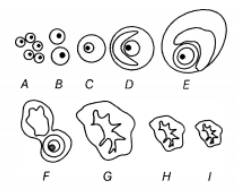
The following is the illustration of the sequence of ovarian events (A-I) in a humans female.
Image
i. Identify the figure that illustrates ovulation and mention the stage of oogenesis it represents. (1)
ii. Name the ovarian hormone and the pituitary hormone that have caused the above mentioned event. (1)
iii. Explain the changes that occur in the uterus simultaneously in anticipation. (2)
OR
Write the differences between C and H. (2)
Read the following and answer any four questions from S(i) to S(v) given below:

Rajat is a student of biotechnology. His professor tells him that for transformation with recombinant DNA the bacterial cells must be made capable of taking up DNA as DNA do not pass through membrane. While doing experiment in the lab, Rajat noticed that bacterial cells were not taking up the foreign DNA even after treating it with sodium ion. He asked his professor, the reason behind this. His professor explained that he should check the valency and charge of the ion that he is using for the treatment.

  1. It is difficult for DNA to pass through the membrane as
  1. It is a hydrophilic molecule.
  2. It is a hydrophobic molecule.
  3. It is a circular molecule.
  4. It changes its shape when it comes in contact with host cell.
  1. What type of ions are used for DNA mediated gene transfers?
  1. Divalent anions.
  2. Divalent cations.
  3. Monovalent cations.
  4. Monovalent anions.
  1. rDNA stands for,
  1. reduced DNA
  2. red DNA
  3. recombinant DNA
  4. related DNA.
  1. Which of the following statements with regard to DNA is correct?
  1. DNA is a positively charged molecule having two polynucleotide chains.
  2. Nitrogen bases of two polynucleotide chain form complementary pairs, i.e., A opposite G and T opposite C.
  3. Backbone of DNA chain is built up of alternate deoxyribose sugar and phosphate group.
  4. Both (a) and (c)
  1. Assertion: Competent host is essential for transformation with rDNA.

Reason: Transfer of DNA in a prokaryotic cell is called transfection.

  1. Both assertion and reason are true and reason is the correct explanation of assertion.
  2. Both assertion and reason are true but reason is not the correct explanation of assertion.
  3. Assertion is true but reason is false.
  4. Both assertion and reason are false.
Read the following and answer any four questions front (i) to (v) given below:
Gene regulation is the mechanism of switching off and switching on of the genes depending upon the requirement of cells and the state of development. Gene regulation is of two types : negative and positive. In negative generegulation the genes continue expressing their effect till their activity is suppressed. Positive gene regulation is the one in which the genes remain non-expressed unless and until they are induced to do it. Operon model is a co-ordinated group of genes such as structural gene, operator gene, promoter gene, regulator gene which function together and regulate a metabolic pathway as a unit, e.g., lac operon, trp operon, ara operon, etc.
  1. Regulation of gene expression occurs at the level of.
  1. Transcription
  2. Processing/splicing
  3. Translation
  4. All of these.
  1. Inducible operon system usually occurs in A pathways. Nutrient molecules serve as B to stimulate production of the enzymes necessary for their breakdown. Genes for inducible operon are usually switched C and the repressor is synthesised in an D form.
S.no
A
B
C
D
(a)
anabolic
corepressor
on
inactive
(b)
anabolic
inducer
off
active
(c)
catabolic
inducer
off
active
(d)
catabolic
corepressor
on
inactive
  1. An mRNA molecule transcribed from the lac operon contains nucleotide sequences complementary to.
  1. Structural genes coding for the enzymes.
  2. the operator region
  3. the promotor region
  4. the repressor gene.
  1. Which statement correctly describes the control of transcription of the genes involved in the breakdown of lactose in Estherichia coli?
  1. A repressor protein binds to the operator and the genes are switched on.
  2. A repressor protein binds to the operator and the genes are switched off.
  3. A transcription factor binds to the promoter and the genes are switched on.
  4. A transcription factor binds to the promoter and the genes are switched off.
  1. Function of catabolic activator protein in lac operon is.
  1. To form mRNA
  2. Help to bind RNA polymerase
  3. Code for repressor
  4. To activates lac gene when glucose is absent.