Question
Explain the assumption related to quantization of angular momentum in Bohr's theory.###Explain quantum condition for orbital motion of electron in hydrogen atom.###Explain Bohr's second postulate of quantisation by de Broglie hypothesis.

Answer

Bohr's Second Postulate : Electron revolves only those orbits in which the angular momentum $( L =m v r)$ is multiple integer of $\frac{h}{2 \pi}$.
According to Bohr's this postulate, $L =\frac{n h}{2 \pi}$
or $\quad m v r=\frac{n h}{2 \pi} \quad$ Where $n$ is an integer whose values are $n=1,2,3, \ldots \ldots$ respectively.
$n$ is principal quantum number and this condition is called Bohr's quantum condition. Motion of electron is limited in possible orbits by this condition.
The stable orbits of different radii of electron can be obtained by given the different values to $n$.

Need a full question paper?

Generate a complete, print-ready paper with questions like this in minutes — across 16+ boards, with answer keys.
Start Generating Free

Similar questions

Explain how the electron was historically discovered.
The wavelength of a probe is roughly a measure of the size of a structure that it can probe in some detail. The quark structure of protons and neutrons appears at the minute length$-$scale of $10^{–15} m$ or less. This structure was first probed in early $1970’s$ using high energy electron beams produced by a linear accelerator at Stanford, $\text{USA.}$ Guess what might have been the order of energy of these electron beams. $($Rest mass energy of electron $= 0.511\ MeV.)$
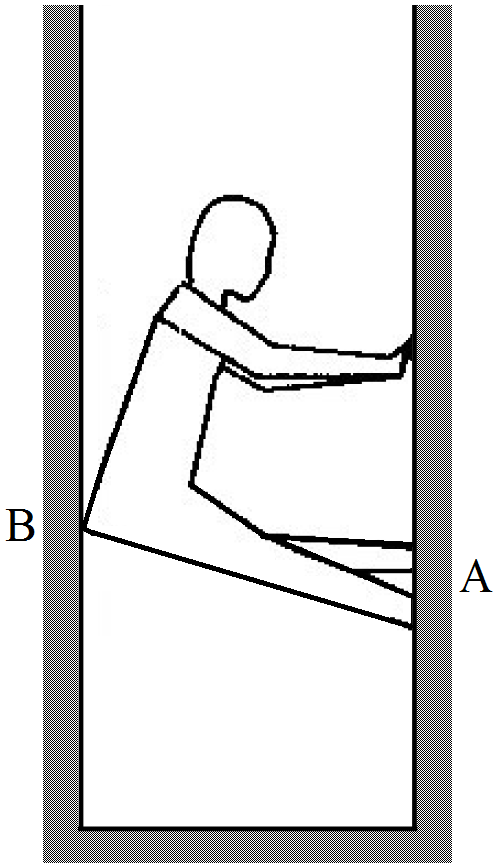
A person $(40\ kg)$ is managing to be at rest between two vertical walls by pressing one wall A by his hands and feet and the other wall B by his back. Assume that the friction coefficient between his body and the walls is $0.8$ and that limiting friction acts at all the contacts.
  1. Show that the person pushes the two walls with equal force.
  2. Find the normal force exerted by either wall on the person. Take $g = 10m/s^2.$
Answer the following questions: When viewing through a compound microscope, our eyes should be positioned not on the eyepiece but a short distance away from it for best viewing. Why? How much should be that short distance between the eye and eyepiece?
Give a circuit diagram of a common emitter amplifier using an n-p-n transistor. Draw the input and output waveforms of the signal. Write the expression for its voltage gain.
A beam of light consisting of two wavelengths $, 650 nm$ and $520 nm,$ are used to obtain interference fringes in a Young's double slit experiment.
$a$. Find the distance of the third bright fringe on the screen from the central maximum for wavelength $650 nm.$
$b$. What is the least distance from the central maximum where the bright fringes due to both the wavelengths coincide?
State the underlying principle of working of a moving coil galvanometer. Write two reasons why a galvanometer can not be used as such to measure current in a given circuit. Name any two factors on which the current sensitivity of a galvanometer depends.
Deuteron is a bound state of a neutron and a proton with a binding energy $B =2.2 MeV. A \gamma-$ ray of energy $E$ is aimed at a deuteron nucleus to try to break it into a $($neutron $+$ proton$)$ such that the $n$ and $p$ move in the direction of the incident $\gamma-$ ray. If $E = B$, show that this cannot happen. Hence calculate how much bigger than $B$ must $E$ be for such a process to happen.
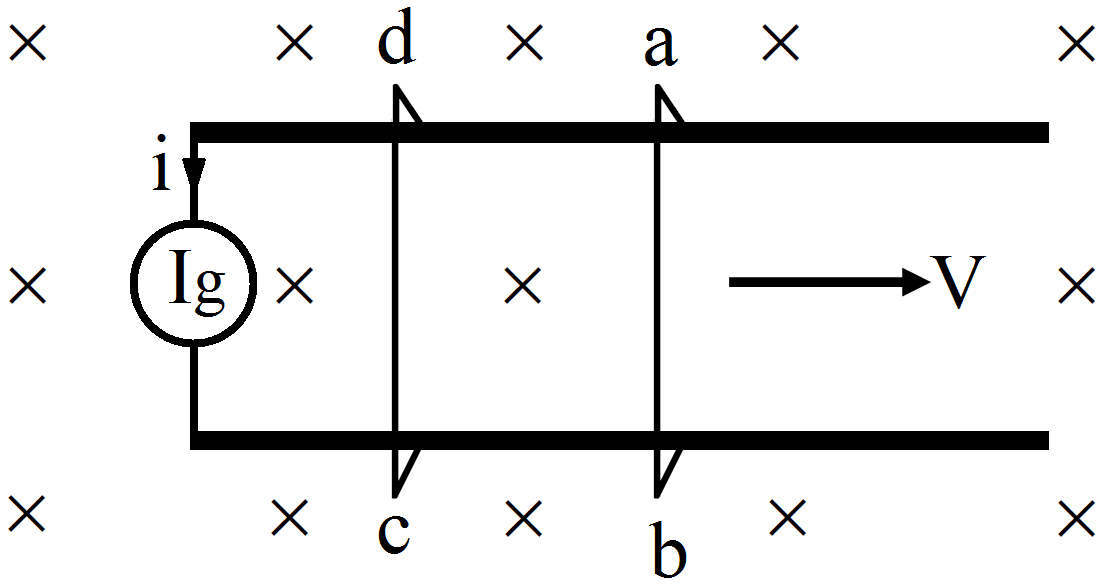
The current generator $I_g$ shown in figure, sends a constant current i through the circuit. The wire cd is fixed and ab is made to slide on the smooth, thick rails with a constant velocity $v$ towards right. Each of these wires has resistance r. Find the current through the wire cd.
State the limitations of ohm's law.