Question
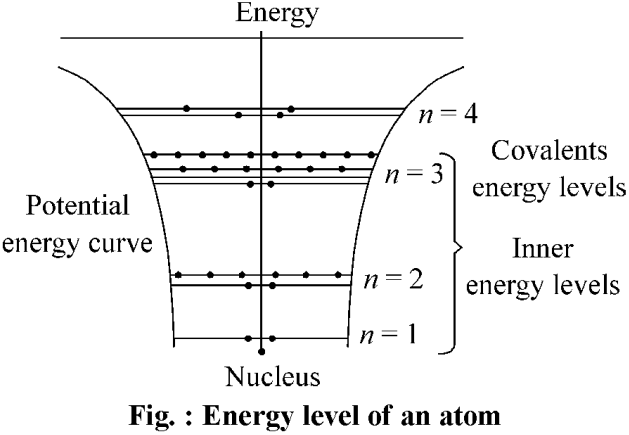
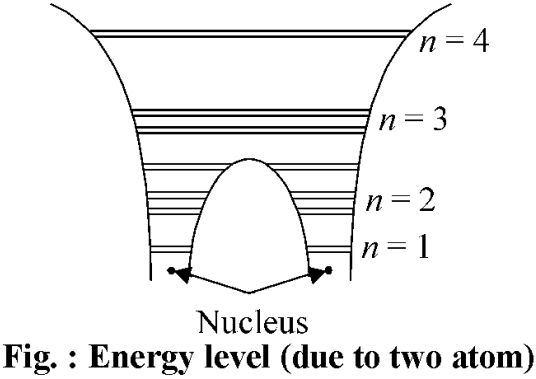
Explain the concept of energy bands with a figure.

Need a full question paper?

Generate a complete, print-ready paper with questions like this in minutes — across 16+ boards, with answer keys.
Start Generating Free

Similar questions

Derive an expression for equivalent capacitance of three capacitors when connected
i. in series and
ii. in parallel.
  1. State the working principle of a potentiometer. With the help of the circuit diagram, explain how a potentiometer is used to compare the emf’s of two primary cells. Obtain the required expression used for comparing the emfs.
  2. Write two possible causes for one sided deflection in a potentiometer experiment.
The plates of a capacitor are 2.00cm apart. An electronproton pair is released somewhere in the gap between the plates and it is found that the proton reaches the negative plate at the same time as the electron reaches the positive plate. At what distance from the negative plate was the pair released?
A 5mm high pin is placed at a distance of 15cm from a convex lens of focal length 10cm. A second lens of focal length 5cm is placed 40cm from the first lens and 55cm from the pin. Find
  1. The position of the final image.
  2. Its nature.
  3. Its size.
A glass vessel measures exactly $10 \mathrm{~cm} \times 10 \mathrm{~cm} \times 10 \mathrm{~cm}$ at $0^{\circ} \mathrm{C}$. It is filled completely with mercury at this temperature. When the temperature is raised to $10^{\circ} \mathrm{C}, 1.6 \mathrm{~cm}^3$ of mercury overflows. Calculate the coefficient of volume expansion of mercury. Coefficient of linear expansion of glass $=6.5 \times 10^{-6}{ }^{\circ} \mathrm{C}$.
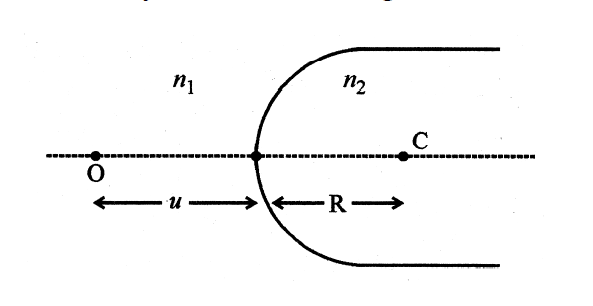
A point object 'O' is kept in a medium of refractive index $n_1$ in front of a convex spherical surface of radius of curvature R which separates the second medium of refractive index $n_2$ from the first one, as shown in the figure. Draw the ray diagram showing the image formation and deduce the relationship between the object distance and the image distance in terms of $n_1, n_2$ and R.
  1.  
  1. hen the image formed above acts as a virtual object for concave spherical, surface separating the medium $n_2$ from $n_1 (n_2> n_1),$ draw this ray diagram and write the similar (similar to (a) relation. Hence obtain the expression for the lens maker's formula.
Suppose the $19\Omega$ resistor of the previous problem is disconnected. Find the current through $P_2Q_2$ in the two situations:
  1. Both the wires move towards right.
  2. If $P_1Q_1$ moves towards left but $P_2Q_2$ moves towards right.
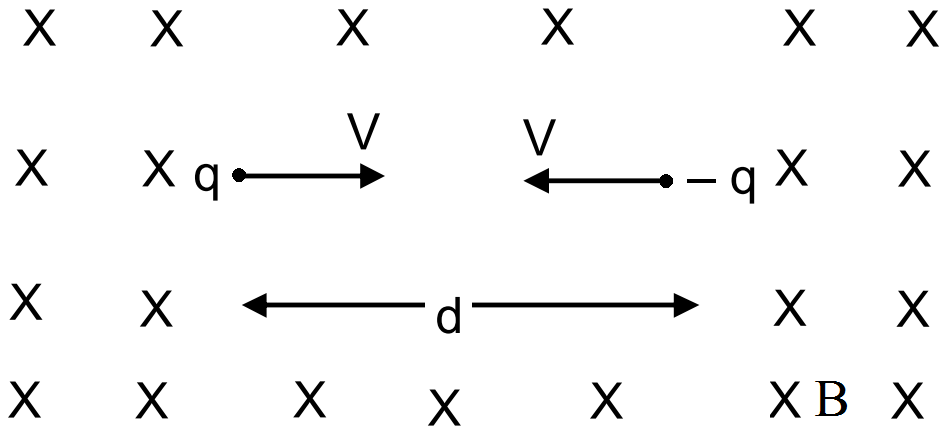
Two particles, each with mass m are placed at a separation d in a uniform magnetic field B, as shown in the figure. They have opposite charges of equal magnitude q. At time t = 0, the particles are projected towards each other, each with a speed v. Suppose the Coulomb force between the charges is switched off.
  1. Find the maximum value $v_m$ of the projection speed, so that the two particles do not collide.
  2. What would be the minimum and maximum separation between the particles if $\text{v}=\text{v}_{\text{m}}\sqrt{2}?$
  3. At what instant will a collision occur between the particles if $v = 2v_m?$
  4. Suppose $v = 2v_m$ and the collision between the particles is completely inelastic. Describe the motion after the collision.
Answer the following question:
The small ozone layer on top of the stratosphere is crucial for human survival. Why?
Three capacitors having capacitances $20\mu\text{F},\ 30\mu\text{F}$ and $40\mu\text{F}$ are connected in series with a 12V battery. Find the charge on each of the capacitors. How much work has been done by the battery in charging the capacitors?