Question
Explain the concept of potential energy.

Answer

self

Need a full question paper?

Generate a complete, print-ready paper with questions like this in minutes — across 16+ boards, with answer keys.

Start Generating Free

Similar questions

Consider the situation of the previous problem:
  1. Find the tension in the string in equilibrium.
  2. Suppose the ball is slightly pushed aside and released. Find the time period of the small oscillations.
The wavelength of sodium light in air is 589nm.
  1. Find its frequency in air.
  2. Find its wavelength in water (refractive index = 1.33).
  3. Find its frequency in water.
  4. Find its speed in water.
A tuning fork is in unison with a sonometer wire 73cm long. If 4 beats are heard on shortening the wire by 5mm, find the frequency of the fork.
A cylindrical log of wood of height $h$ and area of cross-section A floats in a liquid. It is pressed and then released. Show that the log would execute S.H.M. with a time period.
$
T=2 \pi \sqrt{\frac{m}{A \rho g}}
$
Where $m$ is mass of the body and $\rho$ is the density of the liquid.
An icecream vendor applies a 20kg wt of force at an angle 60° with the horizontal. If the displacement is 20m, estimate the work done.
Two bodies of masses m1 and m2 and specific heat capacities s1 and s2 are connected by a rod of length l, cross-sectional area A, thermal conductivity K and negligible heat capacity. The whole system is thermally insulated. At time t = 0, the temperature of the first body is T1 and the temperature of the second body is T2 (T2 > T1). Find the temperature difference between the two bodies at time t.
The motion of a particle executing simple harmonic motion is described by the displacement function,

$\text{x(t)}=\text{A}\cos(\omega\text{t}+\phi).$

If the initial (t = 0) position of the particle is 1cm and its initial velocity is $\omega\text{ cm/s,}$ what are its amplitude and initial phase angle? The angular frequency of the particle is $\pi\text{s}^{-1}.$ If instead of the cosine function, we choose the sine function to describe the SHM: $\text{x}=\text{B}\sin(\omega\text{t}+\alpha),$ what are the amplitude and initial phase of the particle with the above initial conditions.
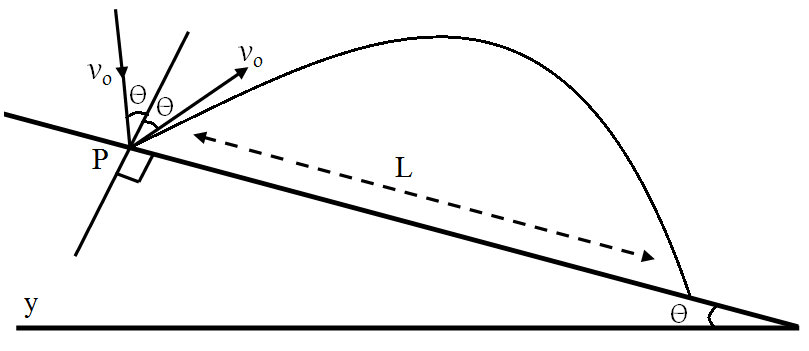
A particle falling vertically from a height hits a plane surface inclined to horizontal at an angle $\theta$ with speed $\text{v}_0$ and rebounds elastically. Find the distance along the plane where if will hit second time.

(Hint:

  1. After rebound, particle still has speed Vo to start.
  2. Work out angle particle speed has with horizontal after it rebounds.
  3. Rest is similar to if particle is projected up the incline.
Explain why.
There is no atmosphere on moon.
What do you understand by Poisson's ratio? Find the value of Poisson's ratio at which the volume of a wire does not change when the wire is subjected to a tension.