Question
Explain the different methods of preparing haloakanes from alcohols.

Answer

self

Need a full question paper?

Generate a complete, print-ready paper with questions like this in minutes — across 16+ boards, with answer keys.

Start Generating Free

Similar questions

Answer the following questions.
Comment on the specificity of enzyme action. What is the most important reason for their specificity?
Describe the differences in the properties of lanthanoids and actinoids.
  1. Complete the following chemical equations:
  1. $Cu + HNO_3 (dilute) →$
  2. $XeF_4 + O_2F_2 \rightarrow $
  1. Explain the following observations:
  1. Phosphorus has greater tendency for catenation than nitrogen.
  2. Oxygen is a gas but sulphur a solid.
  3. The halogens are coloured. Why?
Explain in detail the changing oxidation states of the elements of d group (transition elements) in the context of 3d series.
Match the items given in Column I and Column II.
 
Column I
 
Column II
i.
Saturated solution
a.
Solution having same osmotic pressure at a given temperature as that of given solution.
ii.
Binary solution
b.
A solution whose osmotic pressure is less than that of another.
iii.
Isotonic solution
c.
Solution with two components.
iv.
Hypotonic solution
d.
A solution which contains maximum amount of solute that can be dissolved in a given amount of solvent at a given temperature.
v.
Solid solution
e.
A solution whose osmotic pressure is more than that of another.
vi
Hypertonic solution
f.
A solution in solid phase.
Answer the following question:
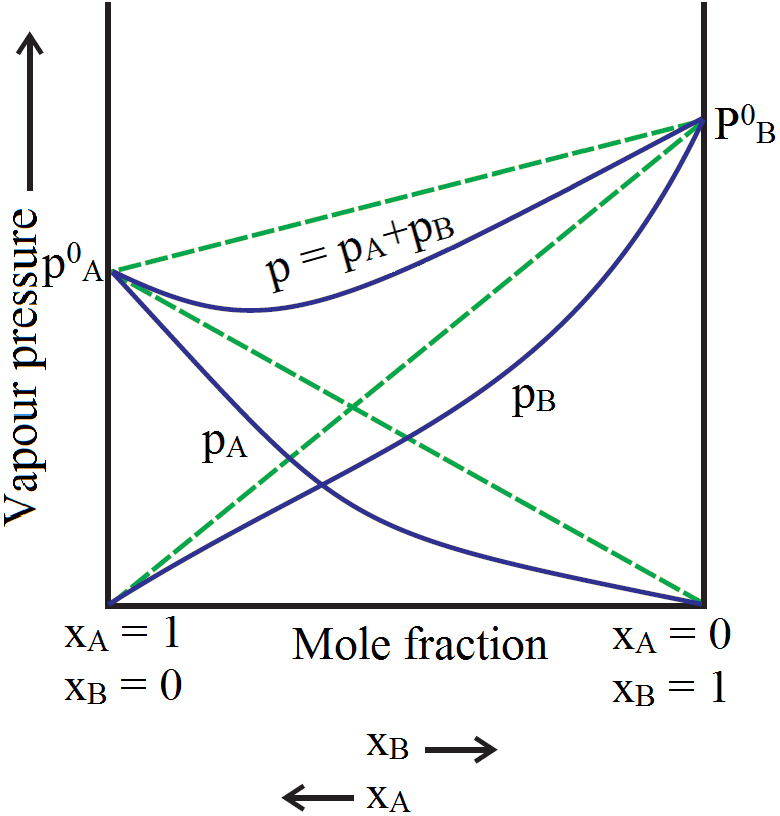
The graphical representation of vapour pressures of two component system as a function of composition is given alongside. By graphic inspection, answer the following questions:
  1. Are the A-B interactions weaker, stronger or of the same magnitude as A-A and B-B?
  2. Name the type of deviation shown by this system from Raoult’s law.
  3. Predict the sign of $\Delta_\text{mix}\text{H}$ for this system.
  4. Predict the sign of $\Delta_\text{mix}\text{H}$ for this system.
  5. Give an example of such a system.
  6. What type of azeotrope will this system form, if possible?

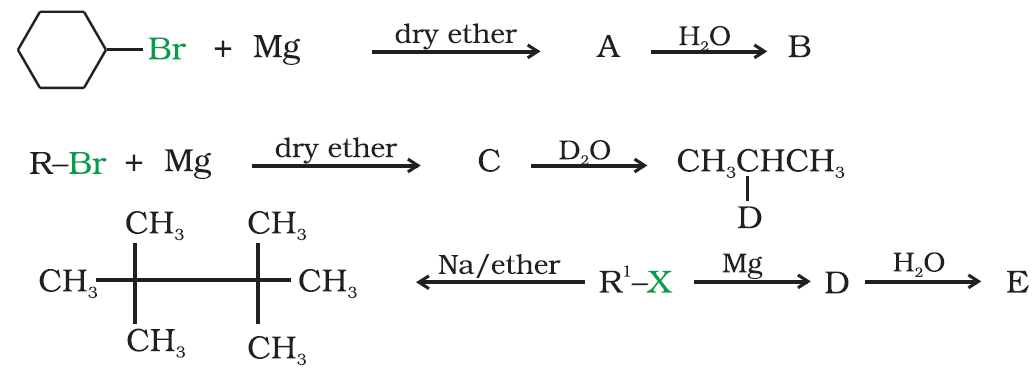
Identify A, B, C, D, E, R and $R^1$ in the following:
Match the coordination compounds given in Column I with the central metal atoms given in Column II and assign the correct code:
 
Column I (Coordination Compound)
 
Column II (Central metal atom)
a.
Chlorophyll
1.
Rhodium
b.
Blood pigment
2.
Cobalt
c.
Wilkinson catalyst
3.
Calcium
d.
Vitamin $B_{12}$
4.
Iron
 
 
5.
Magnesium
Code:
  1. A (5), B (4), C (1), D (2).
  2. A (3), B (4), C (5), D (1).
  3. A (4), B (3), C (2), D (1).
  4. A (3), B (4), C (1), D (2).
Match the items given in Column I with the type of solutions given in Column II.
 
Column I
 
Column II
i.
Soda water
a.
A solution of gas in solid.
ii.
Sugar solution
b.
A solution of gas in gas.
iii.
German silver
c.
A solution of solid in liquid.
iv.
Air
d.
A solution of solid in solid.
v.
Hydrogen gas in palladium
e.
A solution of gas in liquid.
 
 
f.
A solution of liquid in solid.
An element has a body-centred cubic bcc structure with a cell edge of $288\ pm$. The density of the element is $7.2g/ cm^3$​​​​​​​. How many atoms are present in $208\ g$ of the element?