Question
Explain the fact that why organic com pounds are Iarge in number.

Answer

Organic compounds are large in number due to the following unique properties of carbon atom:
a) Tetra covalency of carbon : Carbon has four alence shell electrons. Thus it always forms covalent bonds by sharing electrons with other atoms.
b) Catenation : it is the property of combining any number of carbon atoms to form straight chains, branched chains and rings of different sizes.
c) Formation of multiple bonds: due to small size carbon atom can form multiple bonds with not only carbon but with atoms of other elements like oxyzen, nitrogen etc.
d) isomerism : It forms large number of compounds due to isomerism by means of which compounds having same molecular formula can be have different structural formula.

Need a full question paper?

Generate a complete, print-ready paper with questions like this in minutes — across 16+ boards, with answer keys.

Start Generating Free

Similar questions

If the empirical formula of two compounds is CH and their Vapour densities are 13 to 39 respectively, find their molecular formula.
Differentiate between the terms strong electrolyte and weak electrolyte (stating any two differences)
Consider the following reaction and based on the reaction answer the questions that follow :
$\left( NH _4\right)_2 Cr _2 O _7 \xrightarrow{\text { heat }} N _2( g )+4 H _2 O ( g )+ Cr _2 O _3$
Calculate :
$(i)$ The quantity in moles of $(NH_4)_2Cr_2O_7$ if $63 \ gm$ of $(NH_4)_2Cr_2O_7$​​​​​​​ is heated.
$(ii)$ The quantity in moles of nitrogen formed.
$(iii)$ The volume in litres or $dm^3$​​​​​​​ of $N_2$​​​​​​​ evolved at $\text{STP}$.
$(iv)$ The mass in grams of $Cr_2O_3$​​​​​​​ formed at the same time
$[$Atomic masses $: H = 1, Cr=52, N=14]$
Explain the structure of Hydronium ion.
Give a chemical test to distinguish between Saturated and Unsaturated?
Which of the following methods, (a), (b), (c), (d) or (e) is generally used for preparing the chlorides listed below from (i) to (v). Answer by writing down the chloride and the letter pertaining to the corresponding method. Each letter is to be used only once.
(a) Action of an acid on a metal.
(b) Action of an acid on an oxide or carbonate.
(c) Direct combination.
(d) Neutralization of an alkali by an acid.
(e) Precipitation (double decomposition).
(i) copper(II) chloride.
(ii) iron(II) chloride.
(iii) iron(IIl) chloride.
(iv) lead (II) chloride.
(v) sodium chloride.
Explain hydronium ion. Write the ionization of sulphuric acid showing the formation of hydronium ion.
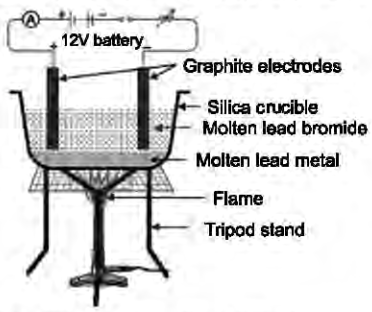
A diagram of the apparatus set up is given below for the electrolysis of fused lead bromide.
Image
(i) Write two properties of silica crucible used in the above apparatus.
(ii) Molten (fused) lead bromide is used as an electrolyte instead of solid lead bromide. Give reason.
(iii) Write the conditions required during the process.
(iv) Write the reactions taking place at the electrodes.
(v) Write the observations during the process.
How will you prove that Hydrochloric acid contains (i) Hydrogen (ii) Chlorine?
Write equations for the reactions. 
Describe an experiment to prove the following:
HCI is highly soluble in water.