Question
Give a chemical test to distinguish between Saturated and Unsaturated?

Answer

Chemical test to distinguish :
Saturated and Unsaturated
Chemical test:- Bromine water test, if unsaturated hydrocarbons are added to it then the solution turns colourless. The unsaturated hydrocarbon decolourise bromine water. Whereas no change takes place to the solution when saturated hydrocarbons are added to bromine water.
Physical test:- Distinction between saturated and unsaturated hydrocarbons: Saturated hydrocarbons burn in the air with clear (blue) flame, whereas burning of unsaturated hydrocarbons (alkenes and alkynes) gives sooty (yellowish) flame. Saturated hydrocarbons contain less percentage of carbon as compared to unsaturated hydrocarbons; therefore, they get completely oxidised by the oxygen present in the air on burning. Unsaturated hydrocarbons require a lot of oxygen for complete oxidation whose demand is not fulfilled by air. Due to this reason, unsaturated hydrocarbons burn with a sooty flame. The sooty flame contains partially burnt carbon in the form of soot.
Need a full question paper?

Generate a complete, print-ready paper with questions like this in minutes — across 16+ boards, with answer keys.

Start Generating Free

Similar questions

How will you bring about following conversions:
(a) Methane to methanol
(b) Ethane to ethanol (acetaldehyde)
(c) Methane to methanoic acid
Draw the structure of ammonia and give the reason for alkaline nature of aqueous ammonia.
Define or explain chain isomerism and position isomerism with examples in each case.
The questions (i) to (v) refer to the following salt solutions listed A to F :
A. Copper nitrate
B. Iron (II) sulphate

C. Iron (III) chloride
D. Lead nitrate
E. Magnesium sulphate
F. Zinc chloride
(i) Which two solutions will give a white precipitate when treated with dilute hydrochloric acid followed by barium chloride solution/
(ii) Which two solutions will give a white precipitate when treated with dilute nitric acid followed by silver nitrate solution?
(iii) Which solution will give a white precipitate when either dilute hydrochloric acid or dilute sulphuric acid is added to it?
(iv) Which solution becomes a deep/inky blue colour when excess of ammonium hydroxide is added to it?
(v) Which solution gives a white precipitate with excess ammonium hydroxide?
How an ore is concentrated by froth floatation process?
State your observation for the following electrolytic reaction
Aqueous copper sulphate is electrolysed between copper electrodes.
Explain the structure of Hydronium ion.
With reference to the electrolysis of acidulated water, answer the following :
a) why distilled water is a non- electrolyte?
b) What is the electrolytic cell called?
c) State what you would observe at the (i) Cathode (ii) Anode
d) Summarize the electrode reactions.
e) why is electrolysis of acidulated water considered as an example of catalysis?
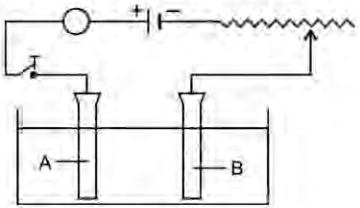
(a) Study the diagram given below and answer the questions that follow:
Image
(i) Give the names of the electrodes A and B.
(ii) Which electrode is the oxidizing electrode?
(b) A strip of copper is placed in four different colourless salt solutions. They are KNO3, AgNO3, Zn(NO3)2 Ca(NO3)2. which one of the solution will finally turn blue?
(c) Write the equation of the reactions which take place at the cathode and anode when acidified water is electrolysed.
Write the
(a) Molecular formula
(b) Electron dot formula and
(c) The structural formula of methane and ethane