Question
Explain the following terms with example: Covalent bond.

Answer

The chemical bond formed by sharing of two valence electrons between the two atoms is called covalent bond.
Example:
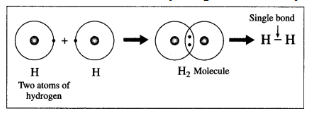
$1.$ Hydrogen molecule formation: The atomic number of hydrogen is $1,$ its atom contains 1 electron in K shell. It requires one more electron to complete the $K$ shell and attain the configuration of helium $(He). $ To meet this requirement two hydrogen atoms share their electrons with each other to form $H_2$ molecule. One covalent bond, i.e. a single bond is formed between two hydrogen atoms by sharing of two electrons.
Image
$2.$ Formation of oxygen molecule:
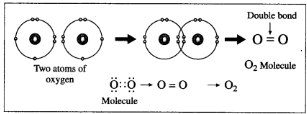
$(1)$ The atomic number of oxygen is $8.$ The electronic configuration of oxygen is $(2, 6)$. Oxygen has $6$ electrons in the outermost shell.
$(2)$ It requires $2$ electrons to complete the L shell and attain the configuration of neon $(Ne).$
$(3)$ Each oxygen atom shares its valence electron with the valence electron of another oxygen atom to give two shared pairs of electrons which results in the formation of oxygen molecule.
$(4)$ Thus, two electron pairs are shared between two oxygen atoms, forming double covalent bond $(=).$
Image

Need a full question paper?

Generate a complete, print-ready paper with questions like this in minutes — across 16+ boards, with answer keys.
Start Generating Free

Similar questions

Write short notes on: Magnetic separation method
Why is variation during reproduction beneficial to the species but not necessarily for the individual?
 An object thrown vertically upwards reaches a height of 500 m . What was its initial velocity? How long will the object take to come back to the earth? Assume $g =10 m / s ^2$
Explain the theory of evolution and mention the proof supporting it.
When a human female reaches a certain age then vaginal bleeding occurs for a few days after regular time intervals.
  1. What is this process known as (i) in scientific terms, and (ii) in everyday language?
  2. At what approximate age this process starts in human females? When is the human female said to have attained at this stage?
  3. After how much time is this process repeated? For how many days does this process usually last?
  4. What does the onset of this process in human females signify?
  5. At which particular event in the life of a human female does this process stop temporarily but start again?
  6. At which approximate age of human female does this process stop permanently?
Explain the froth floatation method with a neat labelled diagram.
Construct ray diagrams to illustrate the formation of a virtual image using:
  1. A converging lens, and.
  2. A diverging lens.
Write short notes: Functional group.
The white solid compound A decomposes quite rapidly on heating in the presence of a black substance X to form a solid compound B and a gas C. When an aqueous solution of compound B is reacted with silver nitrate solution, then a white precipitate of silver chloride is obtained along with potassium nitrate solution. Gas C does not burn itself but helps burn other things.
  1. What is compound A?
  2. What is compound B?
  3. What is gas C?
  4. What do you think is the black substance X? What is its function?
  5. What is the general name of substances like X?
What would be your role in environment management?