Question
Explain the following with the help of a diagram :
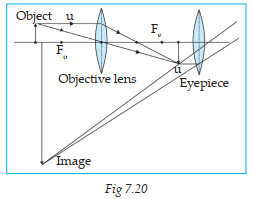
Compound microscope

Answer


(i) A compound microscope is made of two convex lenses objective and eye piece.
(ii) The axes of both lenses are along the same line. The lenses are fitted inside a metallic tube in such a way that the distance between can be changed.
(iii) The objective has smaller cross-section and smaller focal length. The eye piece has bigger cross section, its focal length is also larger than that of the objective.
(iv) Higher magnification can be obtained by the combined effect of the two lenses.
(v) The magnífication occurs in two stages. The image formed by the first lens acts as the object for the second lens.

Need a full question paper?

Generate a complete, print-ready paper with questions like this in minutes — across 16+ boards, with answer keys.

Start Generating Free

Similar questions

What happens when a ray of light is incident normal to the interface between two media? Draw the corresponding neat and labelled diagram.
Anodes need to be replaced from time to time during the electrolysis of alumina.
Name the four main stakeholders in the management of forest resources.
The organisms A, B and C can obtain their food in three different ways. Organism A derives its food from the body of another living organism which is called its D, without killing it. The organism B takes in the solid food by the process of ingestion, digests a part of this food and throws out undigested food in the process called E. The organism C obtains its food from dead and decaying plants.
  1. What is the mode of nutrition of (i) organism A (ii) organism B, and (iii) organism C?
  2. What is the organism like D called?
  3. Name the process E.
  4. Give one example each of organisms like A, B and C.
  5. What is the general name of three modes of nutrition exhibited by organisms A, B and C?
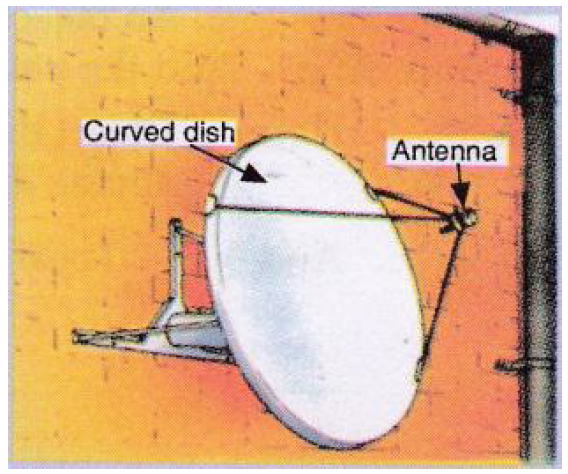
The diagram shows a dish antenna which is used to receive television signals from a satellite. The antenna (signal detector) is fixed in front of the curved dish.
  1. What is the purpose of the dish?
  2. Should it be concave or convex?
  3. Where should the antenna be positioned to receive the strongest possible signals?
  4. Explain what change you would expect in the signals if a larger dish was used.
Explain with diagram step-by-step energy conversion in Solar thermal power plant.
Explain various causes of environmental pollution?
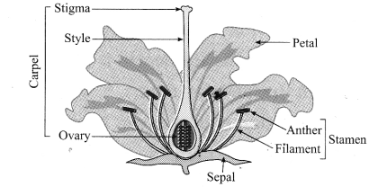
Describe the structure of a flower.
Image
. Read the paragraph and answer the questions given below:
Disasters can be properly classified into three categories, viz. natural disasters, technological disasters and man-made disasters. The forces that cause natural disasters cannot be controlled. Moreover, they are becoming more frequent in the current years due to phenomena of climate change. On and off incidences of cyclones, cloud bursting, floods, etc. am creating havoc in the lives of people. Technological disasters are due to improper and callous behaviour at the different processes carried out in technical establishments. Man-made disasters are conflicts arising due to different religions, regions and-terrorism.
1.What are three broad areas of disasters?
2.Which disasters cannot be controlled? Why?
3.Which type of disasters were very common in Western Maharashtra in recent times? Why?
4.Give any one example of technological disaster that shook the entire India.
5.Which types of disasters can be controlled in order to lead happy, peaceful and secured life? How?
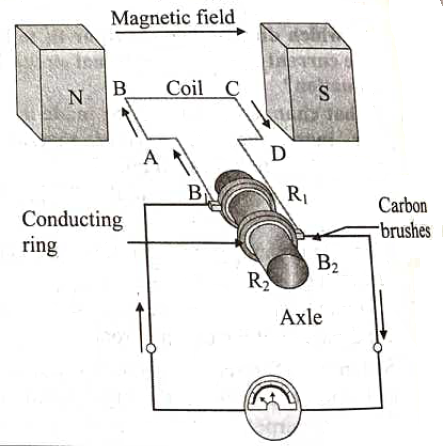
Observe the following diagram and answer the questions given below:

Image
i. Identify the above diagram.
ii. Write the principle on which the above appliance works.
iii. write the working of the above appliance.
iv. Write the use of the above appliance.