Question
Explain the forward bias characteristics of $p-n$ junction diode with necessary graph.
Answer

Image

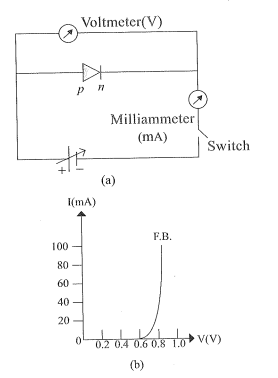
The circuit arrangement for studying the V-I characteristics of a diode, (i.e. Variation of current I as a function of applied voltage V ) is shown in fig. (a).
As shown in Fig., the battery is connected to the diode through a potentiometer (or rheostat) so that the applied voltage to the diode can be changed.
For different values of voltages, the value of current is noted. A graph between V and I is obtained as shown in fig. (b). For the forward bias, the current is of the order of $m A$.
As it is seen in the fig., in forward bias, the current first increases very slowly, almost negligibly till the voltage across the diode crosses a certain value.
After the characteristic voltage, the diode current increases significantly (exponentially) even for a very small increase in the diode bias voltage. This voltage is called the threshold voltage or cut-in voltage ( $\sim 0.2 V$ for germanium diode and $\sim 0.7 V$ for silicon diode).
For diodes, the ratio of small change in voltage $\Delta V$ to a small change in current $\Delta I$ is called dynamic resistance.
$r_d=\frac{\Delta V }{\Delta I }$
Its unit is ohm $(\Omega)$.
The resistance of the diode in forward bias mode is approximately between $10 \Omega$ to $100 \Omega$.

Need a full question paper?

Generate a complete, print-ready paper with questions like this in minutes — across 16+ boards, with answer keys.
Start Generating Free

Similar questions

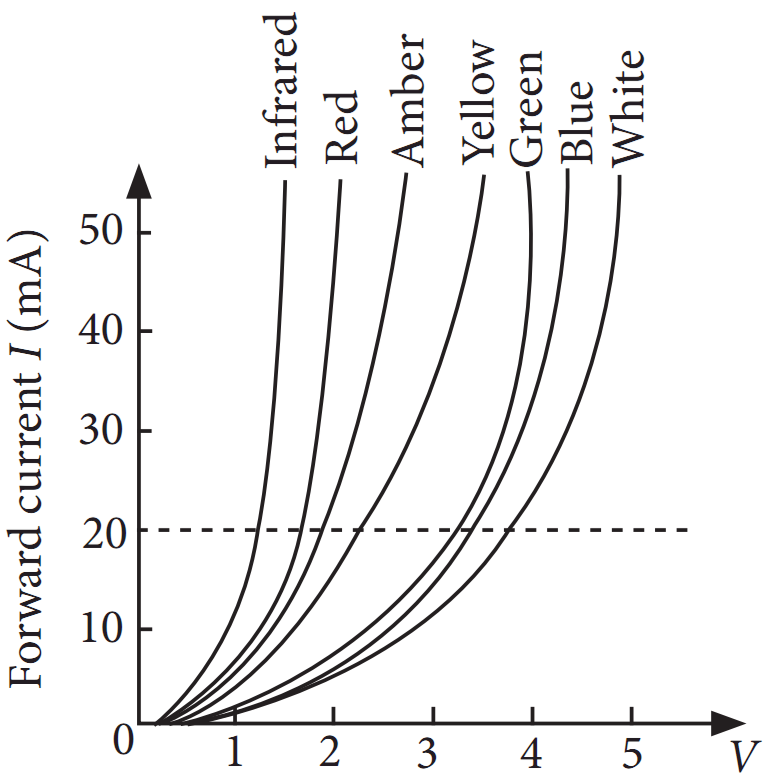
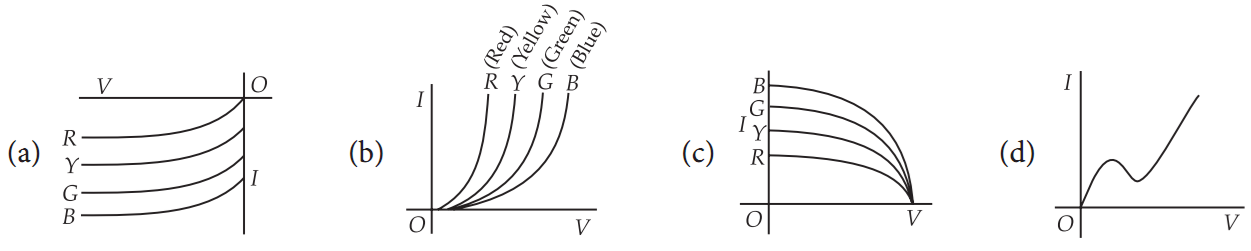
Light emitting diode is a photoelectric device which converts electrical energy into light energy. It is a heavily doped $p-n$ junction diode which under forward biased emits spontaneous radiation. The general shape of the $I-V$ characteristics of an $\text{LED}$ is similar to that of a normal $p-n$ junction diode, as shown. The barrier potentials are much higher and slightly different for each colour.
  1. The $I-V$ characteristic of an $\text{LED}$ is:
  1. The schematic symbol of light emitting diode is $\text{(LED)}.$
  1. An $\text{LED}$ is constructed from a p-n junction based on a certain $Ga-$ As $-P$ semiconducting material whose energy gap is $1.9eV$. Identify the colour of the emitted light.
  1. Blue.
  2. Red.
  3. Violet.
  4. Green.
  1. Which one of the following statement is not correct in the case of light emitting diodes?
  1. It is a heavily doped $p-n$ junction.
  2. It emits light only when it is forward biased.
  3. It emits light only when it is reverse biased.
  4. The energy of the tight emitted is less than the energy gap of the semiconductor used.
  1. The energy of radiation emitted by $\text{LED}$ is:
  1. Greater than the band gap of the semiconductor used.
  2. Always less than the band gap of the semiconductor used.
  3. Always equal to the band gap of the semiconductor used.
  4. Equal to or less than the band gap of the semiconductor used.
(a) Two insulated charged copper spheres A and B have their centres separated by a distance of 50 cm. What is the mutual force of electrostatic repulsion if the charge on each is 6.5 x $10^{-7} C$ ? The radii of A and B are negligible compared to the distance of separation.
(b) What is the force of repulsion if each sphere is charged double the above amount, and the distance between them is halved?
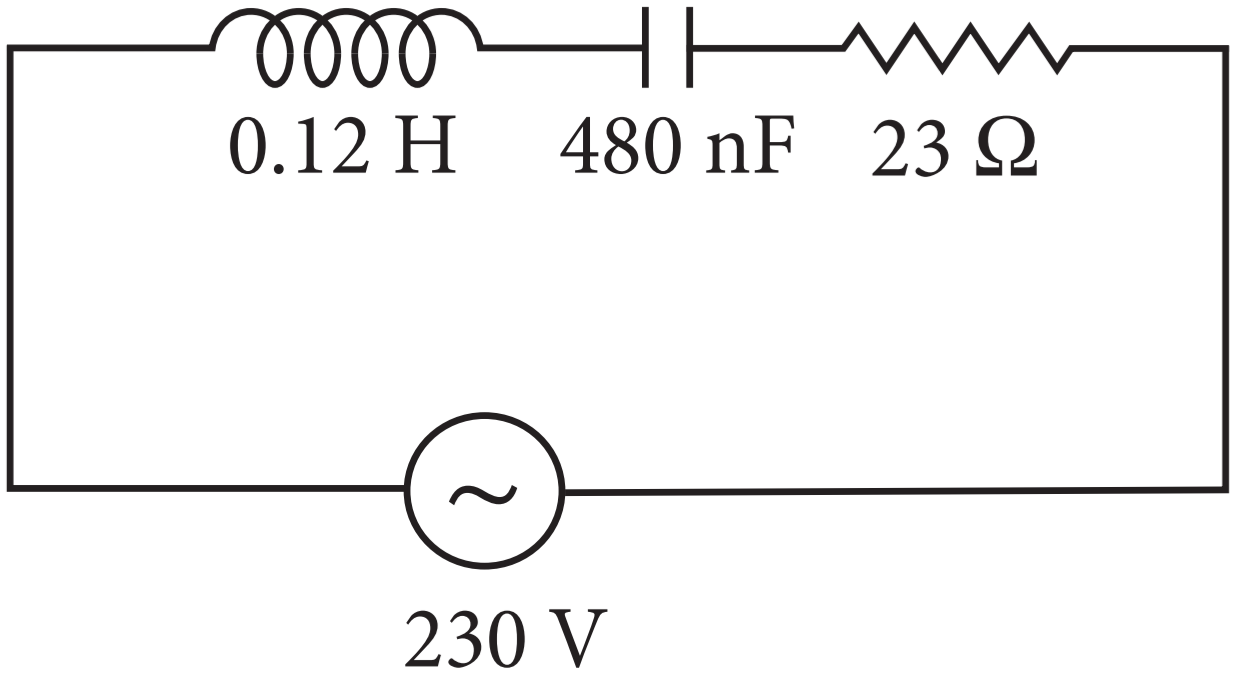
When the frequency of ac supply is such that the inductive reactance and capacitive reactance become equal, the impedance of the series $\text{LCR}$ circuit is equal to the ohmic resistance in the circuit. Such a series $\text{LCR}$ circuit is known as resonant series $\text{LCR}$ circuit and the frequency of the ac supply is known as resonant frequency. Resonance phenomenon is exhibited by a circuit only if both Land Care present in the circuit. We cannot have resonance in a $\text{RL}$ or $\text{RC}$ circuit.
A series $\text{LCR}$ circuit with $L = 0.12H, C = 480\ nF, \text{R} = 23\Omega$ is connected to a $230V$ variable frequency supply.
  1. Find the value of source frequency for which current amplitude is maximum.
  1. $222.32\ Hz$
  2. $550.52\ Hz$
  3. $663.48\ Hz$
  4. $770\ Hz$
  1. The value of maximum current is:
  1. $14.14A$
  2. $22.52A$
  3. $50.25A$
  4. $47.41A$
  1. The value of maximum power is:
  1. $2200W$
  2. $2299.3W$
  3. $5500W$
  4. $4700W$
  1. What is the $Q-$factor of the given circuit?
  1. $25$
  2. $42.21$
  3. $35.42$
  4. $21.74$
  1. At resonance which of the following physical quantity is maximum?
  1. Impedance
  2. Current
  3. Both $(a)$ and $(b)$
  4. Neither $(a)$ nor $(b)$
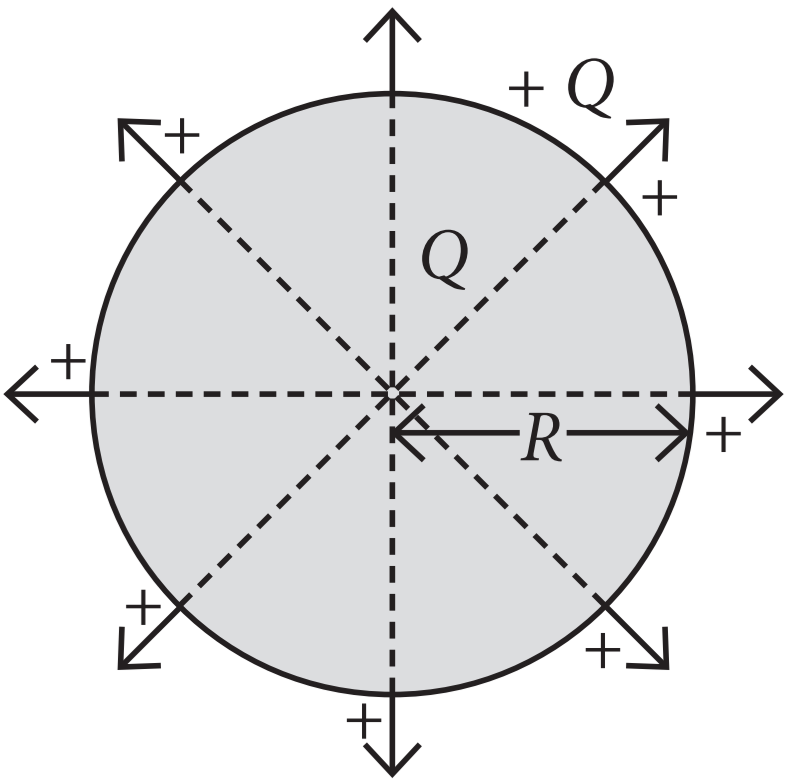
The electrical capacitance of a conductor is the measure of its ability to hold electric charge. An isolated spherical conductor of radius $R$. The charge $Q$ is uniformly distributed over its entire surface. It can be assumed to be concentrated at the centre of the sphere. The potential at any point on the surface of the spherical conductor will be $\text{V}=\frac{1}{4\pi\epsilon_0}\frac{\text{Q}}{\text{R}}.$
Capacitance of the spherical conductor situated in vacuum is $\text{C}=\frac{\text{Q}}{\text{V}}=\frac{\text{Q}}{\frac{1}{4\pi\epsilon_0}.\frac{\text{Q}}{\text{R}}}$ or $\text{C}=4\pi\epsilon_0\text{R}$ Clearly, the capacitance of a spherical conductor is proportional to its radius.
The radius of the spherical conductor of $1F$ capacitance is $\text{R}=\frac{1}{4\pi\epsilon_0}. C$ and this radius is about $1500$ times the radius of the earth $(\sim6\times10^3\text{km}).$
  1. If an isolated sphere has a capacitance $50pE$ Then radius is:
  1. $90\ cm$
  2. $45\ cm$
  3. $45m$
  4. $90m$
How much charge should be placed on a capacitance of $25 pF$ to raise its potential to $105V$?
  1. $1\mu\text{C}$
  2. $1.5\mu\text{C}$
  3. $2\mu\text{C}$
  4. $2.5\mu\text{C}$
Dimensions of capacitance is:
  1. $[M L^{-2} T^4 A^2]$
  2. $[M^{-1} L^{-1} T^3 A^1]$
  3. $[M^{- }L^{-2} T^4 A^2]$
  4. $[M^0 L^{-2} T^4 A^1]$
Metallic sphere of radius $R$ is charged to potential $V$. Then charge $q$ is proportional to:
  1. $V$
  2. $R$
  3. Both $V$ and $R$
  4. None of these
If $64$ identical spheres of charge $q $ and capacitance $C$ each are combined to form a large sphere. The charge and capacitance of the large sphere is:
  1. $64q, C$
  2. $16q, 4C$
  3. $64q, 4C$
  4. $16q, 64C$
What is the difference between Magnification and Magnifying power ?
A horizontal overhead power line carries a current of 90 A in east to west direction. What is the magnitude and direction of magnetic field due to the current 1.5 m in below the line?
A container contains water upto a height of 20cm and there is a point source at the centre of the bottom of the container. A rubber ring of radius r floats centrally on the water. The ceiling of the room is 2.0m above the water surface.
  1. Find the radius of the shadow of the ring formed on the ceiling if r = 15cm.
  2. Find the maximum value of r for which the shadow of the ring is formed on the ceiling. Refractive index of water $\frac{4}{3}.$
  1. A mobile phone lies along the principal axis of a concave mirror. Show, with the help of a suitable diagram, the formation of its image. Explain why magnification is not uniform.
  2. Suppose the lower half of the concave mirror's reflecting surface is covered with an opaque material. What effect this will have on the image of the object? Explain.
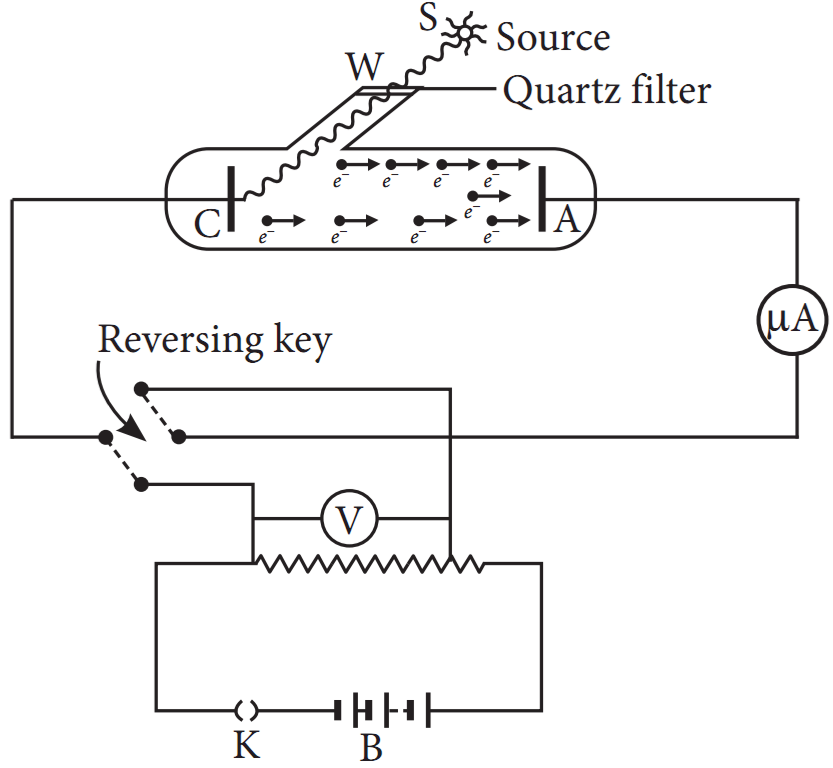
When a monochromatic radiations of suitable frequency obtained from source $S,$ after being filtered by a filter attached on the window $W,$ fall on the photosensitive place $C,$ the photo electrons are emitted from $C,$ which get accelerated towards the plate $A$ if it is kept at positive potential. These electrons flow in the outer circuit resulting in photoelectric current. Due to it, the microammeter shows a deflection. The reading of micrommeter measures the photoelectric current.

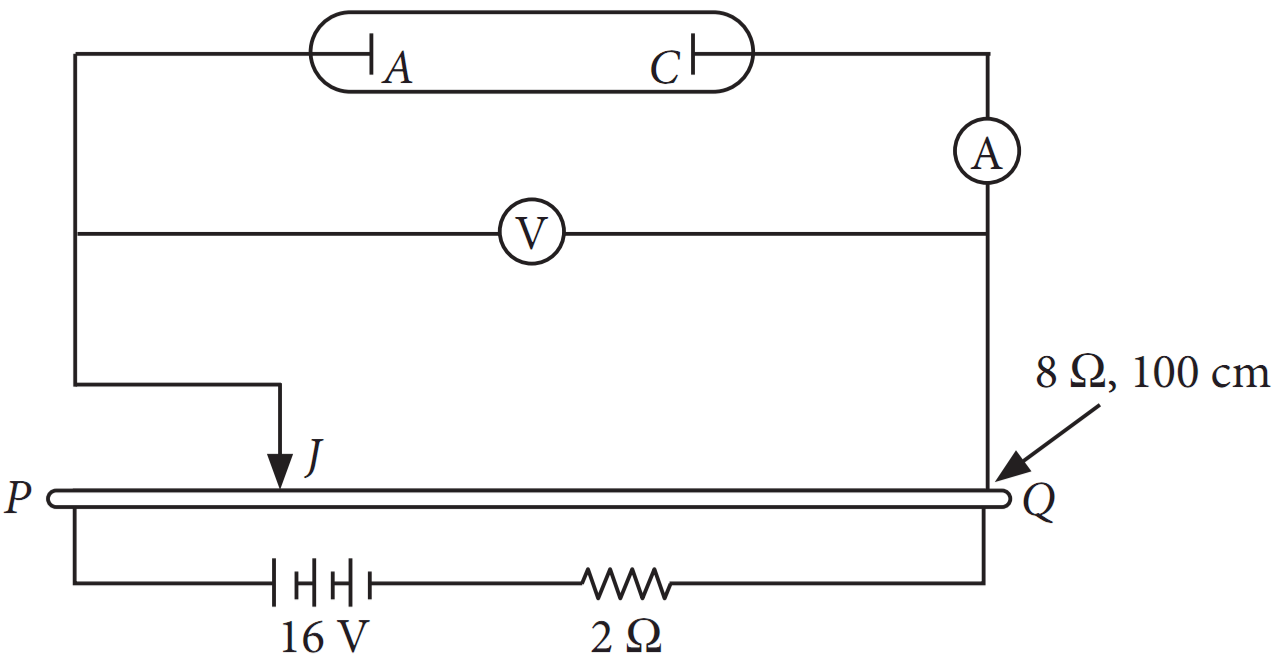
An experimental setup of verification of photoelectric effect is shown in figure. The voltage across the electrodes is measured with the help ofan ideal voltmeter, and which can be varied by moving jockey Jon the potentiometer wire. The battery used in potentiometer circuit is of $16 V$ and its internal resistance is $2\Omega$. The resistance of $100\ cm$ long potentiometer wire is $8\Omega$.

The photocurrent is measured with the help of an ideal ammeter. Two plates of potassium oxide of area $50\ cm^2$ at separation $0.5\ mm$ are used in the vacuum tube. Photocurrent in the circuit is very small, so we can treat the potentiometer circuit as an independent circuit.​​​​​​​
Light
$1$ Violet
$2$ Blue
$3$ Green
$4$ Yellow
$5$ Orange
$6$ Red
$\lambda(\text{in } \mathring{\text{A}})$
$4000-500$ $4500-5000$ $5000-5500$ $5500-6000$ $6000-6500$ $6500-7000$
  1. When radiation falls on the cathode plate, a current of $2\mu\text{A}$ is recorded in the ammeter. Assuming that the vacuum tube setup follows Ohm's law, the equivalent resistance of vacuum tube operating in the case when jockey is at end $P$ is:
  1. $8\times10^8\Omega$
  2. $16\times10^6\Omega$
  3. $8\times10^6\Omega$
  4. $10\times10^6\Omega$
  1. It is found that ammeter current remains unchanged $(2\mu\text{A})$ even when the jockey is moved from the end $P$ to the middle point of the potentiometer wire. Assuming that all the incident photons eject electrons and the power of the light incident is $4\times10^{-6}\Omega$. Then, the color of the incident light is:
  1. Green
  2. Violet
  3. Red
  4. Orange
  1. Which of the following colors may not give photoelectric effect for this cathode?
  1. Green
  2. Violet
  3. Red
  4. Orange
  1. When other light falls on the anode plate, the anuneter reading zero till jockey is moved from the end $P$ to the middle point of the wire $PQ$. Therefore, the deflection is recorded in the anuneter. The maximum kinetic energy of the emitted electron is:
  1. $16eV$
  2. $8eV$
  3. $4eV$
  4. $10eV$
  1. If the intensity of incident radiation is increased twice, the number of photoelectrons emitted per second will be:
  1. Halves
  2. Double
  3. Remain same
  4. Four times
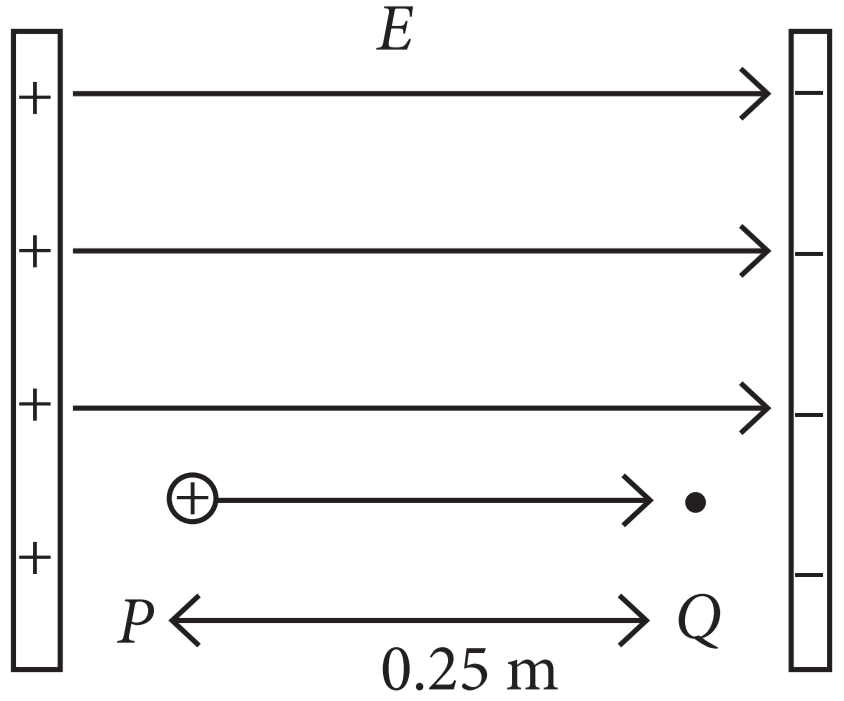
Potential difference $(\triangle\text{V})$ between two points $A$ and $B$ separated by a distance $x,$ in a uniform electric field $E$ is given by $\triangle\text{V}=-\text{Ex},$ where xis measured parallel to the field lines. If a charge $q_0$ moves from $P$ to $Q,$ the change in potential energy $(\triangle\text{U})$ is given as $\triangle\text{U}=-\text{q}_0\triangle\text{V}.$ A proton is released from rest in uniform electric field of magnitude $4.0 \times 10^8Vm^{-1}$ directed along the positive $X-$ axis. The proton undergoes a displacement of $0.25m$ in the direction of $E$. Mass of a proton $= 1.66 \times 10^{-27}kg$ and charge of proton $ = 1.6 \times 10^{-19}C$.
  1. The change in electric potential of the proton between the points $A$ and $B$ is:
  1. The potential energy of proton decreases.
  2. The potential energy of proton increases.
  3. The proton loses kinetic energy.
As the proton moves from $P$ to $Q,$ then:
  1. $-1.1J$
  2. $2J$
  3. $2.5J$
  4. $3J$
If a system consistsoftwocharges $4mC$ and $-3mC$ with no external field placed at $(-5\ cm, 0, 0)$ and $(5\ cm, 0, 0)$ respectively.The amount of work required to separate the two charges infinitely away from each other is:
  1. $1.56 \times 10^{-14}J$
  2. $5.5 \times 10^{-14}J$
  3. $2.56 \times 10^{-14}J$
  4. $4.56 \times 10^{-14}J$
The mutual electrostatic potential energy between two protons which are at a distance of $9 \times 10^{-15}m, in _{92}U^{235 }$ nucleus is:
  1. $1.6 \times 10^{11}J$
  2. $0.5 \times 10^{23}J$
  3. $-1.6 \times 10^{-11}J$
  4. $3.2 \times 10^{22}J$
The change in electric potential energy of the proton for displacement from $A$ to $B$ is:
  1. $-1 \times 10^8V$
  2. $1 \times 10^8V$
  3. $6.4 \times 10^{-19}V$
  4. $-6.4 \times 10^{-19}V$
Total energy of the proton increases.