Question
Potential difference $(\triangle\text{V})$ between two points $A$ and $B$ separated by a distance $x,$ in a uniform electric field $E$ is given by $\triangle\text{V}=-\text{Ex},$ where xis measured parallel to the field lines. If a charge $q_0$ moves from $P$ to $Q,$ the change in potential energy $(\triangle\text{U})$ is given as $\triangle\text{U}=-\text{q}_0\triangle\text{V}.$ A proton is released from rest in uniform electric field of magnitude $4.0 \times 10^8Vm^{-1}$ directed along the positive $X-$ axis. The proton undergoes a displacement of $0.25m$ in the direction of $E$. Mass of a proton $= 1.66 \times 10^{-27}kg$ and charge of proton $ = 1.6 \times 10^{-19}C$.
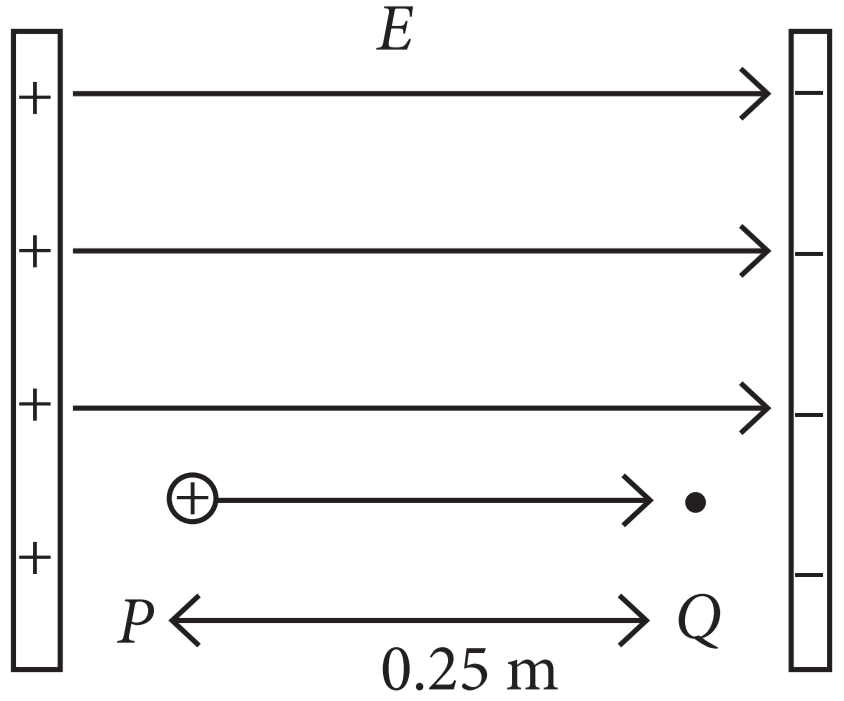
  1. The change in electric potential of the proton between the points $A$ and $B$ is:
  1. The potential energy of proton decreases.
  2. The potential energy of proton increases.
  3. The proton loses kinetic energy.
As the proton moves from $P$ to $Q,$ then:
  1. $-1.1J$
  2. $2J$
  3. $2.5J$
  4. $3J$
If a system consistsoftwocharges $4mC$ and $-3mC$ with no external field placed at $(-5\ cm, 0, 0)$ and $(5\ cm, 0, 0)$ respectively.The amount of work required to separate the two charges infinitely away from each other is:
  1. $1.56 \times 10^{-14}J$
  2. $5.5 \times 10^{-14}J$
  3. $2.56 \times 10^{-14}J$
  4. $4.56 \times 10^{-14}J$
The mutual electrostatic potential energy between two protons which are at a distance of $9 \times 10^{-15}m, in _{92}U^{235 }$ nucleus is:
  1. $1.6 \times 10^{11}J$
  2. $0.5 \times 10^{23}J$
  3. $-1.6 \times 10^{-11}J$
  4. $3.2 \times 10^{22}J$
The change in electric potential energy of the proton for displacement from $A$ to $B$ is:
  1. $-1 \times 10^8V$
  2. $1 \times 10^8V$
  3. $6.4 \times 10^{-19}V$
  4. $-6.4 \times 10^{-19}V$
Total energy of the proton increases.

Answer

  1.  $-1 \times 10^8V$
As $\triangle\text{V}=-\text{E}\triangle\text{x}=-(4.0\times10^8\frac{\text{V}}{\text{m}})(0.25\text{m})$
$=-10^8\text{V}.$
  1. $ -1.6 \times 10^{-11}J$
As $\triangle\text{U}=\text{q}_0\triangle\text{V}$
$=-(1.6\times10^{-19})\times(-1.0\times10^8\text{V})$
$=-1.6\times10^{-11}\text{V}.$
  1. $2.56 \times 10^{-14}J$
Here $, q_1 = q_2 = 1.6 \times 10^{-19}C, r = 9 \times 10^{-15}m$
$\text{U}=\frac{9\times10^9\times1.6\times10^{-19}\times1.6\times10^{-19}}{9\times10^{-15}}$
$=2.56\times10^{-14}\text{J}.$
  1.  $-1.1J$
Here, $\text{q}_1=4\mu\text{C},\text{ q}_2=3\mu\text{C}$
$r = 10\ cm = 0.1m$
Electrostatic potential energy,
$\text{U}=\frac{1}{4\pi\epsilon_0}\frac{\text{q}_1\text{q}_2}{\text{r}}$
$=9\times10^9\times\frac{4\times10^{-6}\times(-3)\times10^{-6}}{0.1}$
$= -1.1J$
  1.  The potential energy of proton decreases.
As proton moves in the direction of the electric field, then its potential energy decreases.

Need a full question paper?

Generate a complete, print-ready paper with questions like this in minutes — across 16+ boards, with answer keys.

Start Generating Free

Similar questions

Define eddy currents. How are they produced? In what sense are these currents undesirable in a transformer and how are these reduced in a device ?
In a chamber, a uniform magnetic field of 6.5 G (1 G = 10-4T ) is maintained. An electron is shot into the field with a speed of 4.8 X 10⁶ m s-1normal to the field. Explain why the path of the electron is a circle. Determine the radius of the circular orbit.
$\left( e =1.6 \times 10^{-19} C , m_e=9.1 \times 10^{-31} kg\right)$
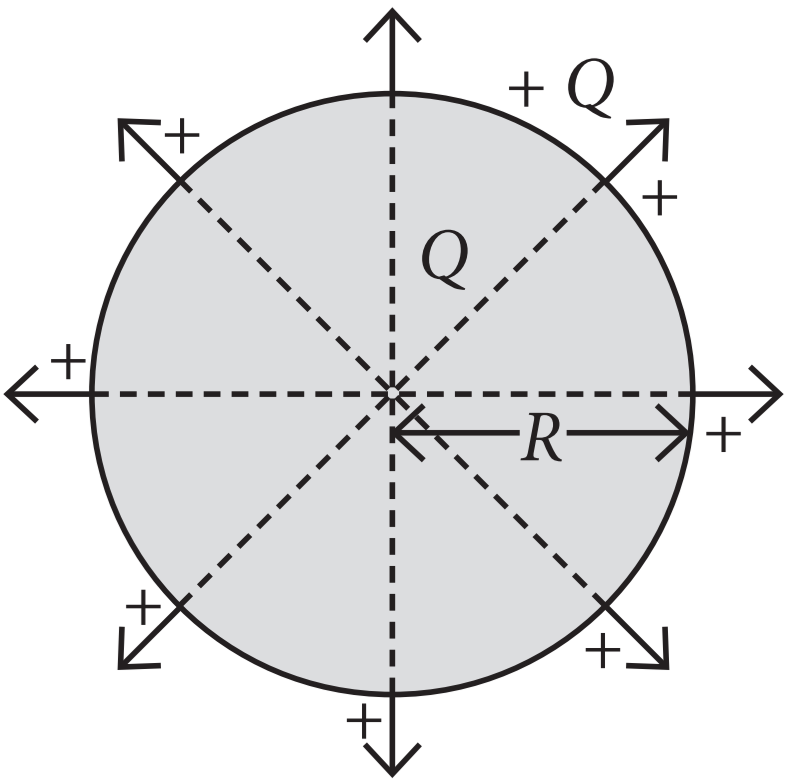
The electrical capacitance of a conductor is the measure of its ability to hold electric charge. An isolated spherical conductor of radius $R$. The charge $Q$ is uniformly distributed over its entire surface. It can be assumed to be concentrated at the centre of the sphere. The potential at any point on the surface of the spherical conductor will be $\text{V}=\frac{1}{4\pi\epsilon_0}\frac{\text{Q}}{\text{R}}.$
Capacitance of the spherical conductor situated in vacuum is $\text{C}=\frac{\text{Q}}{\text{V}}=\frac{\text{Q}}{\frac{1}{4\pi\epsilon_0}.\frac{\text{Q}}{\text{R}}}$ or $\text{C}=4\pi\epsilon_0\text{R}$ Clearly, the capacitance of a spherical conductor is proportional to its radius.
The radius of the spherical conductor of $1F$ capacitance is $\text{R}=\frac{1}{4\pi\epsilon_0}. C$ and this radius is about $1500$ times the radius of the earth $(\sim6\times10^3\text{km}).$
  1. If an isolated sphere has a capacitance $50pE$ Then radius is:
  1. $90\ cm$
  2. $45\ cm$
  3. $45m$
  4. $90m$
How much charge should be placed on a capacitance of $25 pF$ to raise its potential to $105V$?
  1. $1\mu\text{C}$
  2. $1.5\mu\text{C}$
  3. $2\mu\text{C}$
  4. $2.5\mu\text{C}$
Dimensions of capacitance is:
  1. $[M L^{-2} T^4 A^2]$
  2. $[M^{-1} L^{-1} T^3 A^1]$
  3. $[M^{- }L^{-2} T^4 A^2]$
  4. $[M^0 L^{-2} T^4 A^1]$
Metallic sphere of radius $R$ is charged to potential $V$. Then charge $q$ is proportional to:
  1. $V$
  2. $R$
  3. Both $V$ and $R$
  4. None of these
If $64$ identical spheres of charge $q $ and capacitance $C$ each are combined to form a large sphere. The charge and capacitance of the large sphere is:
  1. $64q, C$
  2. $16q, 4C$
  3. $64q, 4C$
  4. $16q, 64C$
The radio and TV programmes, telecast at the studio, reach our antenna by wave motion. Is it a mechanical wave or nonmechanical?
The half-life of $^{226}Ra$ is $1602y.$ Calculate the activity of $0.1g$ of $RaCl_2$ in which all the radium is in the form of $^{226}Ra.$ Taken atomic weight of $Ra$ to be $226\ g/mol^{-1}$ and that of $Cl$ to be $35.5\ g/mol^{-1}.$
Two friends $A$ and $B$ are standing a distance $x$ apart in an open field and wind is blowing from $A$ to $B$.
A beats a drum and $B$ hears the sound $t_1$ time after he sees the event. $A$ and $B$ interchange their positions and the experiment is repeated. This time $B$ hears the drum $t_2$ time after he sees the event. Calculate the velocity of sound in still air $v$ and the velocity of wind $u$. Neglect the time light takes in travelling between the friends.
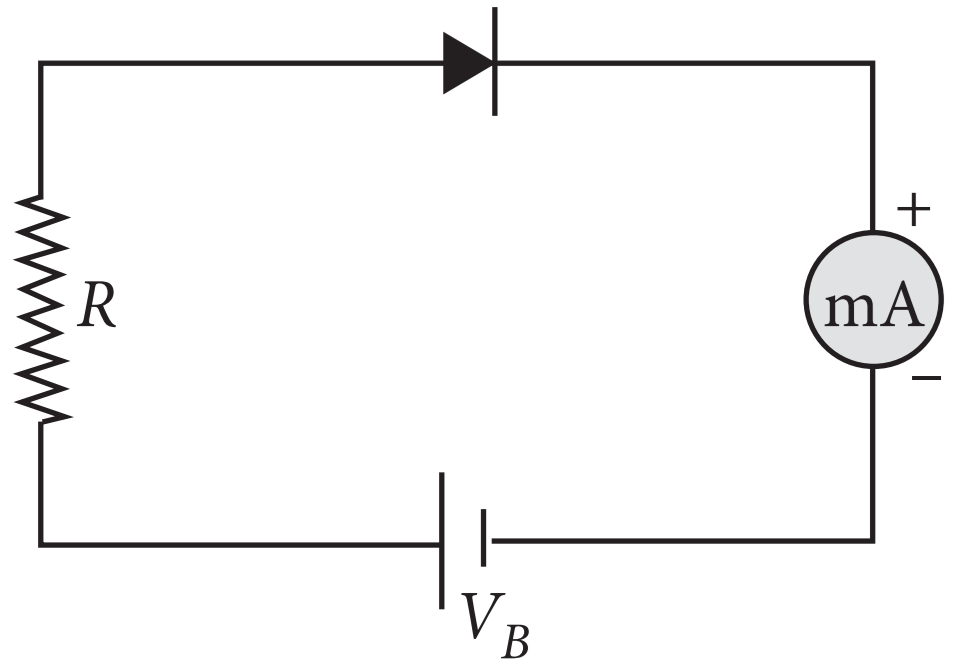
A silicon $p-n$ junction diode is connected to a resistor Rand a battery of voltage $V_B$ through milliammeter $(mA)$ as shown in figure. The knee voltage for this junction diode is $V_N = 0.7V$. The $p-n$ junction diode requires a minimum current of $1 mA$ to attain a value higher than the knee point on the $I-V$ characteristics of this junction diode. Assuming that the voltage Vacross the junction is independent of the current above the knee point. A $p-n$ junction is the basic building block of many semiconductordevices like diodes. Important process occurring during the formation of a $p-n$ junction are diffusion and drift. ln an $n-$type semiconductor concentration of electrons is more as compared to holes. ln a $p-$ type semiconductor concentration of holes is more as compared to electrons.
  1. If $V_{B }= 5V,$ the maximum value of $R$ so that the voltage $V$ is above the knee point voltage is:
  1. $40\text{k}\Omega$
  2. $4.3\text{k}\Omega$
  3. $5.0\text{k}\Omega$
  4. $5.7\text{k}\Omega$
  1. If $V_B = 5V,$ the value of $R$ in order to establish a current to $6mA$  in the circuit is:
  1. $833\Omega$
  2. $717\Omega$
  3. $950\Omega$
  4. $733\Omega$
  1. If $V_B = 6V,$ the power dissipated in the resistor $R,$ when a current of $6mA$ flows in the circuit is:
  1. $30.2mW$
  2. $30.8mW$
  3. $31.2mW$
  4. $31.8mW$
  1. When the diode is reverse biased with a voltage of $6V$ and $V_{bi} = 0.63V$. Calculate the total potential.
  1. $9.27V$
  2. $6.63V$
  3. $5.27V$
  4. $0.63V$
  1. Which of the below mentioned statement is false regarding a $p-n$ junction diode?
  1. Diodes are uncontrolled devices.
  2. Diodes are rectifying devices.
  3. Diodes are unidirectional devices.
  4. Diodes have three terminals.
No part of India is situated on the equator. Is it possible to have a geostationary satellite which always remains over New Delhi?
Two large, thin metal plates are parallel and close to each other. On their inner faces, the plates have surface charge densities of opposite signs and of magnitude $17.0 \times 10^{-22} C / m ^2$. What is E: (a) in the outer region of the first plate, (b) in the outer re-gion of the second plate, and (c) between the plates?
The electron beam in a colour $TV$ is accelerated through $32kV$ and then strikes the screen. What is the wavelength of the most energetic $X-$ray photon$?$