Question
Explain the inheritance of one gene by Punnett Square ?

Answer

→ Punnett Squre:
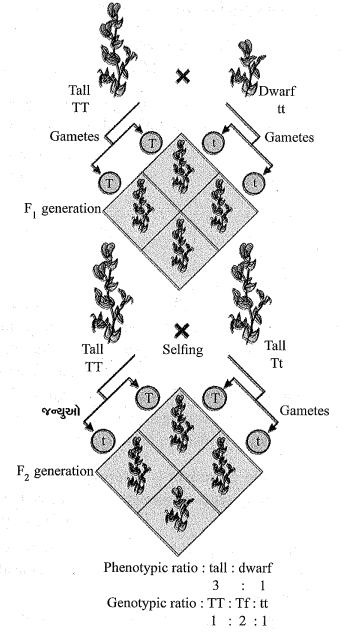
→ The production of gametes by the parents, the formation of the zygotes, the F, and F₂ plants can be understood from a diagram called Punnett Square (By Reginald C. Punnett).
→ It is a graphical representation to calculate the probability of all possible genotypes of offspring in a genetic cross.
→ The Punnett Square shows,
TT → Tall (Male) (♂)
tt → Dwarf (Female) (♀)
Produced Gametes (T, t)
Tt→ F Progeny (self-pollinated)
→ The F₁ plant of the genotype Tt when self- pollinated, produces gametes of the genotype T and t in equal proportion.
→ When fertilisation takes place, the pollen grains of genotype T have a 50 per cent chance to pollinate eggs of the genotype T, as well as of genotype t.
→ Also pollen grains of genotype t have a 50 per cent chance of pollinating eggs of genotype T, as well as of genotype t. As a result of random fertilisation, the resultant zygotes can be of the genotypes TT, Tt or tt.
→ From the Punnett square it is easily seen that 1/4th of the random fertilisations lead to TT, 1/2 lead to Tt and 1/4th to tt.
→ Though the F₁ have a genotype of Tt, but the phenotypic character seen is 'tail'.
→ At $F_2$, 3/4 of the plants are tall, where some of them are TT while others are Tt.
→ Externally it is not possible to distinguish between the plants with the genotypes TT and Tt. Hence, within the genotypic pair Tt only
one character 'T' tall is expressed.
→ Hence the character T or 'tall' is said to dominate over the other allele or 'dwarf character.
→ It is thus due to this dominance of one character over the other that all the $F_1$ are tall (though the genotype is Tt) and in the $F_2$ 3/4 of the plants are tall (though genotypically 1/2 are Tt and only 1/4th are TT).
Genotypic ratio3 : 1 (Tall: Dwarf)
Phenotypic ratio1:2:1 (TT: Tt: tt)
→ The 1/4 1/2 1/4 ratio of TT Tt: tt is mathematically condensable to the form of the binomial expression (ax + by)², that has the gametes bearing genes T or t in equal frequency of 1/2. The expression is expanded as given below:
→ (1/2T + 1/2t)²= (1/2T + 1/2t) X (1/2T + 1/2t)
= 1/4 TT + 1/2 Tt + 1/4 tt
→ Mendel self-pollinated the F₂ plants and found that dwarf F₂ plants continued to generate dwarf plants in F3 and F4 generations. He concluded that the genotype of the dwarfs was homozygous - tt. Image

Need a full question paper?

Generate a complete, print-ready paper with questions like this in minutes — across 16+ boards, with answer keys.

Start Generating Free

Similar questions

Explain the life cycle of Plasmodium (with diagram).
Read the following and answer any four questions from (i) to (v) given below:
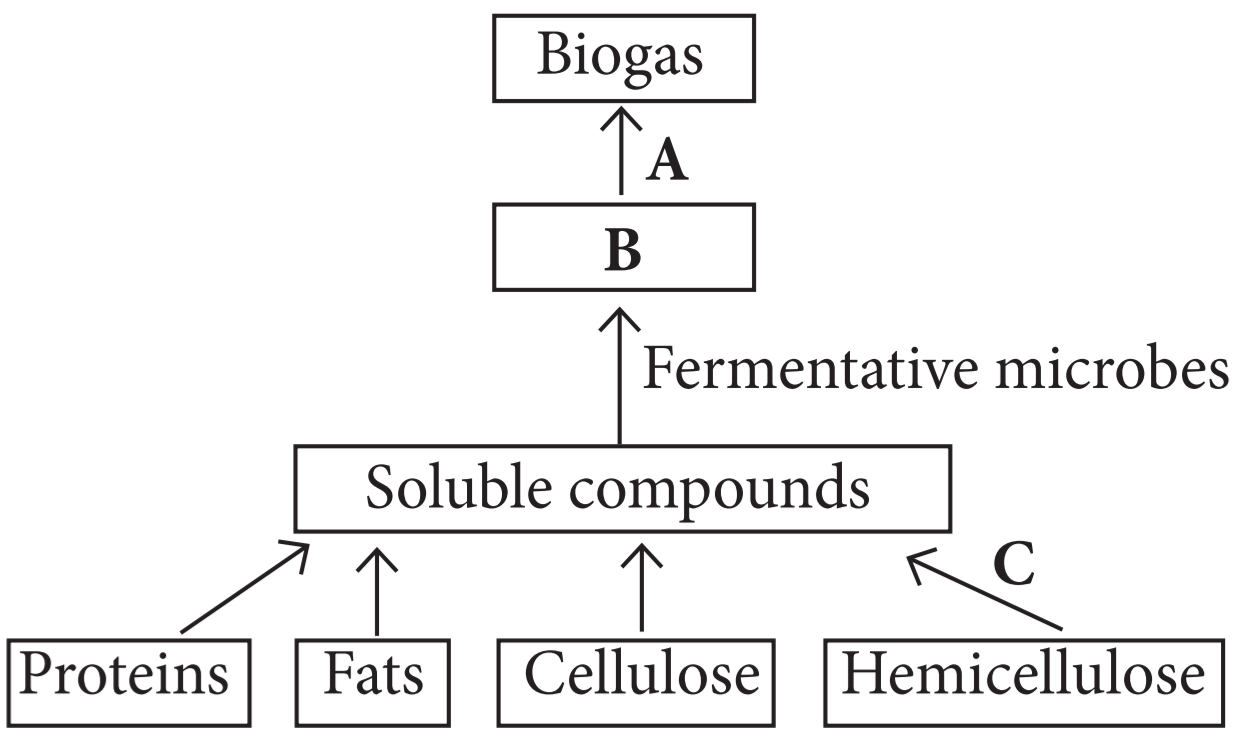
Villagers in a place near Chambur started planning to make power supply for agricultural purposes from cow dung. 'Tiley have started a biogas plant for the purpose. Study the flow chart for biogas production given below and answer the following questions.

  1. Biagas is composed of majorly:
  1. Methane, CO2 and O2
  2. CO2, H2S and H
  3. Methane, CO2
  4.  H2S, H and O2
  1. In the given flow chart, 'A' denotes:
  1. Aerobic bacteria.
  2. Methanogenic bacteria.
  3. Cellulose degrading bacteria.
  4. Yeast and protozoa.
  1. What is represented by 'B' in the flow chart?
  1. Carbohydrates.
  2. Protein polymers.
  3. Organic acids.
  4. Fat globules.
  1. 'C' in the given flow chart causes:
  1. Aerobic breakdown of complex organic compounds.
  2. Anaerobic digestion of complex organic compounds.
  3. Fermentation of organic compounds.
  4. Fermentation of monomers.
  1.  If 'A' is not added in the procedure.
  1. Methane will not be formed.
  2. CO2 will not be formed.
  3. Organic compounds will not be converted to H2S
  4. O2 will not be formed.
Read the following and answer any four questions from (i) to (v) given below:

Oogenesis is the process of formation of ovum in ovaries. It consists of three phases : multiplication, growth and maturation. Oogenesis is controlled by hormones GnRH, LH, FSH. GnRH secreted by the hypothalamus stimulates the anterior lobe of pituitary gland to secrete LH and FSH.

  1. What is the function of hormone FSH?
  1. It inhibits the formation of estrogen.
  2. It induces the release of secondary oocyte.
  3. It stimulates the growth of Graafian follicles.
  4. It causes ovulation.
  1. Which hormone induces the rupture of the mature Graafian follicle?
  1. Follicle stimulating hormone.
  2. Gonadotropin releasing hormone.
  3. Progesterone.
  4. Luteinising hormone.
  1. Which cell division is involved in the formation of secondary oocyte?
  1. Mitosis.
  2. Meiosis I.
  3. Amitosis.
  4. Meiosis II.
  1. Identify the function(s) of LH.
  1. Release of secondary oocyte from Graafian follicle.
  2. Stimulates corpus luteum to secrete progesterone.
  3. Stimulates estrogen formation.
  4. Promotes development of egg to form secondary oocyte.
  1. (A) and (B) only.
  2. (B) and (C) only.
  3. (A), (C) and (D) only.
  4. (B) only.
  1. Assertion: The increase in progesterone level exerts positive feedback on GnRH.

Reason: The rising level of progesterone stimulate production of FSH and LH.

  1. Both assertion and reason are true, and reason is the correct explanation of assertion.
  2. Both assertion and reason are true, but reason is not the correct explanation of assertion.
  3. Assertion is true, but reason is false.
  4. Both assertion and reason are false.
Give a detailed description of human male reproductive system. (Diagram required)
Explain population attributes.
Read the following and answer any four questions from (i) to (v) given below:

Embryo develops at the micropylar end of the embryo sac, where the zygote is situated. Most zygotes divided only after certain amount of endosperm is formed. The early stages of embryo development are similar in both monocotyledons and dicotyledons. The zygote gives rise to the proembryo and subsequently to the globular heart-shaped and mature embryo. A typical dicotyledonous embryo consists of an embryonal axis and two cotyledons. Embryo of monocotyledons possess only one cotyledon.

  1. True embryo develops as a result of fusion of:
  1. Two polar nuclei of embryo sac.
  2. An egg cell and a male gamete.
  3. Synergid and male gamete.
  4. A male gamete and antipodals.
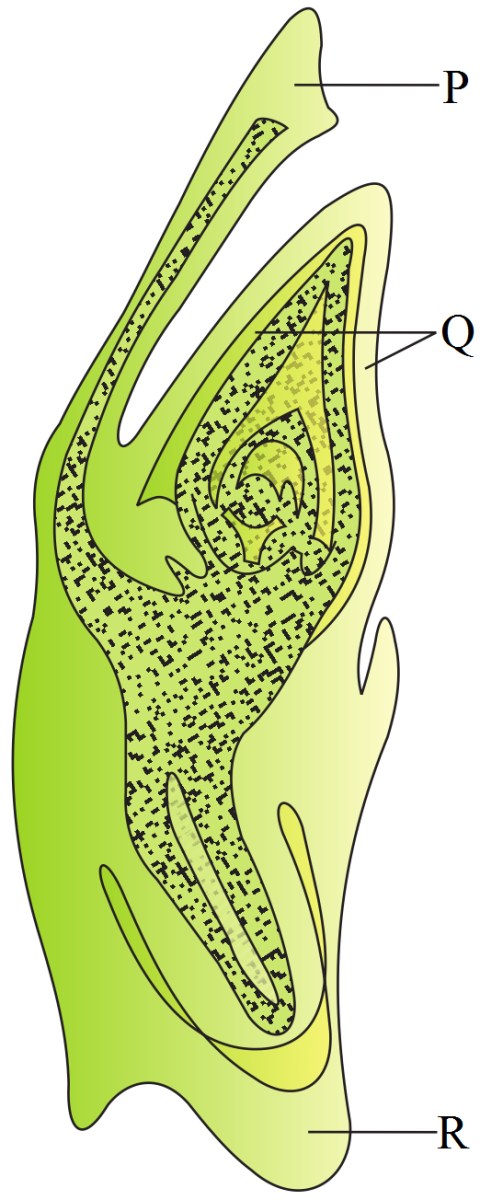
  1. Refer to the given diagram of the embryo of an angiospermous plant with parts labelled P, Q and R. Select the correct statement(s) regarding this.

  1. Part 'P' supplies nutrition to the developing embryo.
  2. Part 'Q' is the protective sheath of radicle and root cap.
  3. Part 'R' is the protective sheath of shoot apex and leaf primordia.
  4. The embryo shown in the diagram is present in members of Family Poaceae.
  1. (IV) only.
  2. (II) and (III) only.
  3. (I) and (IV) only.
  4. (I), (II), (III) and (IV).
  1. Which of the given statements are true?
  1. During the development of a dicot embryo, heart-shaped embryo is followed by globular embryo.
  2. The part of embryonal axis above the level of cotyledons is epicotyl, while the part below the level of cotyledons is hypocotyl.
  3. Monocot seeds possess a single cotyledon, represented by scutellum.
  1. (I) and (II).
  2. (II) and (III).
  3. (I) and (III).
  4. (I), (II) and (III).
  1. Consider the following parts of an embryonal axis of a dicot seed.
  1. Hypocotyl.
  2. Epicotyl.
  3. Radicle.
  4. Plumule.

In which of the following the above parts are correctly arranged from top to base?

  1. (III) → (I) → (II) → (IV).
  2. (II) → (I) → (III) → (IV).
  3. (IV) → (II) → (I) → (III).
  4. (III) → (IV) → (II) → (I).
  1. In grass family, the cotyledon, is called:
  1. Epiblast.
  2. Plumule.
  3. Scutellum.
  4. Perisperm.
Read the following and answer any four questions from (i) to (v) given below:
In recombinant DNA technology, the fragments of DNA generated after cutting the DNA by restriction enzymes are separated according to their size or length by gel electrophoresis. Gel electrophoresis is performed in a gel matrix so that molecules of similar electric charges can be separated on the basis of size. Most commonly used matrix in gel electrophoresis is agarose. The fragments are separated under the influence of electric field. The separated DNA fragments can be seen only after staining the DNA with compound known as ethidium bromide (EtBr) followed by exposure to UV radiation as bright orange band.
  1. Gel electrophoresis is used for the separation of
  1. DNA only.
  2. DNA and RNA only.
  3. DNA and proteins only.
  4. DNA, RNA and proteins.
  1. Most commonly used matrix is _____ which is a ______ extracted from _______.
  1. (i) agarose (ii) polysaccharide (iii) sea weed
  2. (i) agarose (ii) protein (iii) sea weed
  3. (i) EtBr (ii) polysaccharide (iii) sea weed
  4. (i) EtBr (ii) protein (iii) bacteria
  1. A DNA molecule was treated with a restriction endonuclease and three fragments of size (i) 426kb, (ii) 129kb and (iii) 46kb were obtained. Identify the order in which these bands will arrange themselves in the gel plate after gel electrophoresis is completed. (Assuming that negative part of electrode is towards the well)
  1. (iii) → (ii) → (i)
  2. (i) → (ii) → (iii)
  3. (i) → (iii) → (ii)
  4. (iii) → (i) → (ii)
  1. Which of the following statements regarding gel electrophoresis is incorrect?
  1. Separated DNA fragments can be seen only after staining DNA with EtBr.
  2. DNA fragments are separated according to their size.
  3. Under the influence of electric field, positively charged molecules move towards the anode and negatively charged molecules move towards the cathode.
  4. None of these.
  1. The factor that will not affect the rate of DNA migration in gel electrophoresis is:
  1. Size of DNA molecule.
  2. Concentration of DNA.
  3. Voltage supplied.
  4. Concentration of the gel.
Read the following and answer any four questions from (i) to (v) given below:
Green manuring is the fanning practice where a leguminous plant which has derived enough benefits from its association with appropriate species of Rhizobium, is ploughed into the field soil and then a non-legume is sown and allowed to get benefitted from the already present nitrogen fixer. Some legumes, such as, Crotolaria juncea, Sesbania rostrata, Lencaena leucocephala, etc. are used as green manure. Rhizobia, that fix atmospheric nitrogen in the form of nitrate, live in the roots ofleguminous plants. These nutrients are used by non-leguminous plants through the practice of green manuring.
  1. Green manures mainly provide nutrient enriched in:
  1. Magnesium.
  2. Sulphur.
  3. Nitrogen.
  4. Both (a) and (b).
  1. Which of the following plants is used as green manure in crop fields?
  1. Saccharum.
  2. Dichanthium.
  3. Phyllonthus.
  4. Crotolaria.
  1. Green manure plants belong to the Family:
  1. Lamiaceae.
  2. Papilionaceae.
  3. Liliaceae.
  4. Poaceae.
  1. Due to excess use of chemical fertilisers rich in nitrate, ________ disease occurred in children.
  1. Jaundice.
  2. Septicemia.
  3. Methemoglobinemia.
  4. Botulism.
  1.  A green manure is:
  1. Rice.
  2. Maize.
  3. Sorghum.
  4. Sesbania.
Define decomposition and describe the processes and products of decomposition.###Describe factor affecting decomposition.
Early diagnosis is not possible by traditional methods for diagnosis and treatment- discuss in detail.