Question
Explain the inheritance of one gene by Punnett Square ?

Answer

→ Punnett Squre:
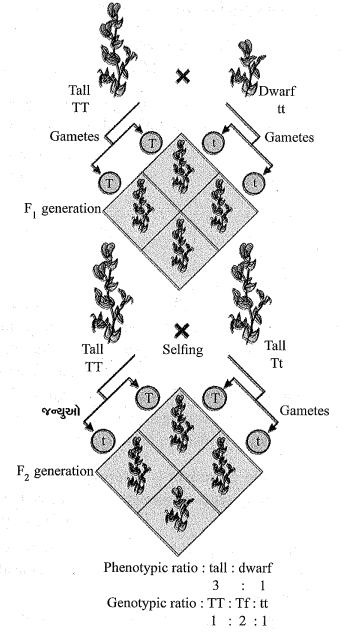
→ The production of gametes by the parents, the formation of the zygotes, the F, and F₂ plants can be understood from a diagram called Punnett Square (By Reginald C. Punnett).
→ It is a graphical representation to calculate the probability of all possible genotypes of offspring in a genetic cross.
→ The Punnett Square shows,
TT → Tall (Male) (♂)
tt → Dwarf (Female) (♀)
Produced Gametes (T, t)
Tt→ F Progeny (self-pollinated)
→ The F₁ plant of the genotype Tt when self- pollinated, produces gametes of the genotype T and t in equal proportion.
→ When fertilisation takes place, the pollen grains of genotype T have a 50 per cent chance to pollinate eggs of the genotype T, as well as of genotype t.
→ Also pollen grains of genotype t have a 50 per cent chance of pollinating eggs of genotype T, as well as of genotype t. As a result of random fertilisation, the resultant zygotes can be of the genotypes TT, Tt or tt.
→ From the Punnett square it is easily seen that 1/4th of the random fertilisations lead to TT, 1/2 lead to Tt and 1/4th to tt.
→ Though the F₁ have a genotype of Tt, but the phenotypic character seen is 'tail'.
→ At $F_2$, 3/4 of the plants are tall, where some of them are TT while others are Tt.
→ Externally it is not possible to distinguish between the plants with the genotypes TT and Tt. Hence, within the genotypic pair Tt only
one character 'T' tall is expressed.
→ Hence the character T or 'tall' is said to dominate over the other allele or 'dwarf character.
→ It is thus due to this dominance of one character over the other that all the $F_1$ are tall (though the genotype is Tt) and in the $F_2$ 3/4 of the plants are tall (though genotypically 1/2 are Tt and only 1/4th are TT).
Genotypic ratio3 : 1 (Tall: Dwarf)
Phenotypic ratio1:2:1 (TT: Tt: tt)
→ The 1/4 1/2 1/4 ratio of TT Tt: tt is mathematically condensable to the form of the binomial expression (ax + by)², that has the gametes bearing genes T or t in equal frequency of 1/2. The expression is expanded as given below:
→ (1/2T + 1/2t)²= (1/2T + 1/2t) X (1/2T + 1/2t)
= 1/4 TT + 1/2 Tt + 1/4 tt
→ Mendel self-pollinated the F₂ plants and found that dwarf F₂ plants continued to generate dwarf plants in F3 and F4 generations. He concluded that the genotype of the dwarfs was homozygous - tt. Image

Need a full question paper?

Generate a complete, print-ready paper with questions like this in minutes — across 16+ boards, with answer keys.
Start Generating Free

Similar questions

Read the following and answer any four questions from (i) to (v) given below:

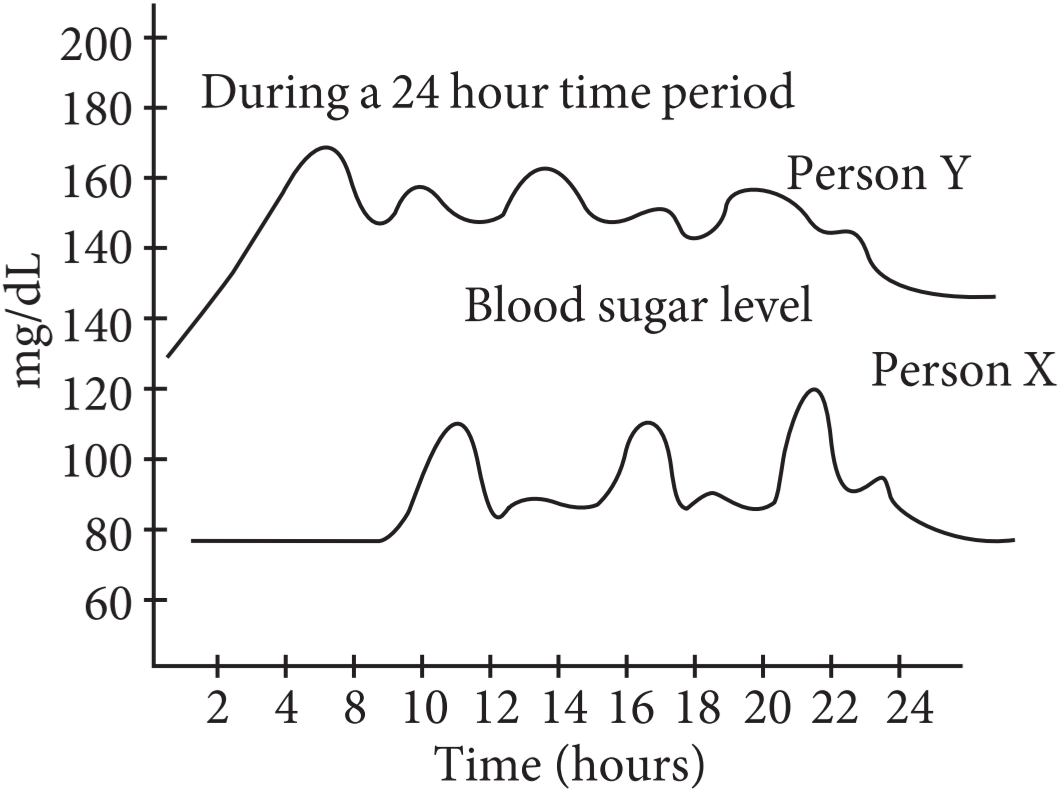
The given graphs show fluctuations in blood sugar of person X and Y during a 24 hour time period.

Based on the above information, answer the following questions.

  1. Which of the following holds true for person X?
  1. Person X is suffering from type I diabetes.
  2. Person X shows severe insulin deficiency and beta cell depletion.
  3. Person X is normal and shows good control of blood sugar level.
  4. Person X is subjected to excessive urination and abnormal thrust.
  1. The given graph indicates that person Y is suffering from.
  1. Diabetes
  2. Hypertension
  3. Atherosclerosis
  4. Rheumatic heart disease.
  1. Which of the following conditions are common in person Y?
  1. Excretion of glucose in urine and excessive urination.
  2. Polydipsia and mild beta cell depletion.
  3. Progressive erosion of articular cartilage at synovial joint.
  4. Both (a) and (b).
  1. A person suffering from diabetes mellitus becomes weak because.
  1. The cells are unable to utilise glucose and other carbohydrates for energy production.
  2. Degradation of fat increases production of toxic ketone bodies.
  3. Cells utilise proteins for obtaining energy
  4. All of these.
  1. Assertion: Type I diabetes involves failure of insulin to facilitate the movement of glucose into cells.

Reason: Type II diabetes is caused by failure of beta cells to produce adequate amount of insulin due to beta cell depletion.

  1. Both assertion and reason are true, and reason is the correct explanation of assertion.
  2. Both assertion and reason are true, but reason is not the correct explanation of assertion.
  3. Assertion is true, but reason is false.
  4. Both assertion and reason are false.
Explain with diagram - Hershey and Chase experiment.###On the basis of experimental proof explain the diagram that DNA is genetic material.###How did Hershey and Chase differentiate between DNA and protein in their experiment while proving that DNA is the genetic material?
Read the following and answer any four questions from (i) to (v) given below:

The process of translation requires transfer of genetic information from a polymer of nucleotides to synthesise a polymer of amino acids. The relationship between the sequence of amino acids in a polypeptide and nucleotide sequence of DNA or mRNA is called genetic code. George Gamow suggested that in order to code for all the 20 amino acids, code should be made up of three nucleotides.

  1. What is a codon?
  1. A length of DNA which codes for a particular protein.
  2. A part of the tRNA molecule to which a specific amino acid is attached.
  3. A part of the tRNA molecule which recognises the triplet code on the messenger RNA.
  4. A part of the messenger RNA molecule that has a sequence of bases coding for an amino acid.
  1. Three consecutive bases in the DNA molecule provide the code for each amino acid in a protein molecule. What is the maximum number of different triplets that could occurs?
  1. 16
  2. 20
  3. 24
  4. 64
  1. Listed below are some amino acids and their corresponding mRNA triplets.
Amino acid
mRNA triplet
Phenylalanine
UUU
Lysine
AAG
Arginine
CGA
Alanine
GCA
Which DNA sequence would be needed to produce the following polypeptide sequence? Alanine-Arginine-Lysine-Phenylalanine

  1. $\text{CGT}\ \ \ \text{GCT}\ \ \ \text{TTC}\ \ \ \text{AAA}$

  2. $\text{CGT}\ \ \ \text{GCT}\ \ \ \text{TTC}\ \ \ \text{TTT}$

  3. $\text{CGU}\ \ \ \text{GCU}\ \ \ \text{UUC}\ \ \ \text{AAA}$

  4. $\text{CGU}\ \ \ \text{GCU}\ \ \ \text{UUC}\ \ \ \text{TTT}$

  1. Identify the non-sense codons among the following.
  1. AUG
  2. GUG
  3. UAA
  4. UGG
  1. A polypeptide is made using synthetic mRNA molecules as shown.
Synthetic mRNA used
Polypeptide produced
UUUAAAUUUAAA
Phenylalanine-Iysine-phenylalanine-Iysine

What are the DNA codes for the amino acids phenylalanine and lysine?

S.no
Phenylalanine
Lysine
(a)
AAA
TTT
(b)
AAA
UUU
(c)
GGG
CCC
(d)
TTT
GGG
Read the following and answer any four questions from (i) to (v) given below:

Tools used in the formation of recombinant DNA are of three types. These are enzymes, cloning vectors and competent host. lysing enzymes are used to extract DNA for experimental purpose from the cells. Cleaving enzymes break the DNA molecules. TI1ey are of three types : exonucleases, endonucleases and restriction endonucleases. A competent host is required for transformation with recombinant DNA and cloning vectors help to propagate DNA.

  1. Which of the following is an example of natural Iysing activity in a human body?
  1. Lysozyme present in tears dissolve the bacterial cell wall.
  2. Conversion of starch to maltose in the buccal cavity
  3. Absorption of digested food into the intestinal cells.
  4. Conversion of protein molecules into amino acids in the stomach.
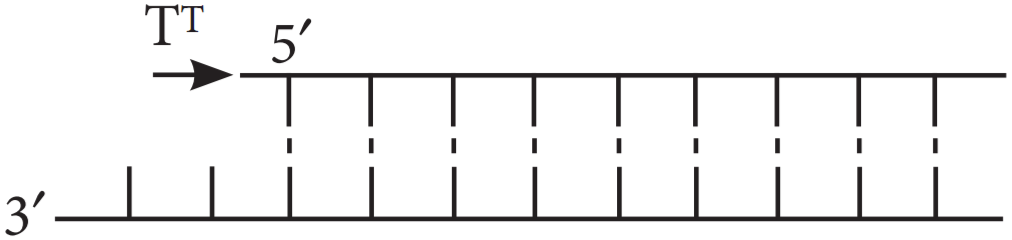
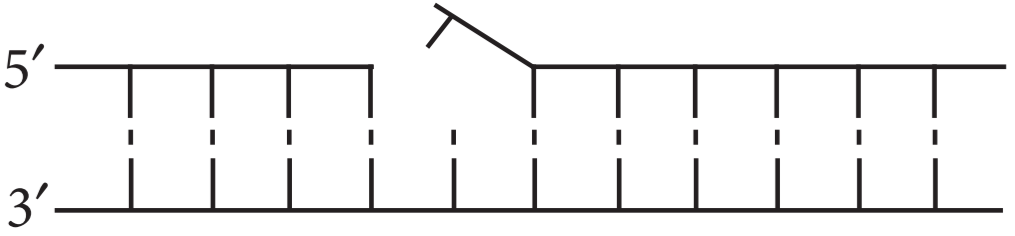
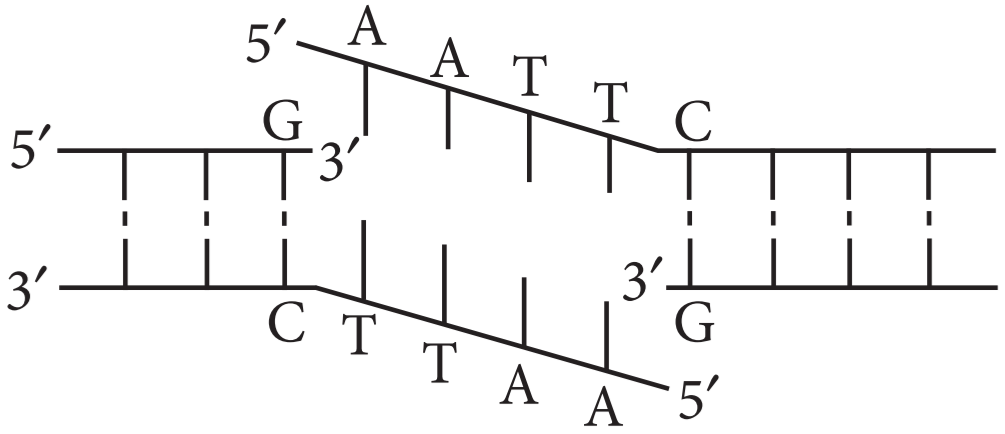
  1. Which of the following depicts exonuclease activity?
  1.  

  1.  

  1.  


  1. All of these
  1. Cloning vectors are the DNA molecules that.
  1. Carry foreign DNA segment but do not replicate inside the host cell.
  2. Carry foreign DNA segment and replicate inside the host cell.
  3. Transfer nuclear DNA form nucleus to the cytoplasm of the same cells.
  4. Help in sealing gaps in DNA segments.
  1. Transfer of DNA into a eucaryotic cell is called:
  1. Transformation.
  2. Transduction.
  3. Transfection.
  4. Electroporation.
  1. Assertion: Type I restriction enzymes are not used in rDNA technology.

Reason: Biotechnology mostly involves cutting and pasting of desired DNA fragments.
  1. Both assertion and reason are true and reason is the correct explanation of assertion.
  2. Both assertion and reason are true but reason is not the correct explanation of assertion.
  3. Assertion is true but reason is false.
  4. Both assertion and reason are false.
Give an account of energy flow in an ecosystem.
Read the following and answer any four questions from (i) to (v) given below:

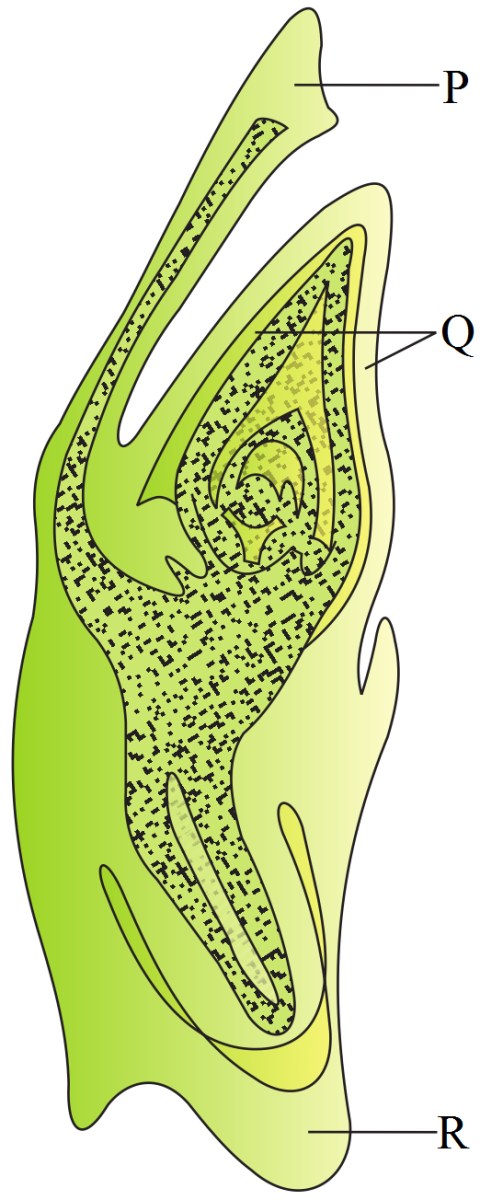
Embryo develops at the micropylar end of the embryo sac, where the zygote is situated. Most zygotes divided only after certain amount of endosperm is formed. The early stages of embryo development are similar in both monocotyledons and dicotyledons. The zygote gives rise to the proembryo and subsequently to the globular heart-shaped and mature embryo. A typical dicotyledonous embryo consists of an embryonal axis and two cotyledons. Embryo of monocotyledons possess only one cotyledon.

  1. True embryo develops as a result of fusion of:
  1. Two polar nuclei of embryo sac.
  2. An egg cell and a male gamete.
  3. Synergid and male gamete.
  4. A male gamete and antipodals.
  1. Refer to the given diagram of the embryo of an angiospermous plant with parts labelled P, Q and R. Select the correct statement(s) regarding this.

  1. Part 'P' supplies nutrition to the developing embryo.
  2. Part 'Q' is the protective sheath of radicle and root cap.
  3. Part 'R' is the protective sheath of shoot apex and leaf primordia.
  4. The embryo shown in the diagram is present in members of Family Poaceae.
  1. (IV) only.
  2. (II) and (III) only.
  3. (I) and (IV) only.
  4. (I), (II), (III) and (IV).
  1. Which of the given statements are true?
  1. During the development of a dicot embryo, heart-shaped embryo is followed by globular embryo.
  2. The part of embryonal axis above the level of cotyledons is epicotyl, while the part below the level of cotyledons is hypocotyl.
  3. Monocot seeds possess a single cotyledon, represented by scutellum.
  1. (I) and (II).
  2. (II) and (III).
  3. (I) and (III).
  4. (I), (II) and (III).
  1. Consider the following parts of an embryonal axis of a dicot seed.
  1. Hypocotyl.
  2. Epicotyl.
  3. Radicle.
  4. Plumule.

In which of the following the above parts are correctly arranged from top to base?

  1. (III) → (I) → (II) → (IV).
  2. (II) → (I) → (III) → (IV).
  3. (IV) → (II) → (I) → (III).
  4. (III) → (IV) → (II) → (I).
  1. In grass family, the cotyledon, is called:
  1. Epiblast.
  2. Plumule.
  3. Scutellum.
  4. Perisperm.
Explain innate immunity in detail
Explain- Restriction enzymes.
Explain Methodology of HGP
Read the following and answer any four questions from (i) to (v) given below:
In recombinant DNA technology, the fragments of DNA generated after cutting the DNA by restriction enzymes are separated according to their size or length by gel electrophoresis. Gel electrophoresis is performed in a gel matrix so that molecules of similar electric charges can be separated on the basis of size. Most commonly used matrix in gel electrophoresis is agarose. The fragments are separated under the influence of electric field. The separated DNA fragments can be seen only after staining the DNA with compound known as ethidium bromide (EtBr) followed by exposure to UV radiation as bright orange band.
  1. Gel electrophoresis is used for the separation of
  1. DNA only.
  2. DNA and RNA only.
  3. DNA and proteins only.
  4. DNA, RNA and proteins.
  1. Most commonly used matrix is _____ which is a ______ extracted from _______.
  1. (i) agarose (ii) polysaccharide (iii) sea weed
  2. (i) agarose (ii) protein (iii) sea weed
  3. (i) EtBr (ii) polysaccharide (iii) sea weed
  4. (i) EtBr (ii) protein (iii) bacteria
  1. A DNA molecule was treated with a restriction endonuclease and three fragments of size (i) 426kb, (ii) 129kb and (iii) 46kb were obtained. Identify the order in which these bands will arrange themselves in the gel plate after gel electrophoresis is completed. (Assuming that negative part of electrode is towards the well)
  1. (iii) → (ii) → (i)
  2. (i) → (ii) → (iii)
  3. (i) → (iii) → (ii)
  4. (iii) → (i) → (ii)
  1. Which of the following statements regarding gel electrophoresis is incorrect?
  1. Separated DNA fragments can be seen only after staining DNA with EtBr.
  2. DNA fragments are separated according to their size.
  3. Under the influence of electric field, positively charged molecules move towards the anode and negatively charged molecules move towards the cathode.
  4. None of these.
  1. The factor that will not affect the rate of DNA migration in gel electrophoresis is:
  1. Size of DNA molecule.
  2. Concentration of DNA.
  3. Voltage supplied.
  4. Concentration of the gel.