Question
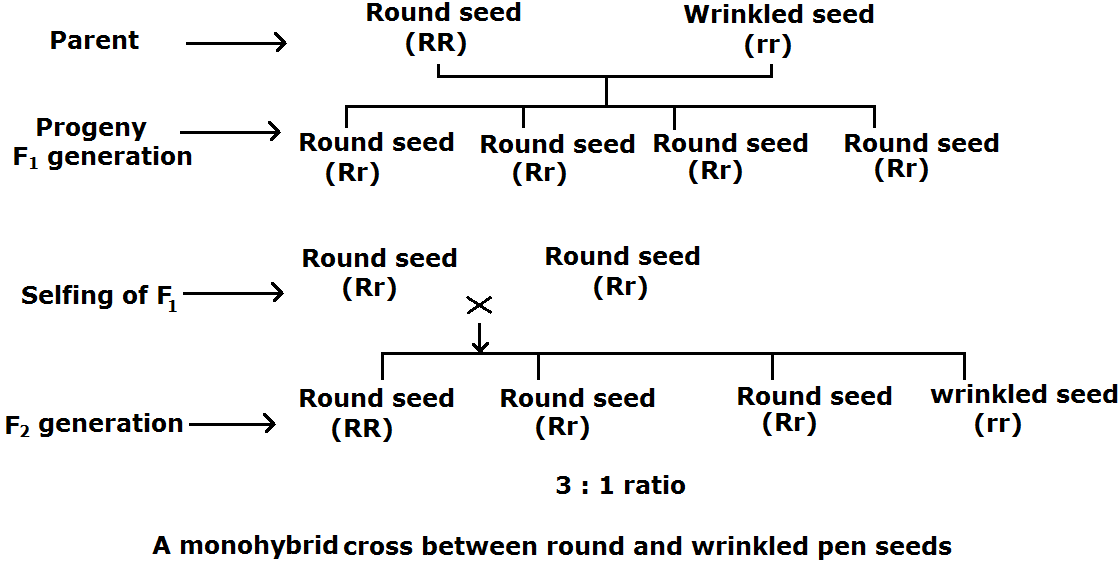
Explain the Law of Dominance using a monohybrid cross.

Answer

Mendel's law of dominance states that a dominant allele expresses itself in a monohybrid cross and suppresses the expression of recessive allele. However, this recessive allele for a character is not lost and remains hidden or masked in the progenies of $F_1$ generation and reappears in the next generation. For example, when pea plants with round seeds (RR) are crossed with plants with wrinkled seeds ( rr ), all seeds in $\mathrm{F}_1$ generation were found to be round (Rr). When these round seeds were self-fertilized, both the round and wrinkled seeds appeared in $F_2$ generation in $3: 1$ ratio. Hence, in $\mathrm{F}_1$ generation, the dominant character (round seeds) appeared and the recessive character (wrinkled seeds) got suppressed, which reappeared in $F_2$ generation.

Need a full question paper?

Generate a complete, print-ready paper with questions like this in minutes — across 16+ boards, with answer keys.

Start Generating Free

Similar questions

Write the sequence of steps involved in the sequencing of genome of an organism.
Explain the events upto fertilisation that occur in a flower after the pollen grain has landed on its compatible stigma.
Draw a diagram of L.S. of an anatropous ovule of an angiosperm and label the following parts
  1. Nucellus
  2. Integuments
  3. Antipodal cells
  4. Secondary nucleus.
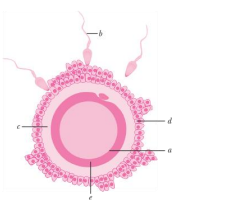
Study the illustration given and answer the questions that follow:

Draw a diagram of ‘b’ separately and label the parts:
  • That help its entry into ‘a’;
  • That carry genetic material;
  • That help in its movement.
The melding of a technique for repeated rounds of DNA synthesis with the discovery of a thermostable DNA polymerase has given scientists the very powerful technique known as polymerase chain reaction (PCR). PCR is based on three simple steps required for any DNA synthesis reaction: (1) denaturation of the template into single strands; (2) annealing of primers to each original strand for new strand synthesis; and (3) extension of the new DNA strands from the primers.
In the given figure, one cycle of polymerase chain reaction (PCR) is shown:
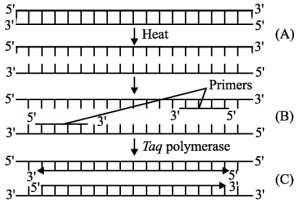
Image
i. Name the steps A, B and C.
ii. Give the purpose of each of these steps.
iii. State the contribution of Thermus aquaticus in this process.
What is Down’s syndrome? Give its symptoms and cause. Why is it that the chances of having a child with Down’s syndrome increases if the age of the mother exceeds forty years?
Draw a diagram and describe the immune system found in humans.
$(i)$ Explain the amino acylation process of $\text{t RNA}$ and describe its role in the translation process.
$(ii)$ How does the translation process start in prokaryotes $($infinite nuclei$)$? Describe.
$(iii) $ Where are the untranslated regions located in $\text{m-RNA}$ and why?
What is genetic engineering? List the steps involved in rDNA technology.
Explain the two complexities that are observed in the process of transcription in eukaryotes and not in prokaryotes.