Question
Explain the techniques of managerial control.

Answer

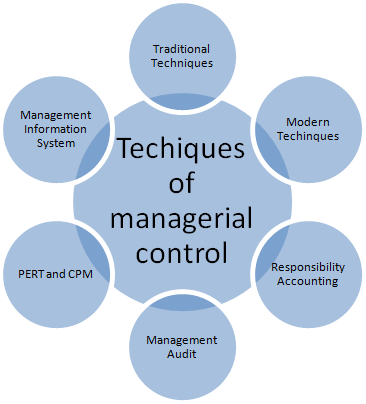
The various techniques of managerial control may be classified into broad categories:
  1. Traditional Techniques: Those techniques which have been used by the companies for a long time now are traditional techniques. However., these have not become obsolete and are still being used by companies.
  1. Personal Observation: Personal observation enables the manager to collect first hand information. It also creates a psychological pressure on the employees to perform well as they are aware that they are being observed personally in their job.
  2. Statistical Reports: Statistical analysis in the form of averages, percentages, ratios, correlation etc. Present useful information to the managers regarding performance of the organisation in various areas. Such information when presented in the form of charts, graphs, tables etc. enables the managers to read them more easily and allow a comparison to be made with performance in previous periods and also with the benchmarks.
  3. Break-even Analysis: It is a technique used by managers to study the relationship between costs, volume and profits. It determines the probable profits and losses at different levels of activity. The sales volume at which there is no profit. no loss is known as break-even point. It is a useful technique for the managers as it helps in estimating profits at different levels of activities.
  4. Budgetary Control: It is a technique of managerial control in which all operations are planned in advance in the form of budgets and actual results are compared with budgetary standards. This comparison reveals the necessary actions to be taken so that organisational goals are accomplished. A budget is a quantitative statement for a definite future period of time for the purpose of obtaining a given objective. It is also a statement which reflects the policy of that particular period. It will contain figures of forecasts both in terms of time and quantities.
  1. Modern Techniques Modern techniques of controlling are those which are of recent origin and are comparatively new in management literature. They provide a new thinking on the ways In which various aspects of an organisation can be controlled.
  1. Return on Investment: Return on Investment (ROI) is a useful technique which provides the basic yardstick for measuring whether or not invested capital has been used effectively for generating reasonable amount of return. It can be calculated as under
$\text{ROI}=\frac{\text{Net income}}{\text{Sales}}\times\frac{\text{Sales}}{\text{Total investment}}$
ROI provides top management an effective means of control for measuring and comparing performance of different departments. It also permits departmental managers to find out the problem which affects ROI in an adverse manner.
  1. Ratio Analysis: It refers to analysis of financial statements through computation of ratios. The most commonly used ratios are:
  • Liquidity Ratio: Which are calculated to determine short term solvency of business.
  • Solvency Ratios: Which are calculated to determine the long term solvency of business are known as Solvency ratios.
  • Profitability Ratio: Which are calculated to analyse the profitability position of a business.
  • Turnover Ratio: They are calculated to determine the efficiency of operations based on effective utilisation of resources.
  1. Responsibility Accounting: Responsibility accounting is a system of accounting in which different sections, divisions and departments of an organisation are set up as ‘responsibility centres’. The head of the centre is responsible for achieving the target set for his centre. Responsibility centres may be of the following types.
  1. Cost Centre: A cost or expense centre Is a segment of an organisation n which managers are held responsible for the cost Incurred in the centre but not for the revenues e.g., production department.
  2. Revenue Centre: A revenue centre is held responsible for generating revenue e.g.. marketing department.
  3. Profit Centre: A profit centre is responsible for both cost and revenue e.g., repair and maintenance department.
  4. Investment Centre: An investment centre is responsible not only for profits but also for investments made in the centre In the form of assets.
​​​​​​​
  1. Management Audit: Management audit refers to systematic appraisal of the overall performance of the management of an organisation. The purpose is to review the efficiency and effectiveness of management and to Improve its performance in future periods. It is helpful in identifying the deficiencies in the performance of management functions The main advantages are:
  1. Helps to locate weaknesses.
  2. It helps to improve control system.
  3. Ensures updating of existing managerial policies and strategies in the light of environmental changes.
  1. PERT and CPM: Programme evaluation and review technique and critical path method are important network techniques useful in planning and controlling These techniques are especially useful in planning, scheduling and Implementing time bound projects Involving performance of a variety of complex, diverse and inter-related activities These techniques deal with time scheduling and resource allocation for these activities and aims at effective execution of projects within given time schedule and structure of costs.
  2. Management Information System: MIS is a computer based Information system that provides information and support for effective managerial decision making A decision maker requires up-to-date accurate and timely information. MIS provides the required information to the managers by systematically processing a massive data generated In an organisation Thus, MIS is an important communication tool for managers.

Need a full question paper?

Generate a complete, print-ready paper with questions like this in minutes — across 16+ boards, with answer keys.

Start Generating Free

Similar questions

Explain ‘Staffing’ as a function of management. Also explain by giving any four reasons why proper staffing is required in an organisation.
State the steps involved in the process of communication.
What is meant by 'Informal Organisation'? State the features of Informal Organisation.
Explain the meaning of ‘Budgetary Control.’ Why is it considered an important technique of controlling?
Explain any six factors affecting the decision that determines the amount of profit earned to be distributed and to be retained in the business.
Discuss Maslow’s Need-Hierarchy theory of motivation.
Two years ago Suruchi completed her BBA course. As she had knowledge of the business she began taking interest in her parental business. Her father used to do the wholesale business of wheat. Suruchi suggested to her father why not they should also go in for the retail business of wheat. Her father agreed. He entrusted full responsibility for the new business to Suruchi. First of all, she conducted a market survey and tried to obtained information regarding the kind of wheat, price, and weight of its packing, that the people liked desi wheat the most. Many varieties of wheat were already available in the market. In order to show that her wheat was distinct from that of other traders, she gave it the name of Sharbati Healthy Food. Wheat was packed in attractive plastic bags. Weight of each packed wheat bag was either 10kg and 20kg so that it is easily carried and moved from one place to the other. Suruchi pasted a label on each bag giving full information about the wheat packed in. While deciding the price of her product she kept in mind, the expectation of the people, price of competitor's products and reasonable rate of profit. Thus a new business came into being. Within a few days, Suruchi was known as a successful trader.
With reference to the above paragraph identify four functions of marketing.
Explain by giving any three reasons why decentralisation is important in an organisation.
Or
It refers to systematic effort to delegate all authority to the lowest level except that which can be exercised at central points. Name it and explain its two importance.
Explain any four points that highlight the importance of controlling.
In an environment of rising petroleum prices and a large middle class population in India. KV Motors Ltd. recognized the need for small cars in India. It created a product far superior than their competitors not only in terms of quality but also in terms of overall driving experience. It soon became the leader in the small car market. As the Indian government was encouraging foreign investment, MNCs having a big name in car manufacturing entered the Indian market.
KV Motors further expanded its service network and quality creating an entry barrier for the competitors. It depicted its strengths through various brand-building activities. As a result, the market share of KV Motors is refusing to go down in spite of all major automakers as its competitors.
  1. Identify the economic reforms highlighted in the above case.
  2. Quoting the lines, explain any two points of importance of Business Environment being highlighted in the above case.