Question
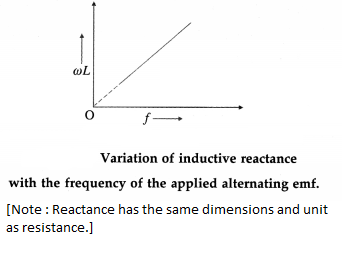
Explain the term inductive reactance. Show graphically variation of inductive reactance with the frequency of the applied alternating emf.
Answer

When an alternating emf e $=e_0 \sin \omega t$ is applied to a pure inductor of inductance $L$, the current in the
circuit is $i = i _0 \sin \left(\omega t -\frac{\pi}{2}\right)$, where $i _0=\frac{\pi}{2}$, where $i _0=\frac{e_0}{\omega L} \ln$ the case of a pure resistor of resistance $R_r i=i_0 \sin \omega t$ for $e=e_0 \sin \omega t$, and $i_0=\frac{e_0}{R}$
Comparison of Eqs. $i_0=\frac{e_0}{\omega L}$ and $i_0=\frac{e_0}{R}$ shows that $\omega L$ is the resistance offered by the inductor to the applied alternating emf. It is called the reactance. It increases linearly with the frequency because $\omega L =2 \pi fL$. This is illustrated in the following figure, $\omega L$ is denoted by $X_{ L }$.
Image

Need a full question paper?

Generate a complete, print-ready paper with questions like this in minutes — across 16+ boards, with answer keys.

Start Generating Free

Similar questions

A substance may be athermanous or diathermanous for certain wavelength ranges while good absorber for other wavelength ranges. Explain.
A parallel-plate air capacitor has a capacity (capacitance) of $20 \mu F$. What will be its new
capacity if
(i) the distance between the plates is doubled
(ii) a marble slab of dielectric constant 8 is introduced filling the entire space between the two plates?
What is a phasor diagram? Illustrate it with an example.
What is series LCR circuit? Obtain the expression for impedance. Hence state the conditions for series resonance and derive the expression for resonant frequency.
Sample of carbon obtained from any living organism has a decay rate of $15.3$ decays per gram per minute. A sample of carbon obtained from very old charcoal shows a disintegration rate of $12.3$ disintegrations per gram per minute. Determine the age of the old sample given the decay constant of carbon to be $3.839 × 10^{-12}$ per second.
A small body of mass $0.3 \mathrm{~kg}$ oscillates in a vertical plane with the help of a string $0.5 \mathrm{~m}$ long with a constant speed of $2 \mathrm{~m} / \mathrm{s}$. It makes an angle of $60^{\circ}$ with the vertical. Calculate the tension in the string.
A thin rod of uniform cross section is made up of two sections made of wood and steel. The wooden section has length $50 \mathrm{~cm}$ and mass $0.6 \mathrm{~kg}$. The steel section has length $30 \mathrm{~cm}$ and mass $3 \mathrm{~kg}$. Find the moment of inertia of the rod about a transverse axis passing through the junction of the two sections.
A proton is to be suspended in vacuum between two parallel plates separated by $1 mm$. Find (i) the electric field required (ii) the potential difference between the plates corresponding to the desired field. $\left[m_p=1.67 \times 10^{-27} kg\right.$ ]
What must be the ratio of the slit width to the wavelength for a single slit to have the first diffraction minimum at $45.0^\circ?$
Describe what is Rayleigh’s criterion for resolution. Explain it for a telescope and a microscope.