Question
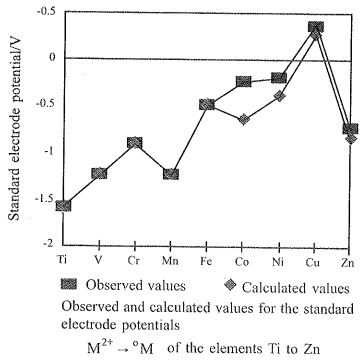
Explain trends in $M^{2+}/M$ standard electrode potentials.

Answer

$\rightarrow$ An element in $M^{2+}$ state in aqueous medium is more stable if the electrode potential $(M^{2+}/M)$ value is more negative.
$\rightarrow$ The general trend towards less negative $E^Θ$ values across the series is related to the general increase in the sum of the first and second ionization enthalpies.
$\rightarrow$ The unique behaviour of $Cu,$ having a positive $EV,$ accounts for its inability to liberate $H_2$ from acids. Only oxidising acids $($nitric and hot concentrated sulphuric$)$ react with $Cu,$ the acids being reduced.
Image
$\rightarrow$ It is interesting to note that the value of $EV$ for $Mn, Ni$ and $Zn$ are more negative than expected from the trend.

Need a full question paper?

Generate a complete, print-ready paper with questions like this in minutes — across 16+ boards, with answer keys.

Start Generating Free

Similar questions

Explain Raoult's Law as a special case of Henry's Law
Write the mechanism of the following reaction :
Image
How can phenol be converted to aspirin?
Answer the following question:Although phenoxide ion has more number of resonating structures than carboxylate ion, carboxylic acid is a stronger acid than phenol. Give two reasons.
Write down uses of lanthanoids and its compounds.
Calculate the value of $\text{EMF}$ for the cell reaction :
$Cu_{(s)}+2 Ag_{(aq)}^{+} \rightarrow Cu_{(aq)}^{2+}+2 Ag_{(s)}$
$E_{Cu^{+2} / Cu}^{o}=0.34 V \text { and } E_{Ag^{+} / Ag}^{o}=0.80 V$
What are essential and non-essential amino acids in human food? Give one example of each type.
What are reduction potential and oxidation potential?
The standard electrode potential $(E^\circ)$ for Deniell cell is $+1.1V.$ Calculated the $ʌG^\circ$ for the reaction
$Zn (s) + Cu^{2+ }(aq) \rightarrow Zn^{2 }(aq) + Cu (s)$
$(1 F = 96500\ C\ mol^{-1}).$
a. Nitrogen gas is soluble in water. At temperature $293 K$, the value of $K_HiS 76.48$ kbar. How would the solubility of nitrogen vary $($increase, decrease or remain the same$)$ at a temperature above $293 K_H$ if the value of $K_1$ rises to 88.8 kbar.
b. Chloroform $(b.p. 61.2^\circ C)$ and acetone $(b.p. 56^\circ C)$ are mixed to form an azeotrope. The mole fraction of acetone in this mixture is $0.339$. Predict whether the boiling point of the azeotrope formed will be $(i) 60^\circ C (ii) 64.5^\circ C$ or $(iii)54 ^\circ C.$ Defend your answer with reason.