Question
Explain what you understand by magnetic flux.

Answer

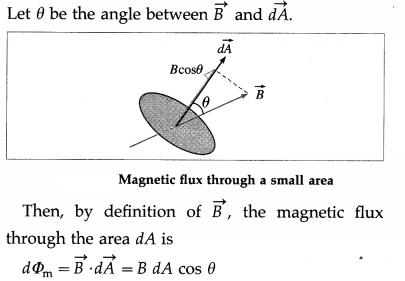
The total number of magnetic lines of force passing normally through a given area in a magnetic field, is called the magnetic flux through that area.
Consider a very small area dA in a uniform magnetic field of induction $\vec{B}$. The area dA can be represented by a vector $\overrightarrow{d A}$ perpendicular to it.
Image
[Note : The area vector is perpendicular to the sur-face, so it can point either up and to the right as shown or down and to the left. Although either choice is acceptable, choosing the direction that is closest to the magnetic field is convenient and usually the one we choose.]

Need a full question paper?

Generate a complete, print-ready paper with questions like this in minutes — across 16+ boards, with answer keys.
Start Generating Free

Similar questions

State the uses of a potentiometer.
A mixture of fuel and oxygen is burned in a constant-volume chamber surrounded by a water bath. It was noticed that the temperature of water is increased during the process. Treating the mixture of fuel and oxygen as the system,
(a) Has heat been transferred ?
(b) Has work been done?
(c) What is the sign of ∆u ?
Explain electrostatic shielding. What is a Faraday cage ?
A parallel beam of green light of wavelength 550 nm passes through a slit of width 0.4 mm. The intensity pattern of the transmitted light is seen on a screen which is 40 cm away. What is the distance between the two first order minima? 
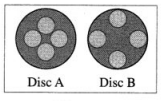
Two circular discs A and B, having the same mass, have four identical small circular discs placed on them, as shown in the diagram. They are simultaneously released from rest at the top of an inclined plane. If the discs roll down without slipping, which disc will reach the bottom first?

Image

What does a heat engine consist of ?
OR
What are the elements (parts) of a typical heat engine?
Give a brief account of Huygens' wave theory of light. State its merits and demerits.
Two wires, each $1 m$ long and of the same diameter, have densities $8 \times 10^3 kg / m ^3$ and $2 \times$ $10^3 kg / m ^3$ and are stretched by tensions $196 N$ and $49 N$, respectively. Compare their fundamental frequencies.
A parallel-plate air capacitor has a capacity (capacitance) of $20 \mu F$. What will be its new
capacity if
(i) the distance between the plates is doubled
(ii) a marble slab of dielectric constant 8 is introduced filling the entire space between the two plates?
What are the uses of logic gates? Why is a NOT gate known as an inverter?