Question
State the uses of a potentiometer.

Answer

The applications of the potentiometer discussed above are used in a laboratory. Some practical applications of the potentiometer are given below.
  1. Voltage divider: The potentiometer can be used as a voltage divider to change the output voltage of a voltage supply.
  2. Audio control: Sliding potentiometers are commonly used in modem low-power audio systems as audio control devices. Both sliding (faders) and rotary potentiometers (knobs) are regularly used for frequency attenuation, loudness control and for controlling different characteristics of audio signals.
  3. Potentiometer as a sensor: lf the slider of the potentiometer is connected to the moving part of a machine, it can work as a motion sensor. A small displacement of the moving part causes a change in potential which is further amplified using an amplifier circuit. The potential difference is calibrated in terms of displacement of the moving part.
  4. To measure the emf (for this, the emf of the standard cell and potential gradient must be known).
  5. To compare the emfs of two cells.
  6. To determine a cell's internal resistance.

Need a full question paper?

Generate a complete, print-ready paper with questions like this in minutes — across 16+ boards, with answer keys.
Start Generating Free

Similar questions

A proton is released from rest in vacuum in a uniform electric field of intensity $100 V / m$. What is its speed after it has travelled a distance of $1 m \ ?\ [m _{ p }=1.67 \times 10^{-27} \ kg , 1 eV =1.6 \times  \left.10^{-19} J \right]$
Explain the acceleration of a particle in UCM. State an expression for the acceleration.
An isosceles prism of refracting angle $179^{\circ}$ and refractive index 1.6 is used as a biprism by' keeping it $10 cm$ away from a slit, the edge of the biprism being parallel to the slit. The slit is illuminated by a light of wavelength $600 nm$ and the screen is $90 cm$ away from the biprism. Calculate the location of the centre of the 10 th dark band from the centre of the interference pattern and the path difference at this location.
Consider a heavy string X and a light string Y joined together at point O. Explain what happens when a wave pulse
(1) travelling from the string X reaches the junction O
(2) travelling from the string Y reaches the junction O.
A rigid object is rolling down an inclined plane. Derive expressions for the acceleration along the track and the speed after falling through a certain vertical distance.
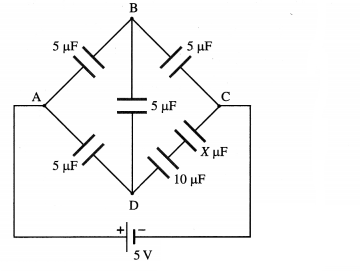
Six capacitors of capacities $5 \mu F , 5 \mu F , 5 \mu F , 5 \mu F , 10 \mu F$, and $X \mu F$ are connected as shown in the network given below:
Image
Find $(a)$ the value of $X$ if the network is balanced $(b)$ the resultant capacitance between $A$ and $C.$
A short bar magnet is placed in an external magnetic field of 700 guass. When its axis makes an angle of 30° with the external magnetic field, it experiences a torque of 0.014 Nm. Find the magnetic moment of the magnet, and the work done in moving it from its most stable to most unstable position.
Prove that an ideal capacitor in an AC circuit does not dissipate power
A body oscillates in SHM according to the equation $x=5 \cos \left(2 \pi t+\frac{\pi}{4}\right)$, where $x$ and $t$ are in Sl units. Calculate the
(i) displacement and
(ii) speed of the body at $t =1.5 s$.
When two cells of emfs. E1 and E2 are connected in series so as to assist each other, their balancing length on a potentiometer is found to be 2.7 m. When the cells are connected in series so as to oppose each other, the balancing length is found to be 0.3 m. Compare the emfs of the two cells.