Question
Explain why the reactance offered by an inductor increases with increasing frequency of an alternating voltage.

Answer

The inductive reactance is given by $\text{X}_\text{L}=2\pi\text{fL}$, $X_L$ is proportional to the frequency and current is inversely proportional to the reactance. An inductor opposes the flow of current through it by developing a back emf according to Lenz’s law. If the current is decreasing, the polarity of the induced emf will be so as to increase the current and vice-versa.
Since, the induced emf is proportional to the rate of change of current.

Need a full question paper?

Generate a complete, print-ready paper with questions like this in minutes — across 16+ boards, with answer keys.
Start Generating Free

Similar questions

A parallel-plate capacitor having plate area $25cm^2$ and separation 1.00mm is connected to a battery of 6.0V. Calculate the charge flown through the battery. How much work has been done by the battery during the process?
A closely wound solenoid of 2000 turns and area of cross-section $1.6 \times 10^{–4} m2,$ carrying a current of 4.0 A, is suspended through its centre allowing it to turn in a horizontal plane.
  1. What is the magnetic moment associated with the solenoid?
  2. What is the force and torque on the solenoid if a uniform horizontal magnetic field of $7.5 \times 10^{–2}\ T$ is set up at an angle of 30º with the axis of the solenoid?
  1. Depict the equipotential surfaces for a system of two identical positive point charges placed a distance ‘d’ apart.
  2. Deduce the expression for the potential energy of a system of two point charges $q_1$ and $q_2$ brought from infinity to the points$\overrightarrow{\text{r}_{1}}$ and $\overrightarrow{\text{r}_{2}}$ respectively in the presence of external electric field $\overrightarrow{\text{E}}.$
When an apple falls from a tree what happens to its gravitational potential energy just as it reaches the ground? After it strikes the ground?
You are given n resistors each of resistance r. They are first connected to get the minimum possible resistance. In the second case, these are again connected differently to get the maximum possible resistance. Calculate the ratio between minimum and maximum values of resistance so obtained.
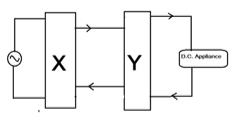
(I) Identify the circuit elements X and Y as shown in the given block diagram and draw the output waveforms of X and Y.

Image

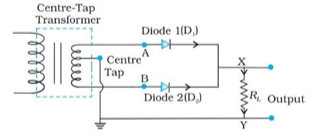
(II) If the centre tapping is shifted towards Diode D1 as shown in the diagram, draw the output waveform of the given circuit.

Image
A point source emitting light uniformly in all directions is placed 60cm above a table-top. The illuminance at a point on the table-top, directly below the source, is 15 lux. Find the illuminance at a point on the table-top 80cm away from the first point.
For a CE-transistor amplifier, the audio signal voltage across the collector resistance of 2 k$\Omega$ is 2 V. suppose the current amplification factor if the transistor is 100, find the input signal voltage and base current if the base resistance is 1 k$\Omega$.
At what time $t$ will the magnitude of sinusoidal alternating current will be (i) $1 / 2$ (ii) $\frac{1}{\sqrt{2}}$ times of its peak value?
A capacitor is connected to an alternating-current source. Is there a magnetic field between the plates?