Question
Explain with the help of one example how genetically modified plants can:
  1. Reduce usage of chemical pesticides.
  2. Enhance nutritional value of food crops.

Answer

  1. Reduce usage of chemical pesticides: Bt toxin is produced by a bacterium called Bacillus thuringiensis (Bt for short). Bt toxin gene has been cloned from the bacteria and been expressed in plants to provide resistance to insects without the need for insecticides; in effect created a bio-pesticide. Examples are Bt cotton, Bt com, rice, tomato, potato and soyabean etc.
  2. Enhance nutritional value of food crops: Golden rice is the transgenic variety of basmati rice which gives high yield and rich in vitamin A, so it is used in the deficiency of vitamin-A causing night blindness and skin disorder.

Need a full question paper?

Generate a complete, print-ready paper with questions like this in minutes — across 16+ boards, with answer keys.
Start Generating Free

Similar questions

What is mycorrhiza? Write its main advantages.
Find out from newspapers and popular science articles any new fossil discoveries or controversies about evolution.
  1. How is artificial hybridisation considered a crop improvement programme?
  2. Explain the process of artificial hybridisation, if
  1. Female parent bears bisexual flowers.
  2. Female parent bears unisexual flowers.
Sunny was rushed to a nearby hospital after an accident, which had caused too much blood loss. The hospital failed to supply 'O' negative blood for transfusion. Ahmed, who was attending a patient there, heard about the situation and agreed to donate blood as he had the same blood group. Sunny's mother initially refused but was later convinced by her daughter's view.
  1. Why cannot 'O' positive blood be transfused into Sunny's body?
  2. What is the genetic basis of blood group inheritance?
  3. Human blood grouping is an example of?
  4. What values do you find in Sunny's sister and Ahmed?
Explain the carbon cycle with the help of a simplified model.
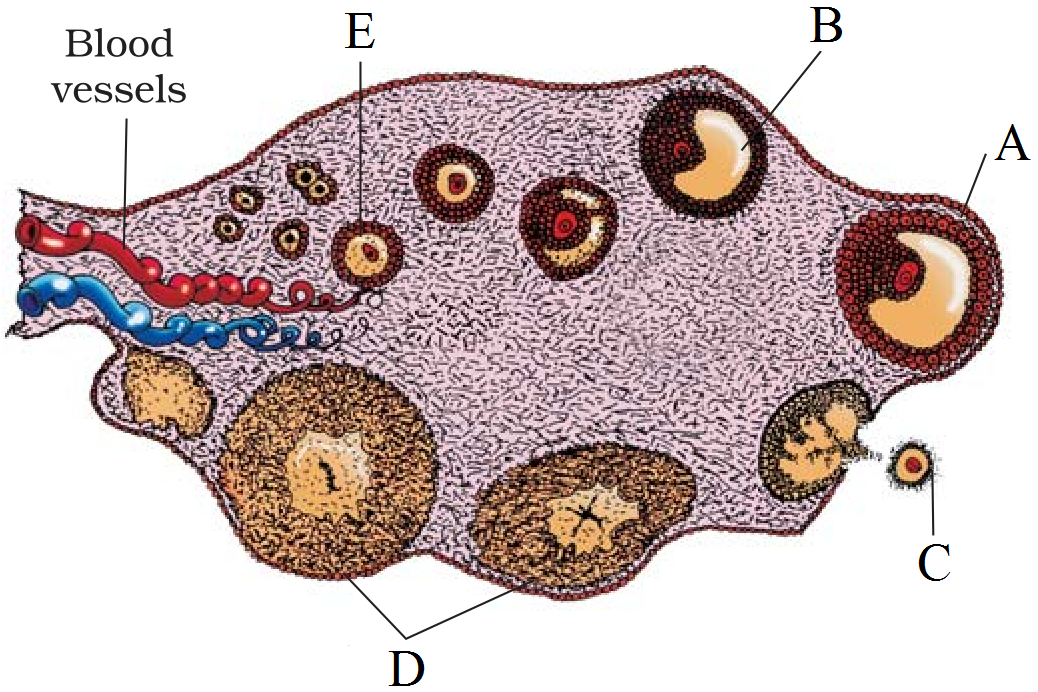
  1. Given below is the TS of human ovary. Identify the following in the diagram:
  • Corpus luteum.
  • Secondary oocyte.
  • Antrum.
  • Primary follicle.
  • Primary oocyte.
  1. Explain the changes the primary oocyte undergoes while in different follicular stages before ovulation.

​​​​​​​

DNA separated from one cell, when introduced in another cell, is able to bestow some of the properties of the former to the latter. What is this change called in technical terms? Describe the experiment evidences which led to the discovery of the above phenomenon.
State and explain any three factors affecting allele frequency in populations.
Malarial parasite ‘Plasmodium’ completes its life cycle in two hosts. Draw its complete life cycle and explain various stages it follows throughout its life.
Mention any two autosomal genetic disorders with their symptoms.