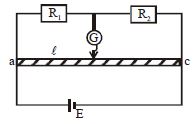
Fig. shows rough sketch of meter bridge. $(G)$ deflects zero at length $\ell \, cm$. Now $R_1$ and $R_2$ are interchanged then balancing length increases by $25\, cm$. Find $R_1/R_2$
Medium
Download our app for free and get started
$\frac{\mathrm{R}_{1}}{\mathrm{R}_{2}}=\frac{\ell}{100-\ell}$ and $\frac{\mathrm{R}_{2}}{\mathrm{R}_{1}}=\frac{\ell+25}{75-\ell}$
So $\frac{\ell}{100-\ell}=\frac{\ell+25}{75-\ell}$ or $\ell=\frac{75}{2} \mathrm{\,cm}$

Download our appand get started for free
Experience the future of education. Simply download our apps or reach out to us for more information. Let's shape the future of learning together!No signup needed.*
Similar Questions
- 1View SolutionWhich of the following statements is false?
- 2A current of $2.0$ ampere passes through a cell of $e.m.f$. $1.5\, volts$ having internal resistance of $0.15\, ohm$. The potential difference measured, in $volts$, across both the ends of the cell will beView Solution
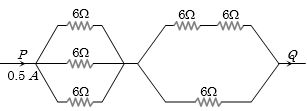
- 3Resistances of $6\, ohm$ each are connected in the manner shown in adjoining figure. With the current $0.5\,ampere$ as shown in figure, the potential difference ${V_P} - {V_Q}$ is .............. $V$View Solution
- 4View SolutionThe resistivity of a wire
- 5A thermocouple of negligible resistance produces an $e.m.f.$ of $40\,\mu V{/^o}C$ in the linear range of temperature. A galvanometer of resistance $10\; ohm$ whose sensitivity is $1\;\mu A/div$, is employed with the thermocouple. The smallest value of temperature difference that can be detected by the system will beView Solution
- 6Current density in a cylindrical wire of radius $R$ is given as $J =$ $\left\{ {\begin{array}{*{20}{c}}View Solution
{{J_0}\left( {\frac{x}{R} - 1} \right)\,\,for\,\,0 \leqslant x < \frac{R}{2}} \\
{{J_0}\frac{x}{R}\,\,\,\,for\,\,\,\frac{R}{2} \leqslant x \leqslant R}
\end{array}} \right.$The current flowing in the wire is: - 7Two long coaxial and conducting cylinders of radius $a$ and $b$ are separated by a material of conductivity $\sigma$ and a constant potential difference $V$ is maintained between them, by a battery. Then the current, per unit length of the cylinder flowing from one cylinder to the other is -View Solution
- 8What equal length of an iron wire and a copper-nickel alloy wire, each of $2 \; {mm}$ diameter connected parallel to give an equivalent resistance of $3 \Omega ?$View Solution
(Given resistivities of iron and copper-nickel alloy wire are $12 \;\mu \Omega {cm}$ and $51\; \mu \Omega {cm}$ respectively) (in ${m}$)
- 9Equivalent resistance between the adjacent corners of a regular $n$-sided polygon of uniform wire of resistance $R$ would be:View Solution
- 10Column $- I$ gives certain physical terms associated with flow of current through a metallic conductor. Column $- II$ gives some mathematical relations involving electrical quantities. Match Column $- I$ and Column $- II$ with appropriate relations.View Solution
Column $- I$ Column $- II$ $(A)$ Drift Velocity $(P)$ $\frac{m}{n e^{2} \rho}$ $(B)$ Electrical Resistivity $(Q)$ $\mathrm{ne} v_{\mathrm{d}}$ $(C)$ Relaxation Period $(R)$ $\frac{\mathrm{eE}}{\mathrm{m}} \tau$ $(D)$ Current Density $(S)$ $\frac{E}{J}$