Figure shows a thick shell made of electrical conductivity $\sigma$ and has inner & outer radii of $10\ cm$ & $20\ cm$ respectively and is filled with ice inside it. Its inside and outside surface are kept at different potentials by a battery of internal resistance $\frac{2}{\pi} \Omega \ \&\ \epsilon = 5V$. Find value of $\sigma$ for which ice melts at maximum possible rate if $25\%$ of heat generated by shell due to joule heating is used to melt ice.
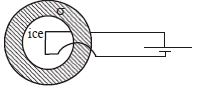
Diffcult
Download our app for free and get started
$\mathrm{dR}=\frac{\rho \mathrm{d} \mathrm{r}}{4 \pi \mathrm{r}^{2}}$
$\mathrm{R}=\int \mathrm{dR}=\frac{\rho}{4 \pi} \int_{\mathrm{r}_{1}}^{\mathrm{r}_{2}} \frac{\mathrm{dr}}{\mathrm{r}^{2}} \Rightarrow \mathrm{R}=\frac{\rho\left(\mathrm{r}_{2}-\mathrm{r}_{1}\right)}{4 \pi \mathrm{r}_{1} \mathrm{r}_{2}}$
Rate of melting is max when power dissipated in sphere is max. Using maximum power transfer theorem,
$\mathrm{R}=\mathrm{r} .$ of battery i.e. $\frac{\rho\left(\mathrm{r}_{2}-\mathrm{r}_{1}\right)}{4 \pi \mathrm{r}_{1} \mathrm{r}_{2}}=\frac{2}{\pi}$
$\rho = \frac{{8{r_1}{r_2}}}{{{r_2} - {r_1}}} = \frac{{8(200)}}{{10}} = \frac{{160}}{{100}}$ (in $SI$)
Also, $\sigma=\frac{1}{\rho}=\frac{10}{16}=\frac{5}{8}$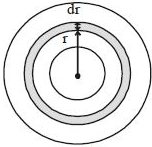

Download our appand get started for free
Experience the future of education. Simply download our apps or reach out to us for more information. Let's shape the future of learning together!No signup needed.*
Similar Questions
- 1A metal wire of resistance $3\,\Omega $ is elongated to make a uniform wire of double its previous length. The new wire is now bent and the ends joined to make a circle. If two points on this circle make an angle $60^o$ at the centre, the equivalent resistance between these two points will beView Solution
- 2A wire of resistance $R$ and radius $r$ is stretched till its radius became $r / 2$. If new resistance of the stretched wire is $x R$, then value of $x$ is $\qquad$View Solution
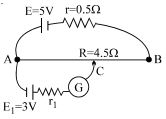
- 3In the given potentiometer circuit length of the wire $AB$ is $3\, m$ and resistance is $R = 4.5 \, \Omega$ . The length $AC$ for no deflection in galvanometer isView Solution
- 4Two identical batteries, each of $e.m.f.$ $2\, volt$ and internal resistance $1.0\, ohm$ are available to produce heat in an external resistance $R = 0.5\,ohm$ by passing a current through it. The maximum Joulean power that can be developed across $R$ using these batteries is ............. $watt$View Solution
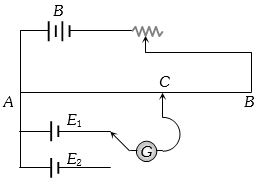
- 5The circuit shown here is used to compare the $e.m.f.$ of two cells ${E_1}$ and ${E_2}({E_1} > {E_2})$. The null point is at $C$ when the galvanometer is connected to ${E_1}$. When the galvanometer is connected to ${E_2}$, the null point will beView Solution
- 6There is a current of $40$ ampere in a wire of ${10^{ - 6}}\,{m^2}$ area of cross-section. If the number of free electron per ${m^3}$ is ${10^{29}}$, then the drift velocity will beView Solution
- 7View SolutionAssertion : Bending a wire does not effect electrical resistance.
Reason : Resistance of wire is proportional ot resistivity of material.
- 8The electromotive force of a primary cell is $2\, volts$. When it is short-circuited it gives a current of $4$ amperes. Its internal resistance in $ohms$ isView Solution
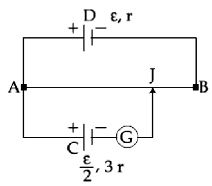
- 9A potentiometer wire $AB$ having length $L$ and resistance $12\, r$ is joined to a cell $D$ of $emf$ $\varepsilon $ and internal resistance $r$. A cell $C$ having $emf$ $\varepsilon /2$ and internal resistance $3r$ is connected. The length $AJ$ at which the galvanometer as shown in figure shows no deflection isView Solution
- 10View SolutionThe reciprocal of resistance is