Question
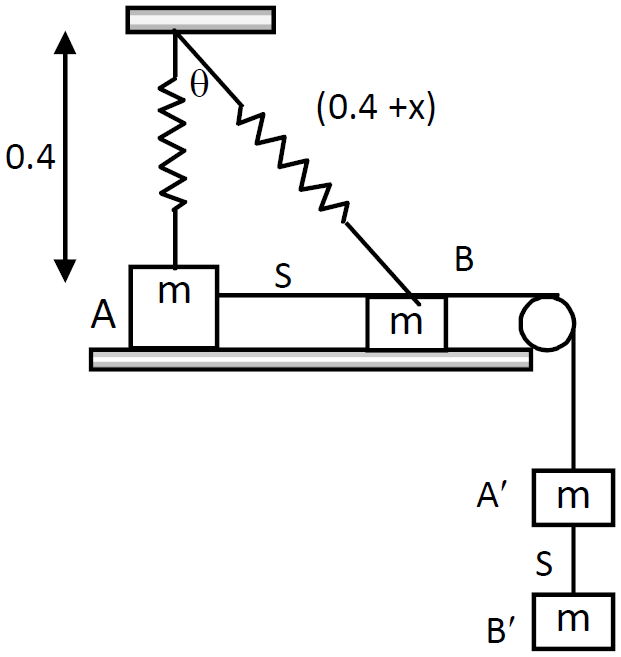
Figure shows two blocks $A$ and $B,$ each having a mass of $320g$ connected by a light string passing over a smooth light pulley. The horizontal surface on which the block $A$ can slide is smooth. The block $A$ is attached to a spring of spring constant $40N/m$ whose other end is fixed to a support $40\ cm$ above the horizontal surface. Initially, the spring is vertical and unstretched when the system is released to move. Find the velocity of the block $A$ at the instant it breaks off the surface below it. Take $g = 10m/s^2.$
Answer

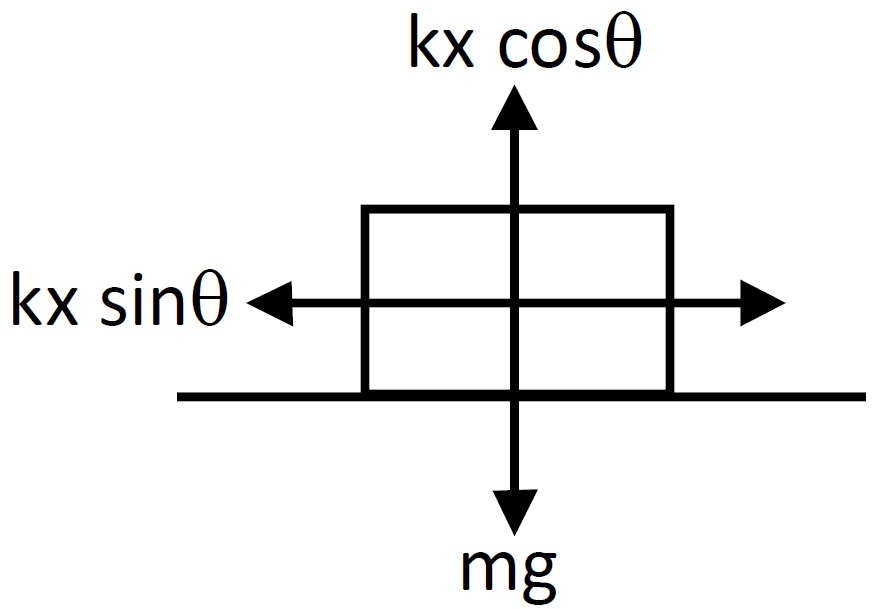
$m = 320g = 0.32\ kg, k = 40N/m h = 40\ cm = 0.4m, g = 10 m/s^2$ From the free body diagram,

$\text{kx}\cos\theta=\text{mg}$
$($when the block breaks off $R = 0)$
$\Rightarrow\cos\theta=\frac{\text{mg}}{\text{kx}}$
So, $\frac{0.4}{0.4+\text{x}}=\frac{3.2}{40+\text{x}}$
$\Rightarrow16\text{x}=3.2\text{x}+1.28$
$\Rightarrow\text{x}=0.1\text{m}$
So, $\text{s}=\text{AB}$
$\Rightarrow\sqrt{(\text{h}+\text{x})^2-\text{h}^2}$
$\Rightarrow\sqrt{(0.5)^2-(0.4)^2}=0.3\text{m}$
Let the velocity of the body at $B$ be $v,$ Charge in $K.E. =$ work done $($for the system$)\Big(\frac{1}{2}\text{mv}^2+\frac{1}{2}\text{mv}^2\Big)=\frac{-1}{2}\text{kx}^2+\text{mgs}$
$\Rightarrow(0.32)\times\text{v}^2=-\Big(\frac{1}{2}\Big)\times40\times(0.1)^2+0.32\times10\times(0.3)$
$\Rightarrow\text{v}=1.5\text{m}/\text{sec}$

Need a full question paper?

Generate a complete, print-ready paper with questions like this in minutes — across 16+ boards, with answer keys.

Start Generating Free

Similar questions

Do magnetic forces obey Newton's third law. Verify for two current elements $\text{dI}_1=\text{dI}\hat{\text{i}}$ located at the origin and $\text{dI}_2=\text{dI}\hat{\text{j}}$ located at $(0, R, 0)$. Both carry current $I.$
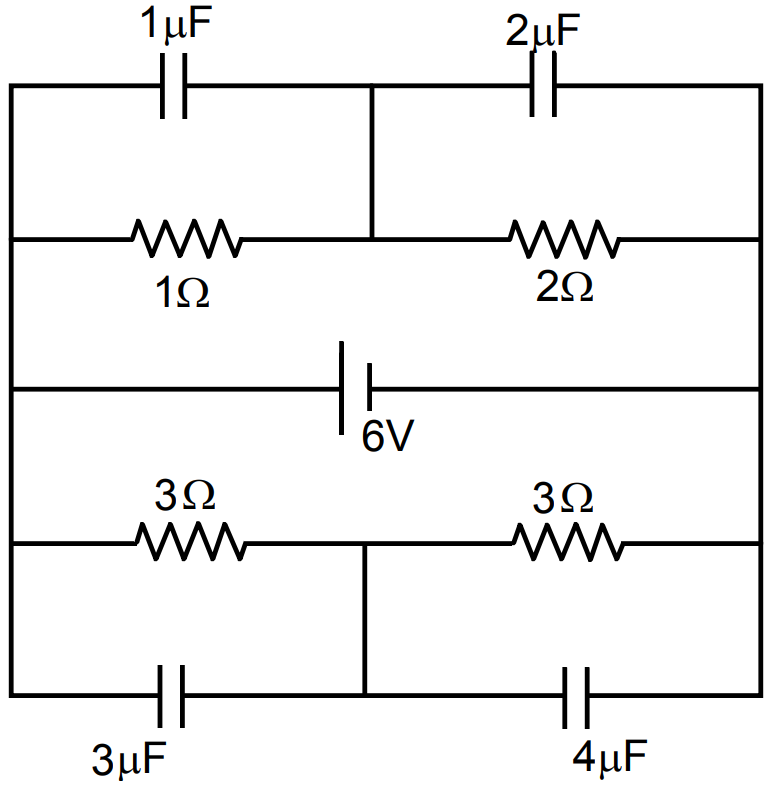
Find the charges on the four capacitors of capacitances $1\mu\text{F},2\mu\text{F},3\mu\text{F}$ and $4\mu\text{F}$ shown in the figure.
A uniform chain of length L and mass M overhangs a horizontal table with its two third part on the table. The friction coefficient between the table and the chain is $\mu.$ Find the work done by the friction during the period the chain slips off the table.
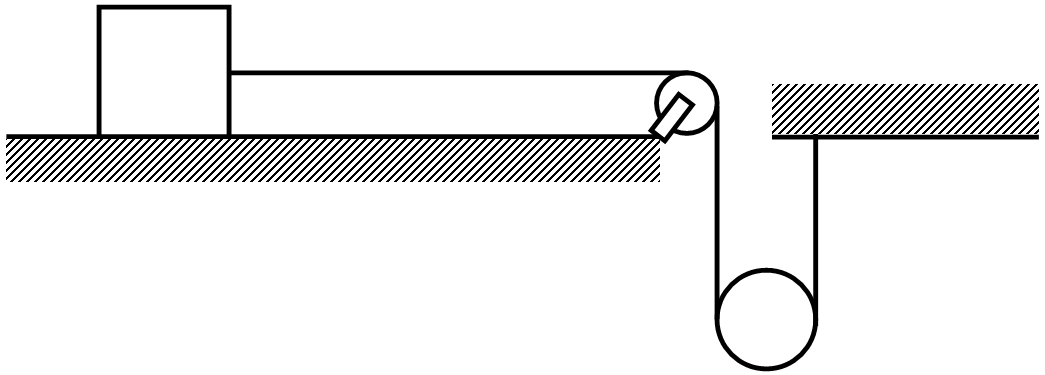
The descending pulley shown in figure has a radius $20\ cm$ and moment of inertia $0.20\ kg-m^2.$ The fixed pulley is light and the horizontal plane frictionless. Find the acceleration of the block if its mass is $1.0\ kg.$​​​​​​​
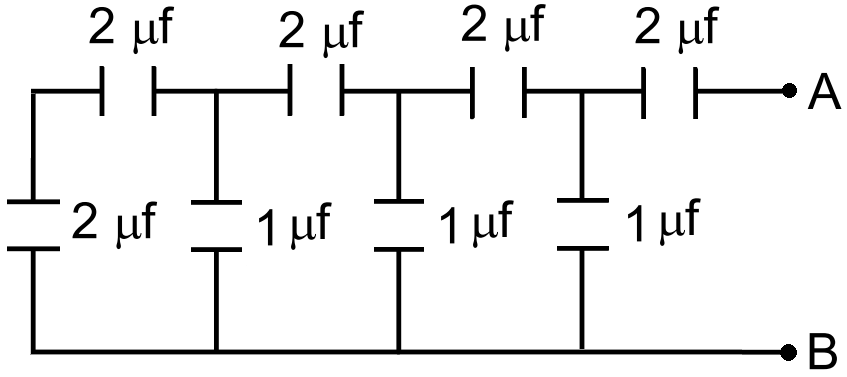
Find the capacitance of the combination shown in figure between $A$ and $B.$
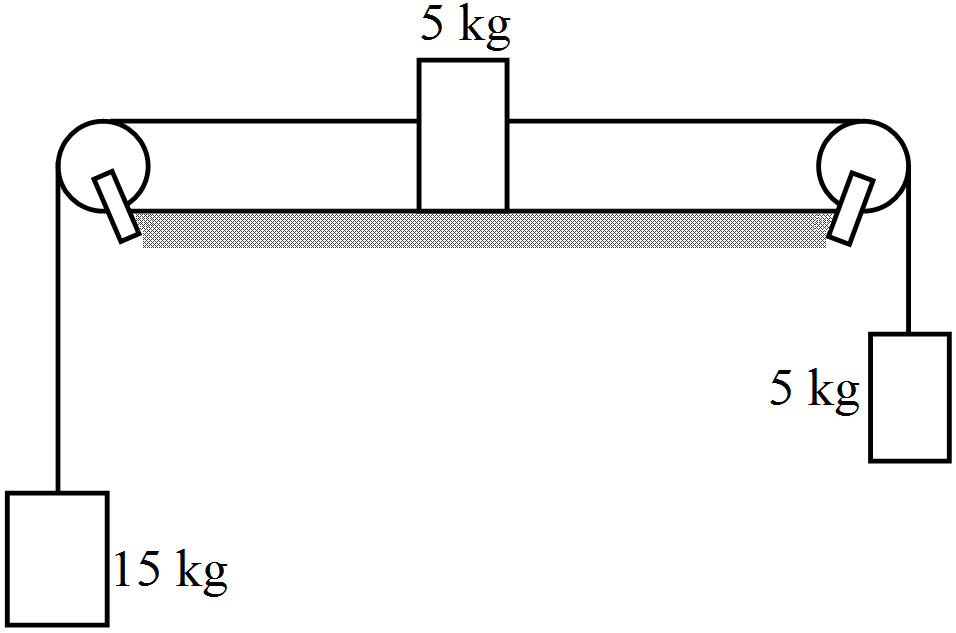
The friction coefficient between the table and the block shown in figure is 0.2. Find the tensions in the two strings.
  1. Write the expression for the force, $\overrightarrow{\text{F}}$, acting on a charged particle of charge $'q\ ',$ moving with a velocity$\overrightarrow{\text{v}}$ in the presence of both electric field $\overrightarrow{\text{E}}$and magnetic field $\overrightarrow{\text{B}}.$ Obtain the condition under which the particle moves undeflected through the fields.
  2. A rectangular loop of size $l\ \times\ b $ carrying a steady current $I$ is placed in a uniform magnetic field $\overrightarrow{\text{B}}.$ Prove that the torque$\overrightarrow{\tau}$ acting on the loop is given by $\overrightarrow{\tau} =\overrightarrow{\text{m}}\times\overrightarrow{\text{B},}$were $\overrightarrow{\text{m}}$is the magnetic moment of the loop.
Assume that a tunnel is dug across the earth $($radius $= R)$ passing through its centre. Find the time a particle takes to cover the length of the tunnel if,
  1. It is projected into the tunnel with a speed of $\sqrt{\text{gR}}.$
  2. It is released from a height $R$ above the tunnel.
  3. It is thrown vertically upward along the length of tunnel with a speed of $\sqrt{\text{gR}}.$
An electron is projected horizontally with a kinetic energy of $10\ keV$. A magnetic field of strength $1.0 \times 10^{-7}T$ exists in the vertically upward direction.
  1. Will the electron deflect towards the right or left of its motion?
  2. Calculate the sideways deflection of the electron while travelling through $1m$. Make appropriate approximations.
A spherical conductor of radius 12cm has a charg of $1.6 \times 10^{-7} C$ distributed uniformly on its surface. What is the electric field:
(a) inside the sphere
(b) just outside the sphere
(c) at a point 18 cm from the centre of the sphere?