MCQ
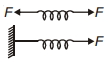
Figure shows two cases. In first case a spring (spring constant $K$ ) is pulled by two equal and opposite forces $F$ at both ends and in second case is pulled by a force $F$ at one end. Extensions $(x)$ in the springs will be
  • A
    In both cases $x=\frac{2 F}{K}$
  • In both cases $x=\frac{F}{K}$
  • C
    In first case $x=\frac{2 F}{K}$, in second case $x=\frac{F}{K}$
  • D
    In first case $x=\frac{F}{K}$, in second case $x=\frac{2 F}{K}$
Answer

Correct option: B.
In both cases $x=\frac{F}{K}$
b
(b)

Figure $(2)$ is $F.B.D.$ of figure $(1)$ at equilibrium $F=K x$

$x=F / K$

Need a full question paper?

Generate a complete, print-ready paper with questions like this in minutes — across 16+ boards, with answer keys.

Start Generating Free

Similar questions

Two equal rods joined at one end are kept on a smooth surface as shown and released. Trajectory of centre of mass of both rods is 
Parallel rays are incident on a transparent sphere along its one diameter. After refrection these rays converge at the other end of this diameter the refractive index of the sphere is
Ice is used in a cooler in order to cool its contents. Which of the following will speed up the cooling process?
A proton with a kinetic energy of $2.0\,eV$ moves into a region of uniform magnetic field of magnitude $\frac{\pi}{2} \times 10^{-3}\,T$. The angle between the direction of magnetic field and velocity of proton is $60^{\circ}$. The pitch of the helical path taken by the proton is $..........cm$ (Take, mass of proton $=1.6 \times 10^{-27}\,kg$ and Charge on proton $=1.6 \times 10^{-19}\,kg)$
A rectangular metallic loop is moving out of a uniform magnetic field region to a field free region with a constant speed. When the loop is partially inside the magnate field, the plot of magnitude of induced emf $(\varepsilon)$ with time $(t)$ is given by
Coatings used on raincoat are waterproof because
$SI$ unit of pressure is
Stokes' law states that the viscous drag force $F$ experienced by a sphere of radius $a$, moving with a speed $v$ through a fluid with coefficient of viscosity $\eta$, is given by $F=6 \pi \eta a v$.If this fluid is flowing through a cylindrical pipe of radius $r$, length $l$ and a pressure difference of $p$ across its two ends, then the volume of water $V$ which flows through the pipe in time $t$ can be written as

$\frac{v}{t}=k\left(\frac{p}{l}\right)^a \eta^b r^c$

where, $k$ is a dimensionless constant. Correct value of $a, b$ and $c$ are

One Mach number is equal to
Two different adiabatic paths for the same gas intersect two isothermal curves as shown in$P-V$ diagram. The relation between the ratio $\frac{V_a}{V_d}$ and the ratio $\frac{V_b}{V_c}$ is: