Question
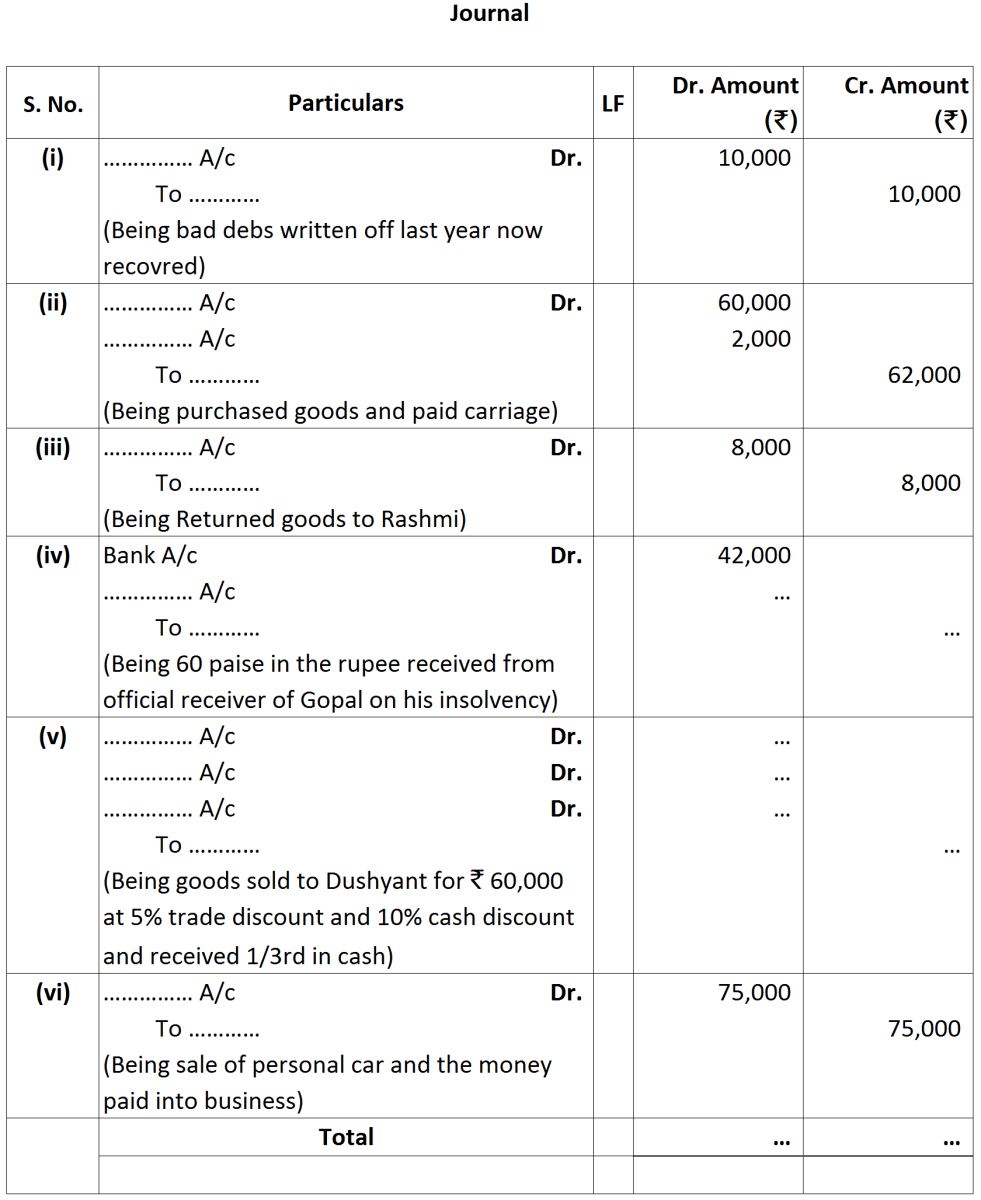
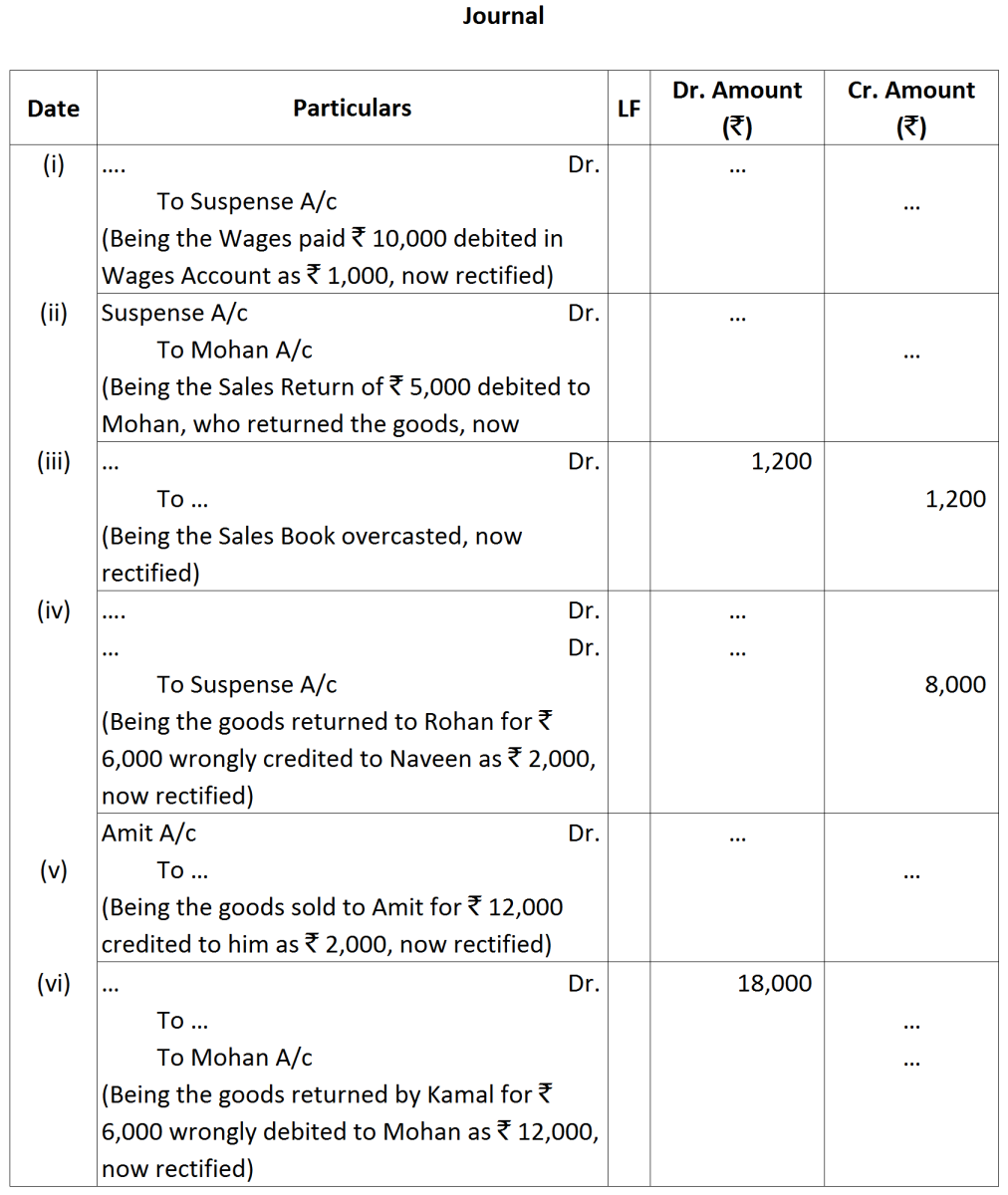
Fill in the missing information in the following Rectifying Journal Entries:
Answer

Get the step-by-step solution for this question inside the Vidyadip app.

Get the answer in the app

Need a full question paper?

Generate a complete, print-ready paper with questions like this in minutes — across 16+ boards, with answer keys.

Start Generating Free

Similar questions

A Book-keeper finds that the totals of his trial balance disagree by ₹ 2,800. He temporarily debits a Suspense Account with this amount and closes the books. On an examination of the books, the following errors are discovered:
i. The total of Purchase Return Book ₹ 710 was posted Twice.
ii. Goods costing ₹ 800 were distributed as free samples but no entry was passed in the books.
iii. Purchase of Machinery for ₹ 5,600 on credit was recorded in Purchase Book as ₹ 6,500.
iv. Cash Sales to Roshan Gupta for ₹ 1,200 were recorded in Cash Book as well as in Sales Book and were posted from both.
v. Closing Stock has been overvalued by ₹ 1,500 .
vi. Sales Return Book was untotalled, though personal accounts were posted ₹ 1,580 .
vii. No entries have been made in the Cash Book for the Insurance Premium directly paid by bank ₹ 700 and interest charged on overdraft ₹ 320 .
viii. A sum of ₹ 200 for Drawings on the Credit Side of Cash Book was not posted to the Drawings account.
Pass entries to rectify the above errors. Close the Suspense Account already opened.
From the following particulars, prepare Bank Reconciliation Statement as on 31st December, 2008:Debit balance as per Cash Book ₹ 10,000.
  1. A cheque for ₹ 500 issued in favour of Karan has not been presented for payment.
  2. A bill for ₹ 700 retired by bank under a rebate of ₹ 20, the full amount of the bill was credited in the Cash Book.
  3. A cheque for ₹ 295 deposited in the bank has been dishonoured.
  4. A sum of ₹ 800 deposited in the bank has been credited as ₹ 80 in the Pass Book.
  5. Payments side of the Cash Book has been undercast by ₹ 200.
  6. A bill receivable for ₹ 1,000 (discounted with the bank in November 2008) dishonoured on 31st December, 2008.
A sold goods for ₹ 40,000 to B on Jan. 01, 2017. He drew upon B a bill of exchange for the same amount payable after 1 month. B accepted the bill and sent it back to A. Adiscounted the bill immediately with his bank @ 9% p.a. On the due date B dishonoured the bill of exchange and the bank paid ₹ 200 as noting charges. B requested A to draw a new bill upon him with interest @ 12% p.a. which he agreed. The new bill was payable after 1 month. One week before the maturity of the second bill B requested A to cancel the second bill. He further requested to accept ₹ 15,000 in cash immediately and draw a third bill upon him including interest of ₹ 1,000. A agreed to B's request. The third bill was payable after one month. B met the third bill on its maturity. Record the necessary journal entries in the books of A and B and also prepare B's account in the books of Aand A's account in the books of B.
Pass journal entries to rectify the following errors detected during preparation of Trial Balance:
  1. Purchases book is undercast by ₹ 1,000.
  2. Wages paid for construction of office debited to wages account ₹ 20,000.
  3. A credit sale of goods ₹ 1,200 to Ramesh has been wrongly passed through the purchase book.
  4. Goods purchased for ₹ 5,000 were posted as ₹ 500 to the purchases account.
  5. An amount of ₹ 2,000 due from Mahesh Chand, which had been written off as a bad debt in a previous year was unexpectedly recovered and has been posted to the personal account of Mahesh Chand.
  6. A credit purchase of ₹ 1,040 from Ramesh was passed in the books as ₹ 1,400.
  7. Goods (Cost ₹ 5,000; Sales Price ₹ 6,000) distributed as free samples among prospective customers was not recorded anywhere.
  8. Goods worth ₹ 1,500 returned by Green and Co. have not been recorded anywhere.
Prepare Two-column Cash Book of Vinod, Delhi from the following transactions:
2018  
Oct. 1 Cash in Hand 25,000
Oct. 1 Cash at Bank 75,000
Oct. 7 Bought goods for ₹ 15,000 plus IGST @ 12% against cheque  
Oct. 8 Bought goods for ₹ 5,000 plus CGST and SGST @ 6% each  
Oct. 10 Honoured our own acceptance by cheque 5,000
Oct. 14 Paid petty expenses 150
Oct. 18 Ramesh who owed ₹ 5,000 became bankrupt and paid us 50 paise in a rupee  
Oct. 20 Received cash from Manohar 7,500
  Allowed discount 250
Oct. 23 Withdrew from bank 4,000
Oct. 24 Paid to Ghanshyamdas & Co. 3,000
  Received discount 100
Oct. 25 Withdrew from bank for personal expenses 3,000
Oct. 27 Sold goods for ₹ 11,000 plus CGST and SGST @ 6% against cash  
Oct. 28 Received cheque for goods sold for ₹ 9,000 plus CGST and SGST @ 6% each  
Oct. 29 Received repayment of a loan of ₹ 5,000 and deposited ₹ 3,000 out of it into bank  
Viaml purchased goods ₹ 25,000 from Kamal on Jan 15, 2016 and accepted a bill of exchange drawn upon him by Kamal payable after two months. On the date of the maturity the bill was duly presented for payment. Vimal dishonoured the bill. record the necessary journal entries in the books of Kamal and Vimal when.
  • The bill was retained by Kamal till the date of its maturity.
  • The bill was immediately discounted by Kamal with his bank @ 6% p.a.
  • The bill was endorsed by Kamal in favour of his creditor Sharad.
  • Five days before its maturity the bill was sent by Kamal to his bank for collection.
Enter the following transactions in double column cash book of M/s Ambica Traders for July 2017:
   
01
Commenced business with cash
50,000
03
Opened bank account with ICICI
30,000
05
Purchased goods for cash
10,000
10
Purchased office machine for cash
5,000
15
Sales goods on credit from Rohan and received chaeque
7,000
18
Cash sales
8,000
20
Rohan’s cheque deposited into bank
 
22
Paid cartage by cheque
500
25
Cash withdrawn for personal use
2,000
30
Paid rent by cheque
1,000
On January 1, 2017, Ajay sold goods to Balbir for ₹ 10,000 at a discount of 20%. On that date, Balbir accepted a bill, drawn on him by Ajay for ₹ 8,000 payable 3 months after sight. Having surplus funds, Balbir paid off the bill on 4th March, 2017 and was allowed a rebate of 18% per annum. Show Journal entries in the books of Ajay and Balbir.
A Company, which closes its books on 31st March every year, purchased on 1st July, 2010, machinery costing ₹ 30,000. It purchased further machinery on 1st January, 2011, costing ₹ 20,000 and on 1st October, 2011, costing ₹ 10,000. On 1st April, 2012, one-third of the machinery installed on 1st July, 2010, became obsolete and was sold for ₹ 3,000.
Show how the machinery account would appear in the books of the Company, it being given that machinery was depreciated by Diminishing Balance Method at 10% per annum. What would be the balance of Machinery Account on 1st April, 2013?
Fill in the missing information in the following journal entries: