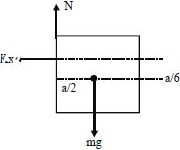
Find maximum amplitude for safe $SHM$ (block does not topple during $SHM$) of $a$ cubical block of side $'a'$ on a smooth horizontal floor as shown in figure (spring is massless)

Diffcult


Download our appand get started for free
Experience the future of education. Simply download our apps or reach out to us for more information. Let's shape the future of learning together!No signup needed.*
Similar Questions
- 1A particle performs $SHM$ on $x-$ axis with time period of $0.5\,sec,$ such that it's velocity is zero at $x = -3\,cm$ and at $x = 9\,cm$. It was located at $x = 0$ and moving in negative $'x'$ at $t = 0$. The equation of $SHM$ of the particle isView Solution
- 2Two particles are executing $SHM$ of the same amplitude $A$ and frequency $\omega $ along the $x-$ axis. Their mean position is separated by $X_0$ (where $X_0 > A$ ). If maximum separation between them is $X_0 + 2A$ , then the phase difference between their motion isView Solution
- 3A particle is executing $S.H.M.$ and its velocity $v$ is related to its position $(x)$ as $v^2+a x^2=b$, where $a$ and $b$ are positive constants. The frequency of oscillation of particle is ..........View Solution
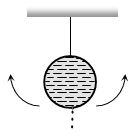
- 4View SolutionA simple pendulum is made of a body which is a hollow sphere containing mercury suspended by means of a wire. If a little mercury is drained off, the period of pendulum will
- 5View SolutionA simple pendulum is set into vibrations. The bob of the pendulum comes to rest after some time due to
- 6A block with mass $M$ is connected by a massless spring with stiffiess constant $k$ to a rigid wall and moves without friction on a horizontal surface. The block oscillates with small amplitude $A$ about an equilibrium position $x_0$. Consider two cases: ($i$) when the block is at $x_0$; and ($ii$) when the block is at $x=x_0+A$. In both the cases, a perticle with mass $m$ is placed on the mass $M$ ?View Solution
($A$) The amplitude of oscillation in the first case changes by a factor of $\sqrt{\frac{M}{m+M}}$, whereas in the second case it remains unchanged
($B$) The final time period of oscillation in both the cases is same
($C$) The total energy decreases in both the cases
($D$) The instantaneous speed at $x_0$ of the combined masses decreases in both the cases
- 7The resultant of two rectangular simple harmonic motions of the same frequency and unequal amplitudes but differing in phase by $\frac{\pi }{2}$ isView Solution
- 8A particle free to move along the $x-$axis has potential energy given by $U(x) = k[1 - \exp {( - x)^2}]$ for $ - \infty \le x \le + \infty $, where k is a positive constant of appropriate dimensions. ThenView Solution
- 9View SolutionTime period of pendulum, on a satellite orbiting the earth, is
- 10The height of liquid column in a $U$ tube is $0.3$ meter. If the liquid in one of the limbs is depressed and then released, then the time period of liquid column will be $.......\,sec$View Solution