MCQ
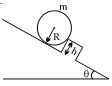
Find minimum height of obstacle so that the sphere can stay in equilibrium. 
  • A
    $\frac{R}{{1 + \cos \theta }}$
  • B
    $\frac{R}{{1 + \sin \theta }}$
  • C
    $R (1- sin\theta )$
  • $R (1 - cos\theta )$

Answer

Correct option: D.
$R (1 - cos\theta )$
d
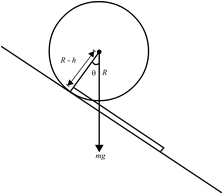
The sphere is on the verge of toppling when a line of action of weight passes through the edge. The equilibrium is because of the line of action of weight and the normal reaction provided by the edge.

$\cos \theta=\frac{(R-h)}{R}$

or

$h=R-R \cos \theta$
Need a full question paper?

Generate a complete, print-ready paper with questions like this in minutes — across 16+ boards, with answer keys.

Start Generating Free

Similar questions

When $1\, gm$ of water at ${0^o}C$ and $1 \times {10^5}\;N/{m^2}$ pressure is converted into ice of volume $1.091\;c{m^2}$, the external work done will be
A body is thrown up in a lift with a velocity $u$ relative to the lift and the time of flight is found to be $ t.$ The acceleration with which the lift is moving up is
If a satellite of mass $400 \,kg$ revolves around the earth in an orbit with speed $200 \,m / s$ then its potential energy is .......... $MJ$
A Container having $1\ mole$ of a gas at a temperature $27\ ^oC$ has a movable piston which maintains at constant pressure in container of $1\ atm.$ The gas is compressed until temperature becomes $127^oC.$ The work done is ........ $J$ $(C_p\ for\  gas\  is\  7.03\ cal/mol-K)$
The adiabatic elasticity of a diatomic gas at $NTP$ is ........ $N / m ^2$
Given below are two statements:

Statement $I:$ For a planet, if the ratio of mass of the planet to its radius increases, the escape velocity from the planet also increases.

Statement $II:$ Escape velocity is independent of the radius of the planet.

In the light of above statements, choose the most appropriate answer from the options given below on :
A particle moving in a circle of radius $R$ with uniform speed takes time $\mathrm{T}$ to complete one revolution. If this particle is projected with the same speed at an angle $\theta$ to the horizontal, the maximum height attained by it is equal to $4 R$. The angle of projection $\theta$ is then given by :
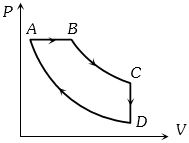
A cyclic process $ABCD$ is shown in the figure $P-V$ diagram. Which of the following curves represent the same process
If two vectors $\vec{A}$ and $\vec{B}$ having equal magnitude $\mathrm{R}$ are inclined at an angle $\theta$, then
In an inelastic collision,