MCQ
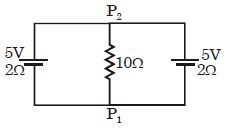
Find the current in the $10\, \Omega$ resistance
  • A
    $0.27\, A \,P_2$ to $P_1$
  • B
    $0.03 \,A \,P_2$ to $P_1$
  • $0.45\, A \,P_2$ to $P_1$
  • D
    $0.27\, A\, P_1$ to $P_2$

Answer

Correct option: C.
$0.45\, A \,P_2$ to $P_1$
c
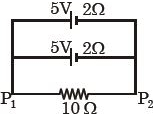
The circuit can be redrawn as:

$\varepsilon_{\mathrm{eq}}=\frac{\frac{\varepsilon_{1}}{\mathrm{r}_{1}}+\frac{\varepsilon_{2}}{\mathrm{r}_{2}}}{\frac{1}{\mathrm{r}_{1}}+\frac{1}{\mathrm{r}_{2}}}=\frac{\frac{5}{2}+\frac{5}{2}}{\frac{1}{2}+\frac{1}{2}}$

$\varepsilon_{\mathrm{eq}}=5 \mathrm{\,V}$

$\frac{1}{r_{e q}}=\frac{1}{r_{1}}+\frac{1}{r_{2}}=\frac{1}{2}+\frac{1}{2} \Rightarrow r_{e q}=1 \,\Omega$

$\therefore \mathrm{i}=\frac{\varepsilon}{\mathrm{r}+\mathrm{R}}=\frac{5}{10+1}=0.45 \mathrm{\,A}$
Need a full question paper?

Generate a complete, print-ready paper with questions like this in minutes — across 16+ boards, with answer keys.

Start Generating Free

Similar questions

A 50 mH coil carries a current of 2 ampere. The energy stored in joules is
The capacity of parallel plate condenser depends on
Mutual inductance of two coils placed near is 4.0 H (Henry). If current in the primary coil decreases from 5 A to zero in $10^{-2}$ seconds, then magnitude of induced emf in secondary coil is :
Coating of strontium oxide on Tungsten cathode in a valve is good for thermionic emission because
Consider two points 1 and 2 in a region outside a charged sphere. Two points are not very far away from the sphere. If E and V represent the electric field vector and the electric potential, which of the following is not possible
If q is the charge per unit area on the surface of a conductor, then the electric field intensity at a point on the surface is 
At neutral temperature, the thermoelectric power $\left(\frac{\mathrm{dE}}{\mathrm{dT}}\right)$ has the value
A capacitor of capacitance $C$ is charged to a potential difference $V$ from a cell and then disconnected from it. A charge $+Q$ is now given to its positive plate. The potential difference across the capacitor is now $Q$

 if $V < CV$

As shown, a narrow beam of light is incident onto a semi-circular glass cylinder of radius $R.$ Light can exit the cylinder when the beam is at the centre. When the beam is moved parallarly to a distance $d$ from the central line, no light can exit the cylinder from its lower surface. Find the refractive index of the glass.
In Boolean algebra, $Y = A + B$ implies that: