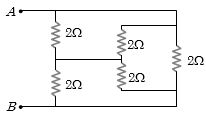
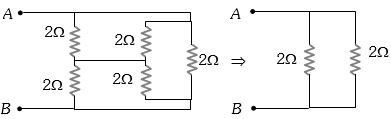
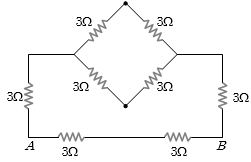
Find the equivalent resistance across $AB$ .............. $\Omega$
Medium


Download our appand get started for free
Experience the future of education. Simply download our apps or reach out to us for more information. Let's shape the future of learning together!No signup needed.*
Similar Questions
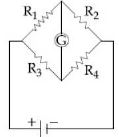
- 1The Wheatstone bridge shown in Fig. here, gets balanced when the carbon resistor used as $R_1$ has the colour code (Orange, Red, Brown). The resistors $R_2$ and $R_4$ are $80\, \Omega $ and $40\,\Omega $, respectively. Assuming that the colour code for the carbon resistors gives their accurate values, the colour code for the carbon resistor, used as $R_3$ would beView Solution
- 2Masses of three wires of copper are in the ratio of $1 : 3 : 5$ and their lengths are in the ratio of $5:3:1.$ The ratio of their electrical resistances areView Solution
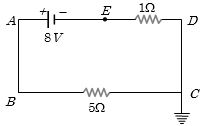
- 3In the given circuit, the potential of the point $E$ isView Solution
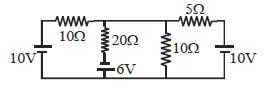
- 4The value of current through $20\,\Omega $ resistor is .................. $A$View Solution
- 5A null point is found at $200\,cm$ in potentiometer when cell in secondary circuit is shunted by $5\,\Omega$. When a resistance of $15\,\Omega$ is used for shunting null point moves to $300\,cm$. The internal resistance of the cell is $..............\,\Omega$.View Solution
- 6To get the maximum current from a parallel combination of $n$ identical cells each of internal resistance $r$ in an external resistance $R$, whenView Solution
- 7Equivalent resistance between $A$ and $B$ will be ............ $ohm$View Solution
- 8Two wires of same material have length $L$ and $2L $ and cross-sectional areas $4A$ and $A$ respectively. The ratio of their specific resistance would beView Solution
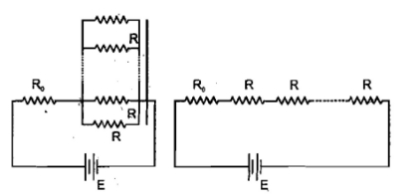
- 9In the circuit shown, $n$-identical resistors $R$ are connected in parallel $(n > 1)$ and the combination is connected in series to another resistor $R_0$. In the adjoining circuit $n$ resistors of resistance $R$ are all connected in series alongwith $R_0$. The batteries in both circuits are identical and net power dissipated in the $n$ resistors in both circuits is same. The ratio $R_0 / R$ isView Solution
- 10If a $30\, V$, $90\, W$ bulb is to be worked on a $120\, V$ line, a resistance of how many ohms should be connected in series with the bulb ............... $ohm$View Solution