If a $30\, V$, $90\, W$ bulb is to be worked on a $120\, V$ line, a resistance of how many ohms should be connected in series with the bulb ............... $ohm$
Medium
Download our app for free and get started
(c) Suppose resistance $R$ is corrected in series with bulb. Current through the bulb $i = \frac{{90}}{{30}} = 3\,A$
Hence for resistance $V = i\,R$$ \Rightarrow $ $90 = 3 \times R \Rightarrow R = 30\,\Omega $
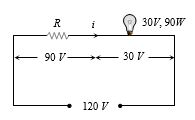
Hence for resistance $V = i\,R$$ \Rightarrow $ $90 = 3 \times R \Rightarrow R = 30\,\Omega $

Download our appand get started for free
Experience the future of education. Simply download our apps or reach out to us for more information. Let's shape the future of learning together!No signup needed.*
Similar Questions
- 1If the resistance of a conductor is $5\,\Omega\,\,$ at $\,50\,^oC$ and $7\, \Omega\,$ at $\,100\,^oC$ then the mean temperature coefficient of resistance of the material is ............... $^oC$View Solution
- 2If $n,\,e,\,\tau $ and $m$ respectively represent the density, charge relaxation time and mass of the electron, then the resistance of a wire of length $l$ and area of cross-section $A$ will beView Solution
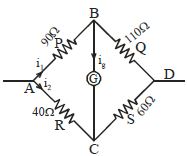
- 3In a Wheatstone bridge, $P = 90\,\Omega $, $Q = 110\,\Omega $ , $R = 40\,\Omega $ and $S = 60\,\Omega $ and a cell of $4\,V\,emf$. Then the potential difference between the diagonal along which a galvanometer is connected is ............. $V$View Solution
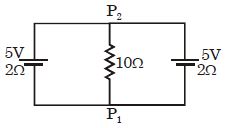
- 4Find the current in the $10\, \Omega$ resistanceView Solution
- 5A potentiometer wire has length $10\, m$ and resistance $20\,\Omega $. A $2. 5\, V$ battery of negligible internal resistance is connected across the wire with an $80\,\Omega $ series resistance. The potential gradient on the wire will beView Solution
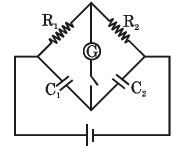
- 6View SolutionCircuit shown is in steady state, now when switch is closed, galvanometer shows no deflection, then correct relation is
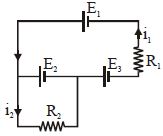
- 7The current $i_1$ and $i_2$ through the resistor $R_1 (= 10\,\Omega )$ and $R_2 (=30 \,\Omega )$ in the circuit diagram with $E_1 = 3\,V, E_2 = 3\,V$ and $E_3 = 2\,V$ are respectively:View Solution
- 8Two resistance of $100\ \Omega$ and $200\ \Omega$ are connected in series with a battery of $4 \mathrm{~V}$ and negligible internal resistance. $A$ voltmeter is used to measure voltage across $100 \Omega$ resistance, which gives reading as $1 \mathrm{~V}$. The resistance of voltmeter must be ___$\Omega$.View Solution
- 9The resistance of a wire is$10\,\Omega $. Its length is increased by $10\%$ by stretching. The new resistance will now be .......... $\Omega$View Solution
- 10When the power delivered by a $100\,volt$ battery is $40\,watts$ the equivalent resistance of the circuit is ........... $ohms$View Solution