MCQ
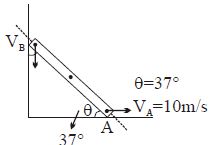
Find $V_B = ?$
  • A
    $V_A\,\,tan\,\,\theta $
  • B
    $V_A\,\,sec^2\,\,\theta $
  • C
    $V_A\,\,cosec\,\,\theta $
  • $V_A\,\,cot\,\,\theta $

Answer

Correct option: D.
$V_A\,\,cot\,\,\theta $
d

Need a full question paper?

Generate a complete, print-ready paper with questions like this in minutes — across 16+ boards, with answer keys.

Start Generating Free

Similar questions

A planet is revolving around the sun in a circular orbit with a radius $r$. The time period is $T$. If the force between the planet and star is proportional to $r^{-3 / 2}$, then the square of time period is proportional to
If the length of the pendulum in pendulum clock increases by $0.1\, \%$, then the error in time per day is: (in $s$)
An object is moving with an initial velocity of $30ms^{-1}$ with uniform acceleration. The velocity of object increases to $40ms^{-1}$ in next $5s.$ The $v-t$ graph which least represents this situation is:
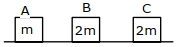
Three objects $A, B$ and $C$ are kept in a straight line on a frictionless horizontal surface. The masses of ${A}, {B}$ and ${C}$ are ${m}, 2\, {m}$ and $2\, {m}$ respectively. $A$ moves towards ${B}$ with a speed of $9$ ${m} / {s}$ and makes an elastic collision with it. Thereafter $B$ makes a completely inelastic collision with $C.$ All motions occur along same straight line. The final speed of $C$ is $....\,{m} / {s}$
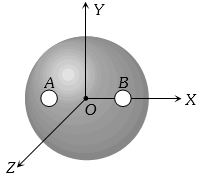
A solid sphere of uniform density and radius $4$ units is located with its centre at the origin $O$ of coordinates. Two spheres of equal radii $1$ unit with their centres at $A(-2, 0, 0)$ and $B(2, 0, 0)$ respectively are taken out of the solid leaving behind spherical cavities as shown in figure
The motion of a particle of mass m is given by $\text{x}=0$ for $\text{t} < 0\ \text{s},$ $\text{x}(\text{t})=\text{A}\sin4\text{p}\ \text{t}$ for $0<\text{t}<(1/ 4)\ \text{s}(\text{A}>\text{o}),$ and $\text{x}=0$ for $\text{t}>(1/4)\ \text{s}.$ Which of the following statements is true?
The equation of a longitudinal wave is represented as $y = 20\cos \pi (50t - x)$. Its wavelength is ..... $cm$
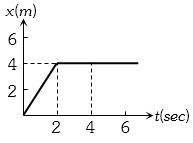
In the figure given below, the position-time graph of a particle of mass $0.1 \,Kg$ is shown. The impulse at $t = 2\sec $ is .......... $kg\,m\,{\sec ^{ - 1}}$
A particle is projected with velocity $v_{0}$ along $x-$ axis. A damping force is acting on the particle which is proportional to the square of the distance from the origin i.e., $ma =-\alpha x ^{2}.$ The distance at which the particle stops:
A pipe $30 cm$ long is open at both ends. Which harmonic mode of the pipe is resonantly excited by a $1.1 kHz$ source ? (Take speed of sound in air =$ 330 ms^{-1}$)