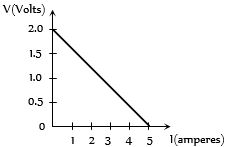
For a cell, the graph between the potential difference $(V) $ across the terminals of the cell and the current $(I)$ drawn from the cell is shown in the figure. The $e.m.f.$ and the internal resistance of the cell are
Medium
Download our app for free and get started
E.m.f. is the value of voltage, when no current is drawn from the circuit so $E = 2\,V$.
Also $r = $ slope $=\frac{2}{5} = 0.4\,\Omega $

Download our appand get started for free
Experience the future of education. Simply download our apps or reach out to us for more information. Let's shape the future of learning together!No signup needed.*
Similar Questions
- 1A primary cell has an $e.m.f.$ of $1.5\,volts$, when short-circuited it gives a current of $3$ amperes. The internal resistance of the cell is .............. $ohm$View Solution
- 2$n$ identical bulbs, each designed to draw a power $p$ from a certain voltage supply, are joined in series across that supply. The total power which they will draw isView Solution
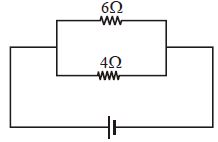
- 3In the circuit shown, the power developed in the $6\,\Omega $ resistor is $6\,W.$ The power developed in the $4\,\Omega $ resistor is .............. $W$View Solution
- 4A $2\, volt$ battery, a $15\,\Omega $ resistor and a potentiometer of $100\, cm$ length, all are connected in series. If the resistance of potentiometer wire is $5\,\Omega $, then the potential gradient of the potentiometer wire is ............... $V/cm$View Solution
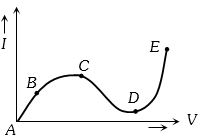
- 5From the graph between current $I$ and voltage $V$ shown below, identify the portion corresponding to negative resistanceView Solution
- 6Masses of three wires of copper are in the ratio of $1 : 3 : 5$ and their lengths are in the ratio of $5:3:1.$ The ratio of their electrical resistances areView Solution
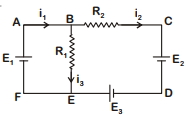
- 7For the circuit given below, the Kirchoff's loop rule for the loop $BCDEB$ is given by the equationView Solution
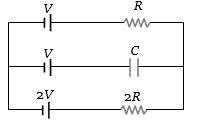
- 8View SolutionIn the given circuit, with steady current, the potential drop across the capacitor must be
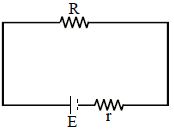
- 9If power in external resistance $R$ is maximum thenView Solution
$(i) R = r$ $(ii)$ Power in $R$ is $\frac{{{E^2}}}{{4R}}$
$(iii)$ Input power $\frac{{{E^2}}}{{2R}}$ $(iv)$Efficiency is $50\%$
- 10The length of a potentiometer wire is $\ell $. A cell of emf $E$ is balanced at a length $\ell /3$ from the positive end of the wire. If the length of the wire is increased by $\ell /2$ at what distance will the same cell give a balanced pointView Solution